
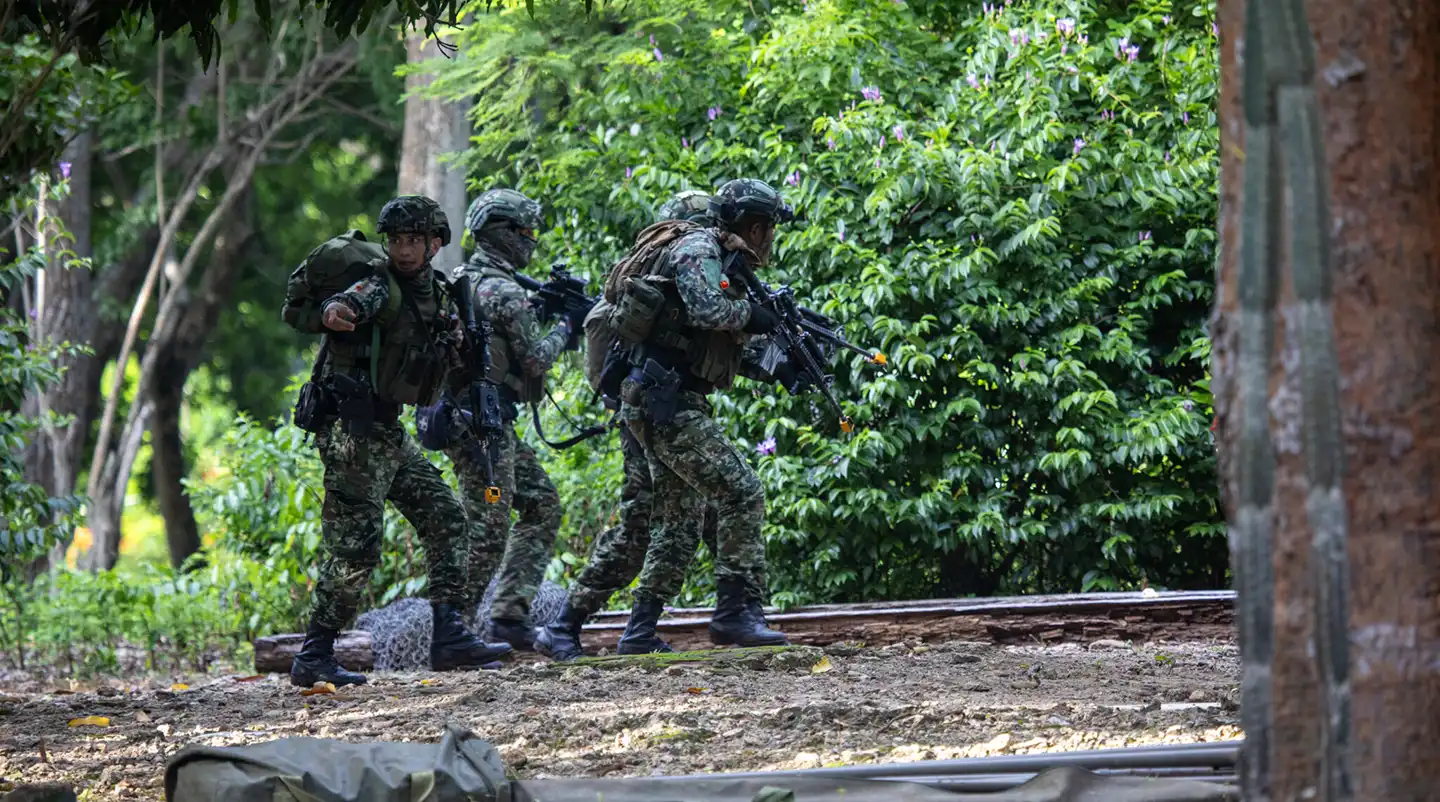
Colombia’s entry into the Americas Counter-Cartel Coalition (ACCC) strengthens hemispheric cooperation against transnational organized crime, bringing decades of operational experience and expertise in confronting threats that extend across national borders. Intelligence, maritime and riverine interdiction, special operations, financial investigations, technology and training are among the capabilities Colombia brings to the coalition. Developed through years of operations against drug trafficking, armed groups and criminal organizations, these capabilities contribute to a more coordinated regional response.
Colombia formally joined the ACCC on August 12, 2026, during a coalition meeting in Panama City. “Colombia has offered to put its capabilities and experience at the service of hemispheric security, leading strategic efforts in the Pacific Ocean and Caribbean Sea alongside Coalition member nations,” the Colombian Ministry of Defense said.
Colombia already shares some of this expertise with countries across the region through cooperation, training and information-sharing programs. The ACCC now provides a framework to bring those efforts together against criminal organizations that operate across national borders.
“We are going to move from mirror operations, in which each country operates on its own side of the border, to joint operations backed by a common vision, purpose, and, above all, the political will to defeat transnational organized crime. And that is going to make the difference,” said Diego Molano, former defense minister of Colombia and director of Citizen Security at the Development Bank of Latin America and the Caribbean (CAF).
That shift requires common procedures, interoperable communications and timely intelligence sharing. “Colombia brings its experience in these types of operations, an interconnected system, communications among armed forces that are prepared for this, and a deep understanding of the criminal landscape — factors that strengthen future regional cooperation,” Molano added.
Intelligence as a force multiplier
Strategic, tactical and operational intelligence are cornerstones of Colombia’s security architecture. Faced with multiple and evolving threats, the country has refined methods to identify criminal structures and their leaders, track communications, map networks and turn information into operational targets.
“The organizations operating today are polycriminal organizations that combine drug trafficking with illegal mining, extortion, money laundering and other illicit activities, while taking advantage of technologies and logistics networks that cross borders,” Molano said.
To respond to that evolution, Colombia has developed mechanisms to integrate information from different sources and identify connections among individuals, routes, sources of financing, and logistics hubs.
Operation Titan, carried out in September 2026, provides a recent example. The Colombian National Police, through its elite anti-kidnapping and anti-extortion unit GAULA Élite, the Police Intelligence Directorate and the Special Operations and Counterterrorism Command (COPES) with support from the Attorney General’s Office and the U.S. Drug Enforcement Administration (DEA), captured two high-ranking members of Tren de Aragua in Manizales, Caldas.
The multinational dimension is also evident in the Orion Naval Campaign, a Colombian-led multinational initiative that coordinates efforts against maritime drug trafficking through information sharing and combined operations. The Colombian Navy’s Intelligence Fusion Center and International Operational Coordination Center integrate information and coordinate efforts with foreign institutions.
“The value of Colombia’s intelligence capabilities lies not only in sharing information, but in the ability to turn that information into coordinated operations with regional partners,” Molano said.
Maritime and riverine interdiction
Colombia’s geography has driven the development of capabilities to operate across the Caribbean and Pacific, as well as along the country’s extensive network of river corridors. The Colombian Navy combines Coast Guard units, surface vessels, naval aviation, Marines and surveillance systems to detect and interdict routes used by criminal organizations.
One of the region’s main challenges is the ability of these networks to constantly adapt. Semi-submersibles are one example, enabling traffickers to move large cocaine shipments while minimizing the risk of detection.
“The semi-submersible has become a key logistics platform for drug trafficking because of its cargo capacity and difficulty of detection. Its evolution requires new responses, and Colombia has experience that can help strengthen the capabilities of units operating under this coalition,” said retired Colombian Marine Corps Col. Nicolás Antonio López Pulgarín, an associate researcher at the Center for Strategic Studies on Security and Defense at Colombia’s War College.
In February 2026, a joint Colombia-U.S. operation intercepted a semi-submersible carrying nearly 10 metric tons of cocaine in international waters and detained its four crew members. The shipment was valued at about $441 million.
Interdictions also generate valuable information about the routes and methods used by criminal organizations. “The value lies in exploiting that information and turning it into operational intelligence to identify patterns, guide new operations and target the structures that sustain these activities,” López Pulgarín said.
The International Center for Research and Analysis against Maritime Drug Trafficking reflects this capability. The center analyzes maritime drug trafficking methods, platforms, routes, and logistics chains to generate information that supports decision-making and information sharing among countries.
Operations and interoperability
More than four decades of operations in jungles, mountains, rivers and coastal areas have led Colombia’s Armed Forces to develop procedures for operating in remote areas with limited infrastructure. “That experience has translated into specialized personnel, doctrine, training, procedures and operational manuals, as well as a way of operating that has been built and refined over decades,” Molano said.
That experience has also been tested alongside foreign forces. During Fused Response 2024, a joint Colombia-U.S. special operations exercise, units conducted air and maritime insertion, evacuation, and joint planning exercises. In the Amazon, Bracolper 2026 brought together the navies of Brazil, Colombia and Peru for combined riverine training, including interdiction and tactical communications exercises.
Colombia’s experience also extends to the legal framework governing military operations. “Colombia is the only country I know of in Latin America where military operations involve a legal team that determines which legal framework and instrument apply — whether international humanitarian law or human rights law — based on everything the country has experienced,” Molano said.
That expertise adds a doctrinal dimension to regional cooperation: It is not simply about training units, but also about sharing procedures and lessons developed through operations in complex environments.
Following the money
Countering organized crime also requires more than operational action. “Tactical actions alone will not dismantle an organization or cartel. Countries need coordinated economic action to target their finances and money laundering,” López Pulgarín said.
Colombia has specialized institutions that track illicit flows. The Financial Information and Analysis Unit (UIAF) analyzes financial, tax and customs information to identify suspicious transactions, establish patterns, and uncover links between illicit activities and economic structures.
International cooperation is critical because illicit funds can move across multiple jurisdictions. “We need global cooperation to trace the information. We need to know where the money goes, where the banks are, and what other organizations are involved. That is how we have achieved concrete results,” López Pulgarín said.
Operation Imperium, carried out in September 2026 by the Colombian National Police, the Attorney General’s Office and the DEA, illustrates this approach. The investigation dismantled a network linked to the Clan del Golfo involved in cocaine trafficking and money laundering. Authorities arrested 10 people and seized 39 assets valued at $12 million through asset forfeiture proceedings.
Criminal networks have adopted new financial mechanisms. “We are talking about groups that have become more sophisticated. It is no longer enough to follow money flows through traditional banks or conventional money-laundering mechanisms. We need to understand illicit financial flows and how funds are moved, including on the dark web,” Molano added.
Diálogo Américas is a publication of U.S. Southern Command.