
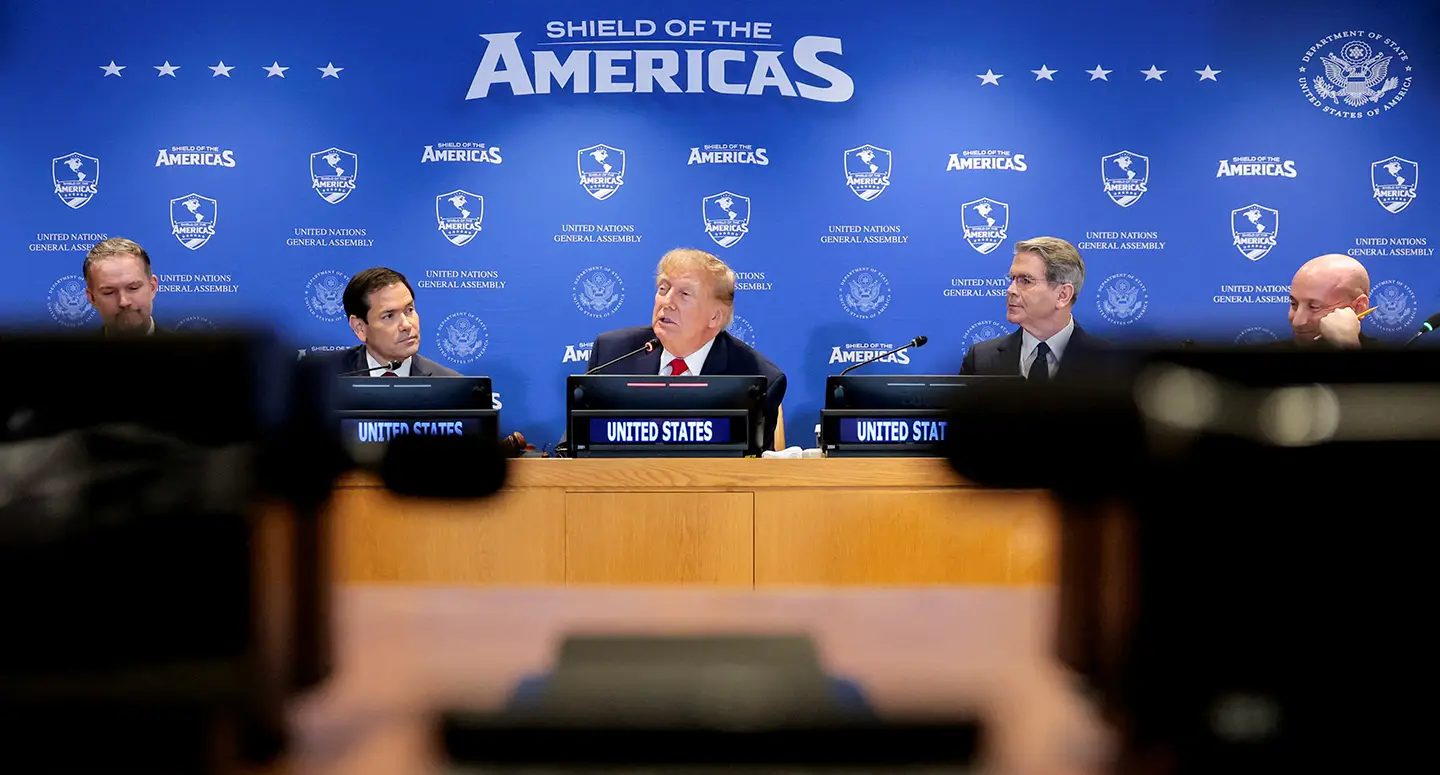
Criminal organizations exploit national borders to move drugs, weapons, money and people, build support networks, and shift their operations when authorities step up pressure. While these groups operate across multiple countries, security forces and judicial authorities remain bound by their respective jurisdictions. Bridging that gap is one of the main objectives of the Shield of the Americas.
Fifteen governments participating in the initiative have agreed to coordinate measures against 24 criminal and armed organizations operating across the hemisphere. Among them are Mexico’s Sinaloa and Jalisco New Generation cartels; Mara Salvatrucha, also known as MS-13; Colombia’s National Liberation Army (ELN) and Clan del Golfo; Brazil’s First Capital Command (PCC); Tren de Aragua (TdA), which originated in Venezuela; Ecuador’s Los Lobos and Los Choneros; and Haiti’s Viv Ansanm coalition.
“These organizations do not operate in isolation. They rely on business structures and networks that cross borders. We see this reality every day,” Colombian Navy Rear Adm. Jaime Leonardo Montañez Torres, head of Naval Operations and former director of its Counternarcotics Directorate, said.
The Joint Statement on Defending Hemispheric Sovereignty, signed September 22 in New York, outlines three pillars of cooperation: economic, security and multilateral coordination. As a first step, the governments expressed their intention to pursue measures including asset freezes, immigration and visa restrictions, and criminal prosecution of those who knowingly provide material or logistical support to the identified organizations.
The goal is to increase pressure not only on members of these organizations but also on the financial and logistical networks that allow them to operate across borders.
Targeting criminal networks
Drug trafficking remains a major source of revenue for many criminal organizations, but they have diversified their activities, expanding into other illicit markets and strengthening their support networks. “Drug trafficking remains their main business, but these organizations have learned not to rely on a single activity. Today, they combine the cocaine trade with illegal mining; migrant smuggling; contraband; arms trafficking; and illegal, unreported and unregulated fishing, using the same routes and methods,” Montañez said.
Illegal gold mining illustrates the transnational nature of these activities. Gold extracted in remote or border regions can pass through several countries before entering legitimate markets, making its origins difficult to trace. In Roraima, along Brazil’s border with Venezuela, investigations have documented the presence of the PCC and TdA in an area where illicit activities, including gold mining, fuel criminal operations.
Operation Hidden Carbon, launched in Brazil in August 2025, exposed the complexity of financial structures under investigation for alleged ties to the PCC. Authorities identified companies, investment funds and financial institutions suspected of being used to conceal and launder illicit proceeds. The investigation uncovered more than 40 investment funds with an estimated $5.5 billion in assets.
These cases underscore the need to go beyond seizures and arrests to target the intermediaries, businesses and financial mechanisms that sustain criminal operations across borders.
The measures proposed under the Shield are intended to address these vulnerabilities. Asset freezes can restrict access to funds linked to criminal organizations, while immigration restrictions can limit movement of their members and associates. Legal action against those providing material or logistical support also can increase pressure on the networks that enable these groups to operate.
Coordination among governments is essential to identifying these connections, sharing intelligence and acting against criminal networks across jurisdictions, while respecting each country’s legal framework.
The need for coordination also extends to ports and commercial shipping routes, which criminal organizations exploit to move illicit cargo through international trade.
Ecuadorian Navy Vice Adm. Marco Salinas Haro, coordinator of the Center for Strategic Naval Warfare Studies at Ecuador’s Naval Academy, described this as “a structural transformation of organized crime that has turned ports into key logistical hubs for transnational drug trafficking.”
“The key strategic shift is to integrate maritime domain awareness, port risk assessments, cargo inspections and financial intelligence across the countries participating in the Shield,” he said.
A threat to communities
The importance of this cooperation goes beyond drug shipments and illicit financial flows. The organizations identified in the declaration also fuel violence, fight for territorial control, and threaten the safety and livelihoods of local communities.
In Ecuador, Los Choneros and Los Lobos have expanded their influence through violence, extortion and control over prison networks. In Colombia, the Clan del Golfo has expanded its territorial reach. According to the Ideas for Peace Foundation, the number of municipalities under its influence grew from 145 in 2022 to 296 in 2025.
In Haiti, the Viv Ansanm coalition has strengthened its hold in parts of Port-au-Prince and other areas of the country, worsening a security crisis that has forced numerous families to flee their homes. Behind these figures are the human costs of criminal control: shuttered businesses, disrupted schooling, displaced families and communities living under threat.
For smaller countries, these challenges can be especially difficult to confront. Addressing the United Nations General Assembly in September, Trinidad and Tobago Prime Minister Kamla Persad-Bissessar highlighted the disproportionate threat that transnational criminal networks pose to small island states, trafficking weapons, drugs and people, and moving illicit funds across borders.
Persad-Bissessar also emphasized the importance of international cooperation in combating organized crime and highlighted her country’s participation in the Shield of the Americas. “We remain confident that this partnership will continue to promote freedom, security and prosperity in our region,” she said.
Turning commitments into action
Existing multinational initiatives provide a foundation for deeper cooperation. The Colombian Navy-led Multinational Orion Strategy has brought together authorities from numerous countries to coordinate maritime counternarcotics efforts.
“Each country operates in its own waters, with its own assets and under its own laws, but we all work toward the same goal. An alert originating in Cartagena can lead to an interdiction in Central America, Africa or Europe,” Montañez explained.
The Shield aims to build on this model of cooperation by extending coordination to financial, immigration, judicial and diplomatic measures. The declaration also calls for consultations through the Organization of American States (OAS) and under the Inter-American Treaty of Reciprocal Assistance, also known as the Rio Treaty, to explore possible collective action against the identified organizations.
In a move consistent with the Shield’s objectives, Argentina announced on October 21 that it had designated five transnational criminal organizations as terrorist organizations: Mexico’s Sinaloa Cartel and La Nueva Familia Michoacana, Colombia’s ELN and FARC-EP, and Ecuador’s Los Tiguerones. The decision provides for their inclusion in Argentina’s national terrorism registry, strengthening the country’s legal framework for targeting organizations involved in transnational crime and their financial networks.
Regional coordination also was reflected on October 1, when the 15 participating governments issued another joint statement backing Bolivia’s efforts to combat drug trafficking and corruption. The statement followed an operation in which Bolivian authorities reported the arrest of 14 people, including then-Attorney General Roger Mariaca, for their alleged ties to a criminal organization.
The statement encouraged Bolivia to pursue further investigations and prosecutions, reaffirming the participating countries’ support for efforts to combat drug trafficking and the networks that enable it.
“Sharing intelligence and coordinating joint operations does not mean giving up sovereignty. It strengthens our ability to exercise it. We lose sovereignty when a criminal organization controls a river, a coastline or a port,” Montañez said.
Diálogo Américas is a publication of U.S. Southern Command.