

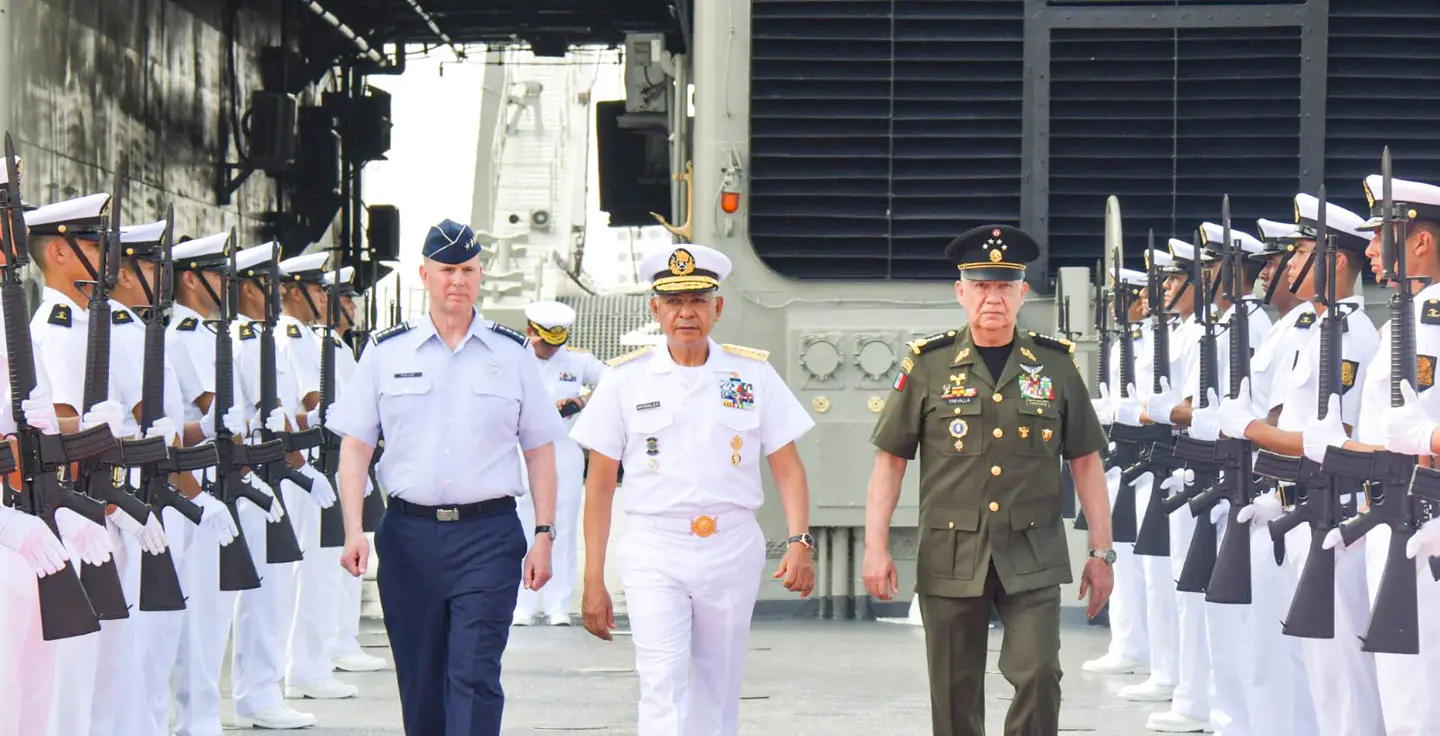
Senior leaders in the Mexican and United States militaries met in Veracruz, Mexico, in July 2026 to discuss effective ways to counter transnational criminal organizations (TCO), special operations training opportunities, information sharing and how best to defend against unauthorized unmanned aerial systems (UAS). The July 19-22 meetings between Gen. Gregory M. Guillot, commander of the U.S. Northern Command (USNORTHCOM) and the North American Aerospace Defense Command (NORAD), and Mexico’s top military leaders, Gen. Ricardo Trevilla Trejo, secretary of national defense, and Adm. Raymundo Pedro Morales Ángeles, secretary of the Navy, built on previous face-to-face meetings as the two North American partners continue to deepen and strengthen their relationship.
“The security of North America relies heavily on the strength of partnerships and our ability to operate with a shared purpose,” Guillot said in a USNORTHCOM news release. “The engagements we had here in Veracruz underscore our deep mutual trust and commitment to addressing complex regional challenges alongside our Mexican partners.”
The strategic engagement also covered the North American Maritime Security Initiative (NAMSI), a regional security effort that also includes Canada. NAMSI was established in 2008 to strengthen interoperability among the three partner nations and increase the security and maritime protection of North America. The initiative was revised in May at a high-level meeting in Norfolk, Virginia, to expand joint training opportunities and place a greater emphasis on combating TCOs. The guiding principles of the agreement, known as the NAMSI Handbook, also were approved to improve the enforcement of international maritime law, enhance communication to thwart illicit acts against safe maritime navigation, and bolster defenses against attacks or other threats to maritime security.
Morales hosted the July meeting in Veracruz, a historic port city in eastern Mexico and a major hub of the nation’s naval operations. “Over the course of these reciprocal visits, the senior leaders have transformed a strong professional partnership into an outstanding personal bond. This relationship establishes a vital foundation for expanding military-to-military collaboration into new strategic areas,” the release stated.
The discussions demonstrated a commitment to North American defense built on mutual trust and respect for sovereignty and territorial integrity, the release said. They also acknowledged the “differentiated responsibility” that each country has for that defense.
Morales and Trevilla visited USNORTHCOM in Colorado Springs, Colorado, for similar talks in June 2025. Morales said then that the meetings were an important signal that the two nations shared the same objective: a safe, secure North America. “We have a clear message: that our institutions, at the highest level, are willing to combine capabilities, experiences, and efforts in favor of security, stability, and respect for sovereignty,” he said.
In recent years, Mexico and the U.S. have worked closely together, collaborating on numerous joint exercises and exchanges. The Bilateral Military Cooperation Roundtable meets regularly to align strategies and work toward achieving closer operational compatibility between the Mexican and U.S. militaries. One example of this cooperation is the mirrored patrols and information sharing along the Mexico-U.S. border, which has contributed to a substantial reduction in illicit smuggling while lowering illegal migration to historically low levels.