

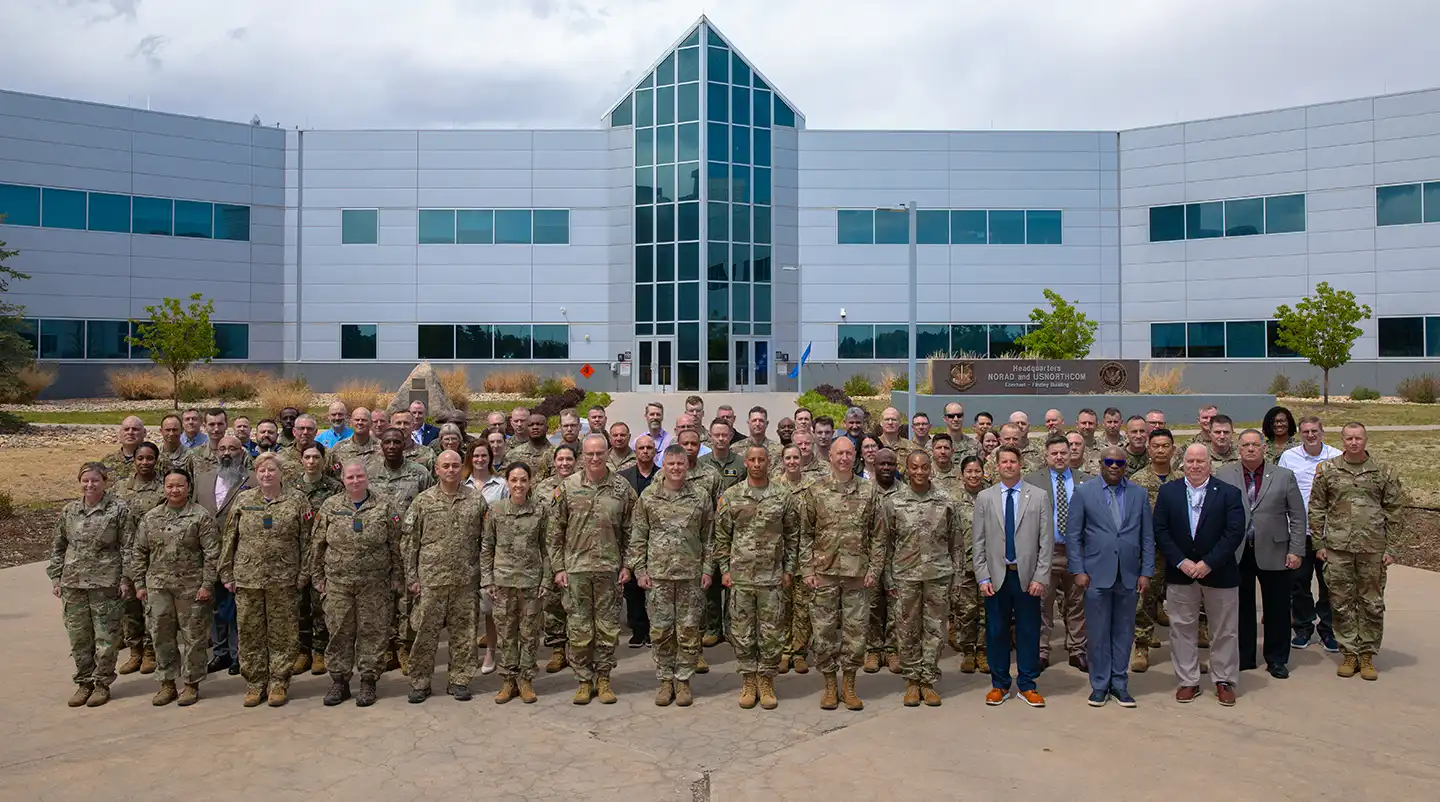
More than 100 logisticians and planners gathered in April at Peterson Space Force Base, Colorado, headquarters of United States Northern Command (USNORTHCOM) and the North American Aerospace Defense Command (NORAD), for a Sustainment Rehearsal of Concept (ROC) Drill. The drill is a collaborative event focused on readiness, logistics integration and interagency coordination. The objective was to “find the seams” across the joint logistics enterprise — mapping where coordination among commands, service components and interagency partners could break down.
The conference tested the commands’ ability to sustain operations in a wartime environment, focusing on distribution and deployment across the vast North American area of responsibility. It drew personnel from as far north as Alaska and Canada, and as far south as Florida. Representatives came from Canadian Joint Operations Command (CJOC), the Canadian NORAD Region, the Joint Staff J4 Logistics Directorate, U.S. Army Western Hemisphere Command, U.S. Army North, Air Forces Northern, U.S. Naval Forces Northern Command, Marine Forces Northern Command, the Defense Logistics Agency, U.S. Transportation Command and the National Guard Bureau.
“Every exercise we do should help us prepare for the future fight. The Sustainment ROC drill is an opportunity to decide where to make investments,” Maj. Gen. Win Burkett, director of operations, plans and exercises for the National Guard Bureau, said in a USNORTHCOM news release. “The opportunities we have to close gaps are critical, and the subject matter expertise from all of the participating mission partners will help to identify the priority investments.”
Before the diverse group could synchronize its efforts, participants needed to visualize a common battlefield. Seven weeks before the ROC drill, Brig. Gen. Mark Siekman, director for logistics and engineering at USNORTHCOM and NORAD, interrupted a planning brief with a clear directive to his staff. “Let me stop you right there and tell you what I want,” Siekman said, according to the news release. “Not PowerPoint. Let’s get a big map where leaders can walk and talk through their concepts of support step-by-step so everyone can follow along.”
The National Geospatial-Intelligence Agency (NGA) quickly met the challenge. The NGA designed, funded and overnight-shipped a 7.6-by-8.5-meter floor map of North America. The “Big Atlas Map,” or BAM, detailed strategic airports, seaports, rail lines and interstate highways.
“Rich Hanes and the NGA Support Team were amazing in its support of this event, designing and delivering the map in short order,” said Lt. Col. Michael Dill, an action officer who helped with the ROC drill. The floor map empowered logisticians to step off the screen and onto the continent.
Participants could physically walk through force flow, identifying critical geographic hubs and solving potential problems. Planners could expose potential friction points — mismatched timelines, unclear authorities or capability gaps — that could have remained hidden until a crisis emerged.
The ROC drill highlighted how early sustainment planning with the Joint Staff, interagency organizations and allies is key to winning conflicts at home and abroad. The event also spotlighted the critical nature of the U.S.-Canada relationship, and the importance of seamlessly integrating binational logistics during a crisis. “This conference gave us the opportunity to come together and identify gaps, work through friction points and build relationships to realize our collective vision,” said Canadian Armed Forces Col. Robert Bailey of CJOC.
Reflecting on the outcomes of the event, Siekman said: “We want to set the theater and understand the aggregated requirements that we and our interagency partners support in strategic plans. This whole exercise facilitated some great work and discussion by the service components, separate commands, NORAD regions and allies, and our interagency partners.”
The Sustainment ROC Drill demonstrated that modern logistics is more than just moving supplies; it is about strengthening the logistics network and the strategic principle of decision advantage. USNORTHCOM and NORAD logisticians proved they are ready to deliver that advantage whenever and wherever it is needed.