

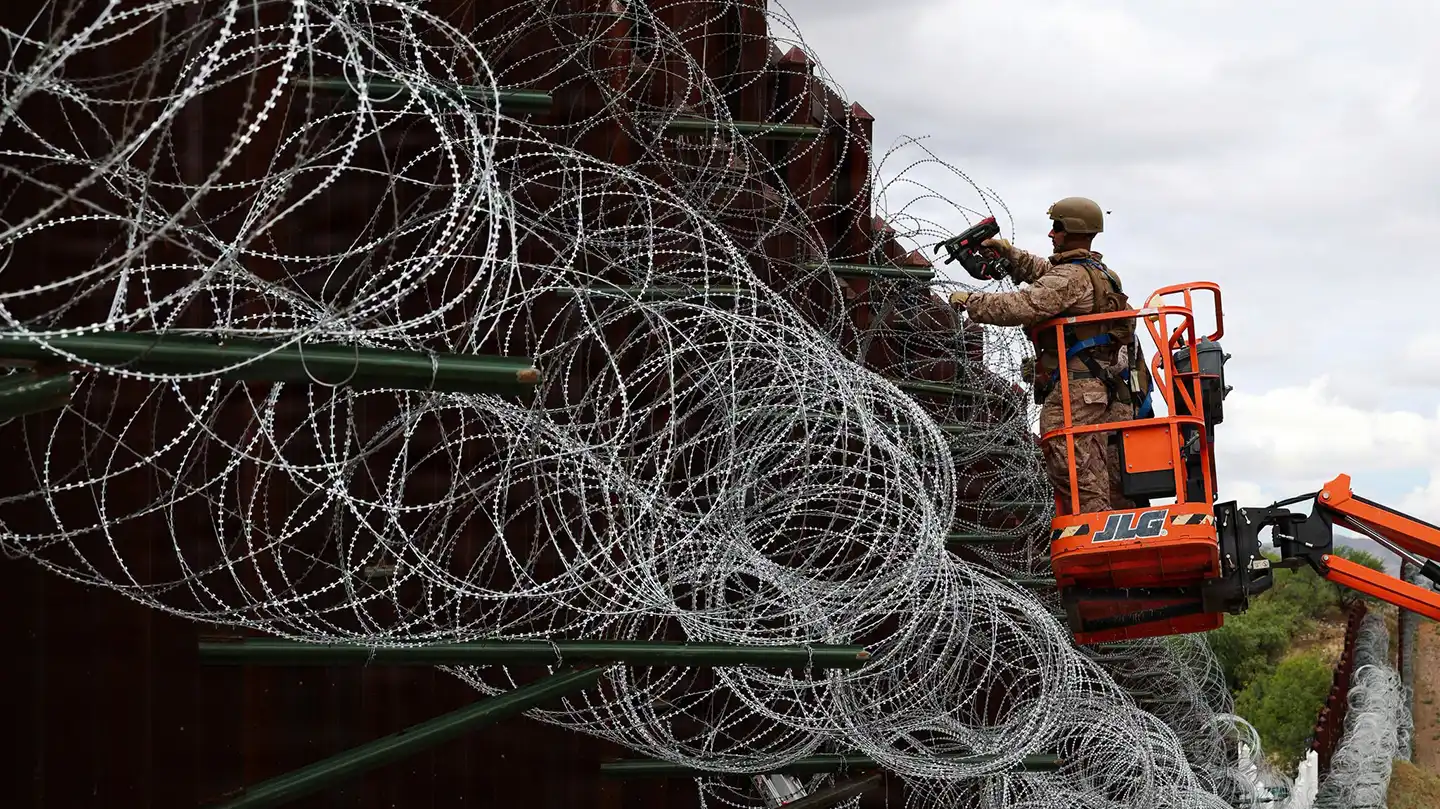
United States Marines braved rugged terrain and scorching temperatures in July 2026 to install barbed wire along a challenging 24-kilometer stretch of the southern border in Arizona. The Marines’ work improved border security in a remote and challenging environment, bolstering the ability of U.S. Customs and Border Protection (CBP) agents to deter illegal migration and criminal activity in the Nogales and Naco districts. Coordinated by Joint Task Force-Southern Border (JTF-SB) as part of Operation Ardent Vanguard, the Marines’ effort reflected their ability to operate quickly and effectively in adverse conditions to meet the objective of securing the 3,145-kilometer border.
Marines in Combat Logistics Battalion 7 (CLB7), 1st Marine Logistics Group, installed durable triple-strand concertina wire in two critical areas in CBP’s Tucson sector in southern Arizona. On July 7, the battalion’s Alpha Company completed 13 kilometers in Zone 21 in Nogales. On July 22, Bravo Company completed 11 kilometers in Naco. The Marines succeeded in securing “both existing gaps and areas with degraded infrastructure,” according to a JTF-SB news release.
The Marines helped the Department of Homeland Security (DHS) meet its objective of fortifying logistically challenging areas of the border. “The completion of barrier reinforcement for Zone 21 in Nogales reflects the sustained drive of our Marines,” said Marine Corps Capt. Kyle Harrison, commanding officer of Alpha Company, CLB 7. “Working concurrently with our sister company in Naco, our Marines are consistently delivering high-quality results across a complex area of operations. The perseverance and excellence in planning and logistics our Marines demonstrate daily to support our DHS partners is phenomenal.”
The reinforcement of barrier infrastructure in July built on earlier accomplishments in Arizona. Since early April, Marines under the direction of JTF-SB have fortified 64 kilometers. They completed the work despite unpredictable summer downpours that quickly turned the steep hillsides into dangerous terrain. The Marines followed strict safety protocols and maintained constant vigilance to avoid accidents on slopes that turned slippery within minutes. After completing the assignment, the battalion’s Marines will proceed to strengthen other critical areas of the border, the release said.
The triple-strand wire presents a tactical advantage to Border Patrol agents as it slows attempted crossings, giving agents more time to respond to incursions in remote areas like Nogales and Naco. “Securing Zone 31 was a true team effort, executed under some of the most demanding environmental conditions our Marines have faced,” said Marine Corps 1st Lt. Jack Morris, 2nd platoon commander for Bravo Company, 8th Engineer Support Battalion, assigned to CLB 7. “Our close coordination with [Border Patrol] agents on the ground ensured that every meter of wire was laid where it would have the maximum tactical impact to provide them with a reliable deterrent.”
In December 2025, JTF-SB said that more than 43,000 rolls of concertina wire, totaling hundreds of kilometers, have been installed in all nine CBP sectors of the border, according to Border Report, a U.S. news website. “This monumental effort is yet another key step in our enduring commitment to national security,” said Chief Blaine Bennett, deputy commander for CBP, JTF-SB, according to Border Report. “The historic speed, scale, and coordination of this effort reflect the dedication of the interagency approach to this issue.”