

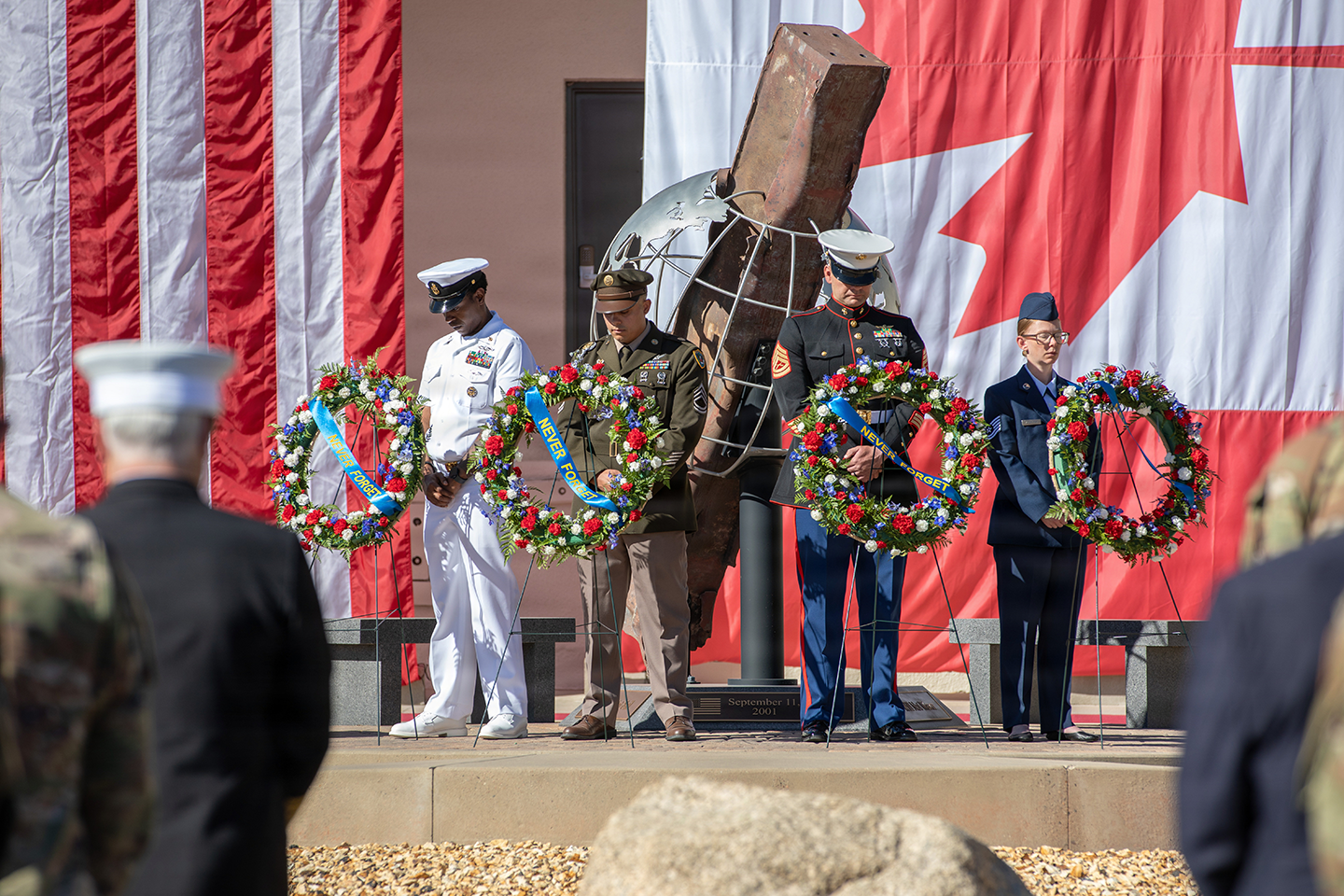
The terrorist attacks of Sept. 11, 2001, which killed nearly 3,000 people, were solemnly remembered in September 2026 as U.S. Northern Command (USNORTHCOM) and the North American Aerospace Defense Command (NORAD) marked the 25th anniversary of 9/11 and reflected on how the tragedy reshaped homeland defense. The two commands, which share a headquarters at Peterson Space Force Base and are led by the same commander, remain central to the mission of defending North America.
At a ceremony at nearby Cheyenne Mountain Space Force Station, leaders of the world’s only binational command emphasized that the defense of North America remains a shared mission between the United States and Canada. Canadian Chief of the Defence Staff Gen. Jennie Carignan said the threat environment has changed dramatically since 2001, but the commitment of the service members assigned to NORAD has not.
“The defense of North America and its approaches is a responsibility shared between Canada and the United States,” Carignan said. “Twenty-five years after the September 11 attacks, the threats facing our continent have evolved, technology is advancing rapidly, and the security environment is increasingly complex. What has not changed is the commitment and professionalism of the Canadians and Americans serving throughout NORAD. Every day, they train, prepare, and operate together to protect the people of both countries. As we remember the lives lost and all those who responded on that tragic day in 2001, we remain focused on ensuring NORAD continues to evolve and remains ready to defend against threats to North America, now and for many years to come. Together, We Have the Watch.”
That partnership was not merely symbolic on Sept. 11, 2001. It was operational. A Canadian officer, then Maj. Gen. Eric “Rick” Findley was leading operations from the Cheyenne Mountain Command Center as NORAD responded to the attacks, a reminder that the command’s binational structure is central to how the United States and Canada defend the continent. His role that day reflected the depth of trust between the two nations and the enduring reality that North American defense has long depended on Americans and Canadians serving side by side.
The attacks marked the only time Cheyenne Mountain has sealed its massive blast doors since the height of the Cold War, according to a NORAD release, and they accelerated a historic shift in the command’s mission. In the years that followed, NORAD expanded beyond its Cold War focus on external aerospace threats and adapted to include new and unconventional internal dangers.
In the wake of the attacks, the U.S. government also moved to create a command focused specifically on defending the U.S. homeland. USNORTHCOM was established on Oct. 1, 2002, to provide command and control for homeland defense and to coordinate defense support of civil authorities, giving the military a dedicated organization to address threats inside North America and respond more effectively to crises at home.
At the Cheyenne Mountain ceremony, attendees gathered beside the installation’s 9/11 memorial: a 2.4-meter, 340-kilogram steel beam recovered from the World Trade Center towers to honor the 2,977 lives lost. The sculpture, donated by the National Homeland Defense Foundation and designed by students from the University of Colorado Colorado Springs, honors both the victims of the attacks and the service members who gave their lives in the years that followed, the release stated.
“Homeland defense is the top priority for both NORAD and USNORTHCOM,” said Gen. Gregory M. Guillot, commander of USNORTHCOM and NORAD. “When we remember September 11, we honor the sacrifice of those lost on that day and the days since by ensuring the command remains steadfast and vigilant while we maintain the watch.”
Hundreds attended the ceremony, which included speeches from retired Gen. Ralph E. Eberhardt, who led NORAD in 2001, and the mayor of Colorado Springs, Yemi Mobolade.