

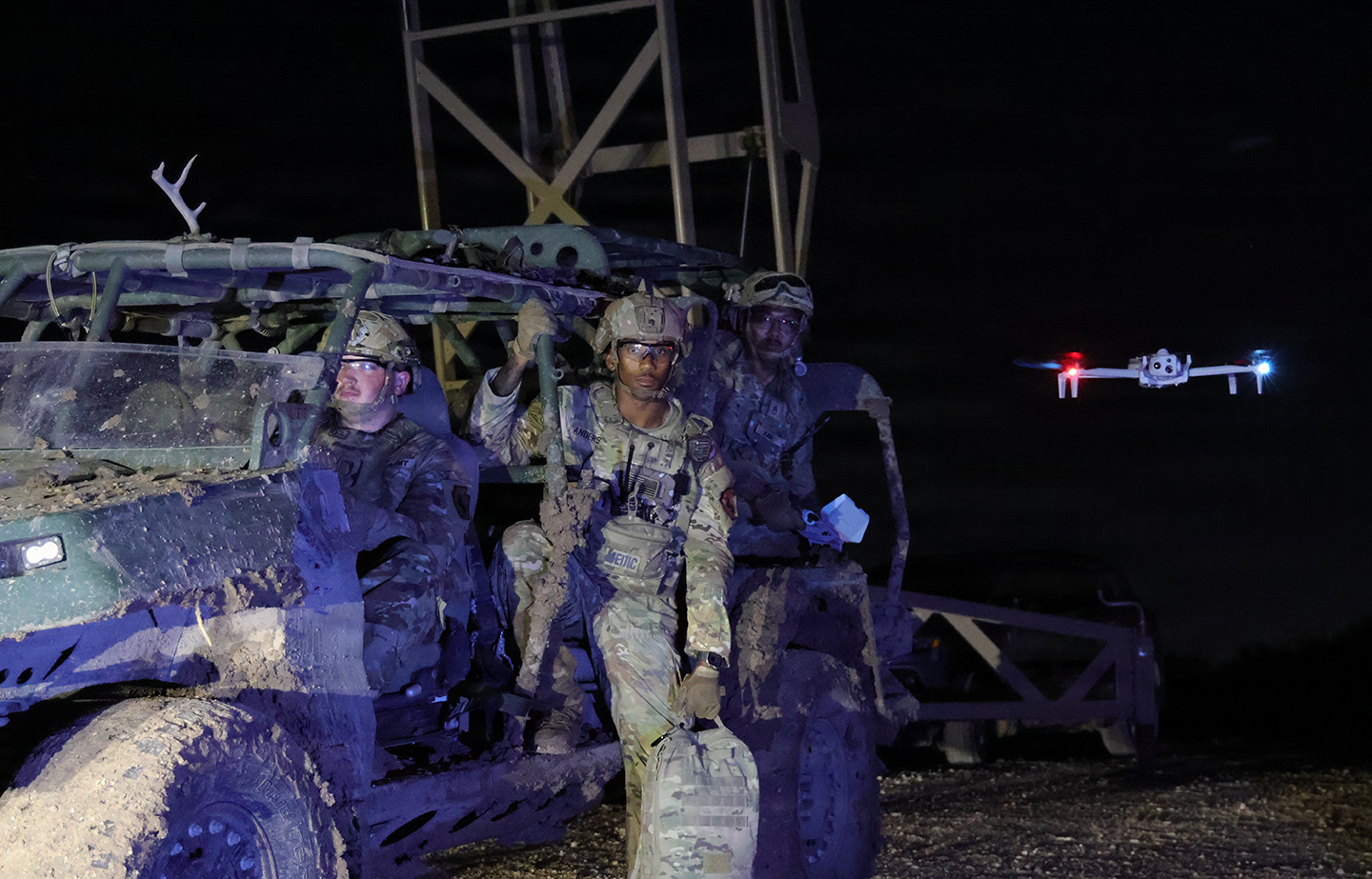
North Carolina National Guardsmen and United States Customs and Border Protection (CBP) agents rescued a man who was bitten by a snake as he crossed into the U.S. from Mexico. The team deployed an uncrewed aerial vehicle (UAV), or drone, with thermal detection capabilities to locate the injured man, a War Department news release said.
While on patrol in Rio Grande City, Texas, National Guard Staff Sgt. Sethone Kan, assigned to Joint Task Force-Southern Border (JTF-SB), got a call from the Fort Brown Border Patrol Station and the Cameron County Sheriff’s Office about the man, who was in distress after being bitten by a snake at about 10:45 p.m. on June 2, 2026. A rescue team was formed immediately with five Army Soldiers and three CBP agents, including medics from both branches.
Because of severe flooding, standard vehicles could not navigate the roads, so the team deployed in an Army Infantry Squad Vehicle (ISV), a lightweight, versatile tactical truck designed to operate in rugged battlefield conditions.
Kan launched the UAV to find the injured man. “Around 11:05 p.m., I found him and activated the strobe lights to guide the ISV team to the location,” Kan said in the news release.
U.S. Army Spc. Michael Smith drove the ISV off-road with the rescue team members. To navigate the featureless, muddy terrain in the dark, the team used the Android Tactical Assault Kit (ATAK), a smartphone with military-grade GPS and mapping software.
“It was rough getting through that mud, especially at night,” Smith said. “There were no trails, but we used our ATAK system to navigate to the location marked by the drone’s strobe light.”
When the rescue team reached the man, Spc. Brycen Anderson and a Border Patrol medic rendered aid, and the rest of the team secured the site. “When I got there, he was semi-conscious and bleeding from his leg. There was a puncture wound that looked like it was from a snakebite,” Anderson said in the release. “His leg appeared to be turning purple from bruising — possible for venom. Also, his foot looked like it was broken.”
The team stabilized the man and drove him to a Brownsville Emergency Medical Services (EMS) team waiting on a nearby road. Brownsville EMS then took him to a local hospital.
The man was treated with morphine and an anti-inflammatory medicine. He also was given antivenom as a precautionary measure. Later, he was in stable condition.
CBP agents stayed with the man to verify his citizenship. Shortly before midnight, the CBP agents confirmed he had entered the country illegally and was from Ecuador. He remained in CBP custody.
U.S. Northern Command (USNORTHCOM) established JTF-SB to execute full-scale, agile and simultaneous multidomain border operations. JTF-SB service members are deployed to protect U.S. sovereignty, territorial integrity and security from unlawful mass migration, drug trafficking, human smuggling and other crimes.
In testimony before the Senate Armed Services Committee on March 19, Gen. Gregory M. Guillot, commander of USNORTHCOM and the North American Aerospace Defense Command, said: “JTF-SB personnel operate in constant coordination with CBP agents while conducting a steadily growing number of parallel cross-border patrols with Mexican military partners. JTF-SB employs innovative tactics, techniques, and procedures while planning and executing unit-level patrols and multidomain named operations that have contributed to a drastic reduction in illicit border crossings over the last year.”