
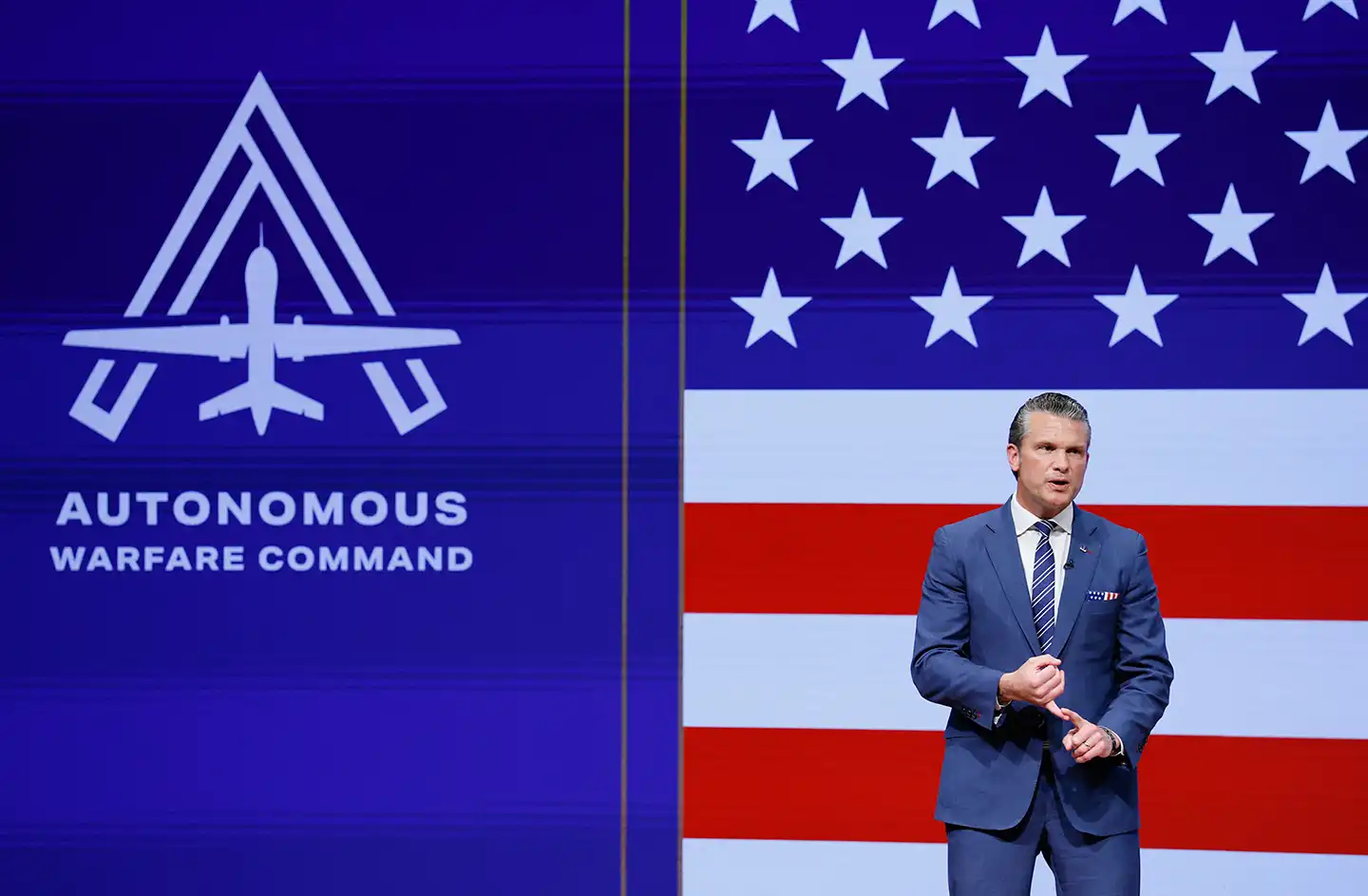
U.S. War Secretary Pete Hegseth in September announced the creation of a new military command that would be dedicated to building and providing autonomous and robotic capabilities across the U.S. military. The command, which Hegseth said would be called Autonomous Warfare Command, highlights the rapidly changing nature of warfare and the need to make progress on systems like drones and the use of artificial intelligence.
Creating a new command is not common — the last one was United States Space Command in 2019 — and the move reflects the Pentagon’s push to shift from costly conventional weapons platforms to cheaper, AI-driven autonomous systems that have proved decisive in recent conflicts. Speaking to hundreds of junior officers and enlisted personnel at Marine Corps Base Quantico in Virginia on September 30, Hegseth said the command would be led by a four-star officer.
“The pace of war is changing faster than the process to support it,” Hegseth said in a speech called the State of the Force. “Cheap compute, superintelligence and advanced commercial manufacturing have enabled the proliferation of low-cost, high-precision strike.”
He also announced other changes, including the creation of an office of religious affairs. The U.S. military currently has 11 combatant commands, which are responsible for different parts of the world and specific tasks.
Experts warn of AI risks
Experts have expressed fears over the potential for unchecked AI development and technology rivalries that could further heighten risks across the global security environment. Both the U.S. and China — the two major drivers of cutting-edge AI development and its global adoption — have been at loggerheads over AI policies and industry practices. Security experts from both countries have called for guardrails and consensus-building regarding AI in military systems, including nuclear weapons.
The United States has long relied on its vast military budget to field some of the world’s most expensive weapons systems. “Today we need both quality and quantity,” Hegseth said.
War in Ukraine illustrates drone warfare
The technology of war has evolved rapidly in recent years, a shift starkly illustrated by Russia’s war in Ukraine. What began as a conflict dominated by tanks and artillery has increasingly become a drone war.
Outgunned in conventional armor and aircraft, Ukraine turned to inexpensive unmanned systems for reconnaissance and attack. Drones are estimated to account for about 70% of Russian casualties, enabling strikes to be carried out remotely and reducing the risk to pilots and aircrews.
The Pentagon has in recent years made notable progress. That includes the creation of a task force — Joint Interagency Task Force 401 — that is focused on countering drones.