

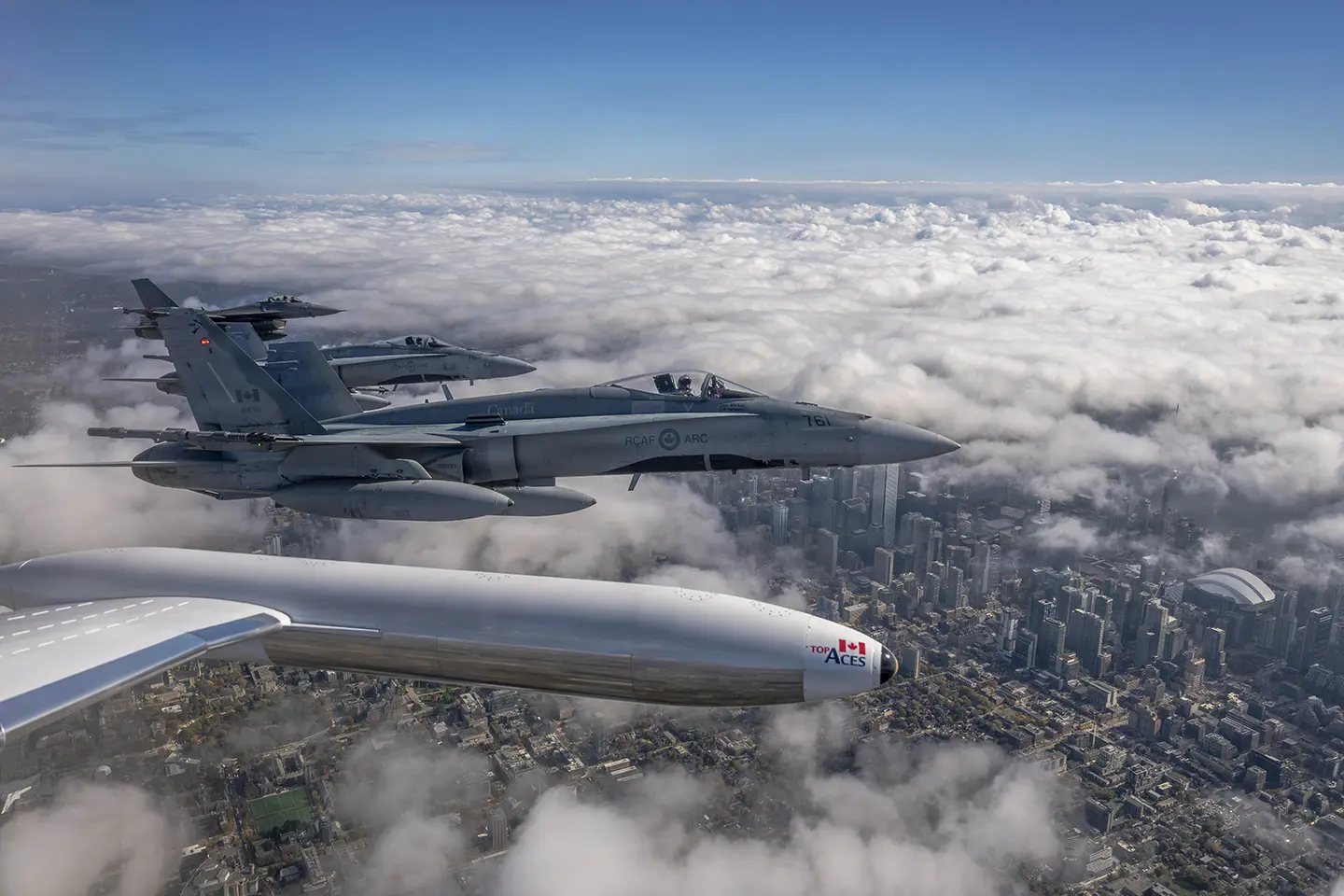
At FIFA World Cup 2026 sites across the United States and Canada in June and July, U.S. Northern Command (USNORTHCOM) and the North American Aerospace Defense Command (NORAD) executed defense and security support missions to ensure safety and security at the games. On the day of the World Cup’s final match, F-16s were deployed in three separate incidents to intercept civilian aircraft violating temporary flight restrictions. “Our support demonstrates the quiet, behind-the-scenes work our commands do every day to keep the skies secure,” said Gen. Gregory M. Guillot, commander of USNORTHCOM and NORAD.
Canada, Mexico and the U.S. welcomed millions of international spectators and visitors during the tournament, which began June 11. Throughout the event, homeland defense and robust interagency partnerships kept matches safe and secure. Working hand in hand, USNORTHCOM and NORAD supported civil and federal partners across the U.S., and in the case of NORAD’s binational command, in both Canada and the U.S.
USNORTHCOM coordinated federal requests for support to counter unmanned aerial systems, securing airspace over stadiums and other public areas. It deployed military canine teams to conduct security sweeps for semifinal matches. The command also stationed defense coordination officers in U.S. host cities to serve as single points of contact for local, state and federal teams. Liaison officers were assigned inside the U.S. government’s World Cup command center at Federal Emergency Management Agency (FEMA) headquarters.
Concurrently, NORAD executed its binational aerospace warning and control missions. In the U.S., NORAD collaborated with the Federal Aviation Administration (FAA), the Department of Homeland Security (DHS) and the Secret Service. The command enforced multiple FAA temporary flight restrictions over the New York and New Jersey metropolitan areas.
On the final day of the tournament, July 19, more than 10 civilian aircraft violated the flight restrictions over MetLife Stadium in East Rutherford, New Jersey, and the Trump National Golf Club in Bedminster, New Jersey, where President Donald Trump has a residence. Trump was in the area to attend the World Cup final.
In three of those incidents, F-16s were deployed to intercept the aircraft. On two of the intercept missions, the F-16s used flares to draw the pilots’ attention. NORAD aircraft safely escorted all three intercepted aircraft out of restricted airspace. In an earlier incident, over New York City on July 17, NORAD F-16s intercepted a civilian aircraft and released flares before safely escorting the aircraft out of restricted airspace.
“NORAD’s mission to defend the skies of the United States and Canada never stops,” Guillot said in a USNORTHCOM and NORAD news release. “We stand watch twenty-four hours a day, every day of the year, which allows us to seamlessly secure major international events like the World Cup so fans can focus on the sport.”
In Canada, supporting games in Vancouver and Toronto, NORAD integrated its aerospace defense mission with Public Safety Canada, the Royal Canadian Mounted Police and the Department of National Defence/Canadian Armed Forces. Leading up to the games, the Canadian NORAD Region and the Royal Canadian Air Force conducted intercept training with air traffic controllers in Ontario and British Columbia.
The bilateral and multilateral ties among the Canadian, Mexican and U.S. militaries proved essential to the execution of this defense mission, involving cooperation among dozens of military, intelligence and law enforcement partners from all three host nations. “This summer, the strong military relationships among the U.S., Canada, and Mexico have been on full display as our forces worked together with local, state, and federal partners to ensure a safe World Cup,” Guillot said in the news release.
Preparation for the tournament began months in advance. USNORTHCOM hosted the 11 Cities Summit in January in Colorado Springs, Colorado. The two-day event drew more than 200 security experts, emergency managers, host city representatives and federal partners from DHS, the FBI, FEMA and the White House Task Force. Participants established a shared understanding of host city plans, reviewed federal capabilities and coordinated emergency response protocols.
At Amalgam Eagle 25 in October 2025, USNORTHCOM, NORAD, Mexico’s Secretariat of National Defense and other interagency partners participated in a cross-border air defense and search and rescue exercise at locations throughout Canada, Mexico and the U.S. The exercise included enforcement of temporary flight restrictions to enhance preparedness for FIFA World Cup 2026. It also marked Canada’s inaugural participation in the exercise, as the Canadian NORAD Region played a key role in response protocols for potential air threats and emergencies.