

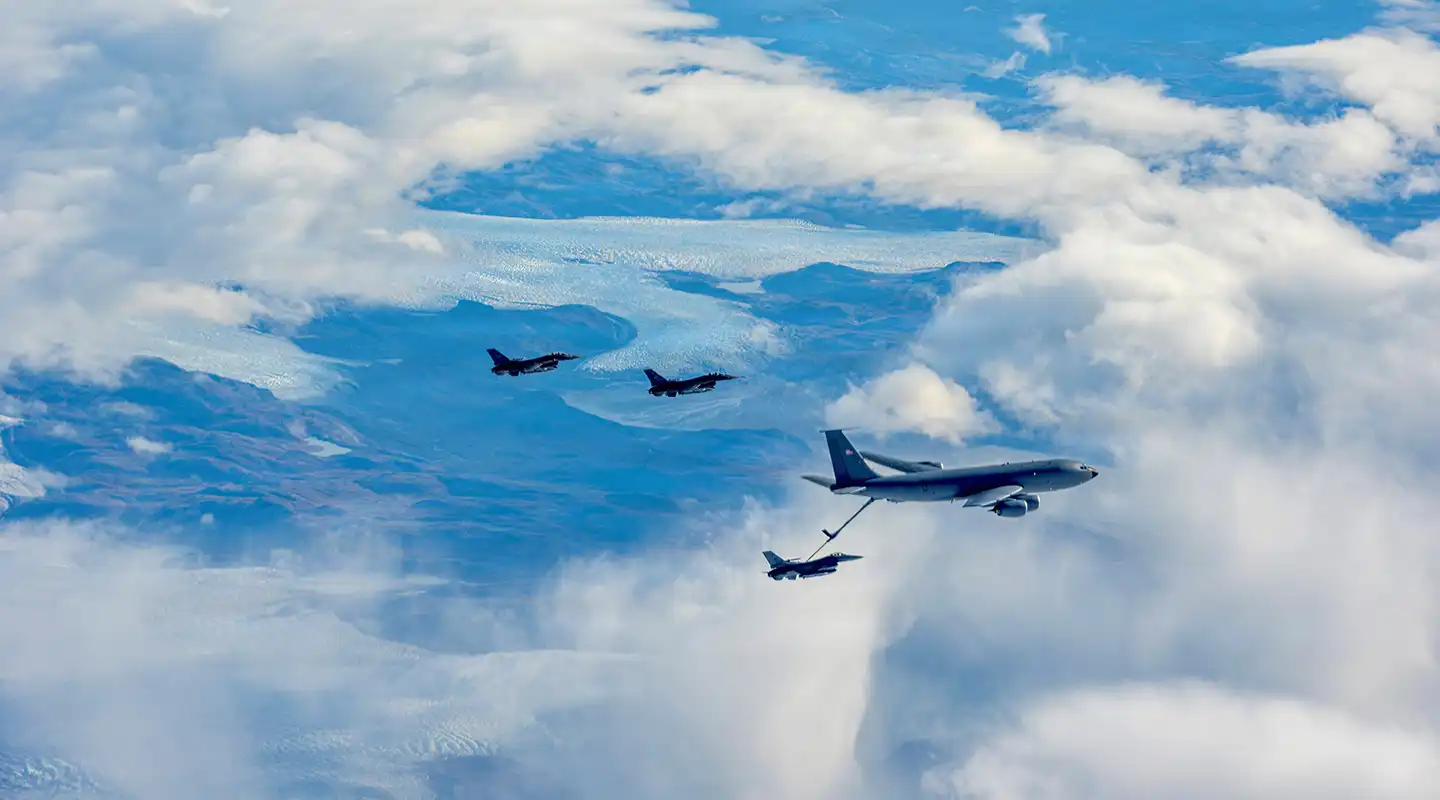
North American Aerospace Defense Command (NORAD), Danish and NATO forces conducted combined air defense training during Operation Arctic Vanguard 26-4.2 in September 2026, integrating fighters, aerial refueling, and airborne command and control to secure North America’s northern borders. Air Force Lt. Gen. Robert D. Davis, commander of the Alaskan NORAD Region, highlighted “our seamless integration with the Canadian NORAD region, the Kingdom of Denmark and our NATO allies. Together, we maintain continuous vigilance and credible deterrence across North America’s northern approaches.”
As part of Operation Arctic Vanguard 26-4.2 from September 13 to 26:
- NORAD fighter aircraft operated from Goose Bay, Newfoundland and Labrador, Canada, alongside aerial refueling and search and rescue aircraft operating from CFB Bagotville, CFB Gander, and CFB Winnipeg.
- In Keflavik, Iceland, Royal Danish Air Force fighters and a CL-604 Challenger participated in training scenarios alongside a French MRTT multirole tanker transport aircraft and NATO airborne warning and control aircraft.
- Four USAF F-16, two RCAF CC-188, two RDAF F-35, a CC-130H, and a CL-604 Challenger landed in Kangerlussuaq, Greenland, for drop-in refueling operations while engaging with Danish and Canadian media representatives to highlight coalition interoperability.
“Coordinating the deployment, sustainment, and command and control of personnel and aircraft across vast distances, from dispersed locations and in an unforgiving, austere environment, is inherently complex,” said Maj. Gen. David Moar, director of operations for NORAD, according to a NORAD news release. “By integrating defensive operations with a NATO E-3 AWACS aircraft, Alaskan NORAD Region F-16s, Canadian NORAD Region CF-18s, Royal Danish Air Force F-35s, and a significant number of support aircraft and equipment, we reinforced our interoperability in the air and on the ground.”
During Operation Arctic Vanguard 26-4.2, aircrews planned and carried out defensive counterair training missions, integrating allied fighters against advanced air threat scenarios. The exercises emphasized tactical data sharing and secure communications for coordinating actions among allied forces.
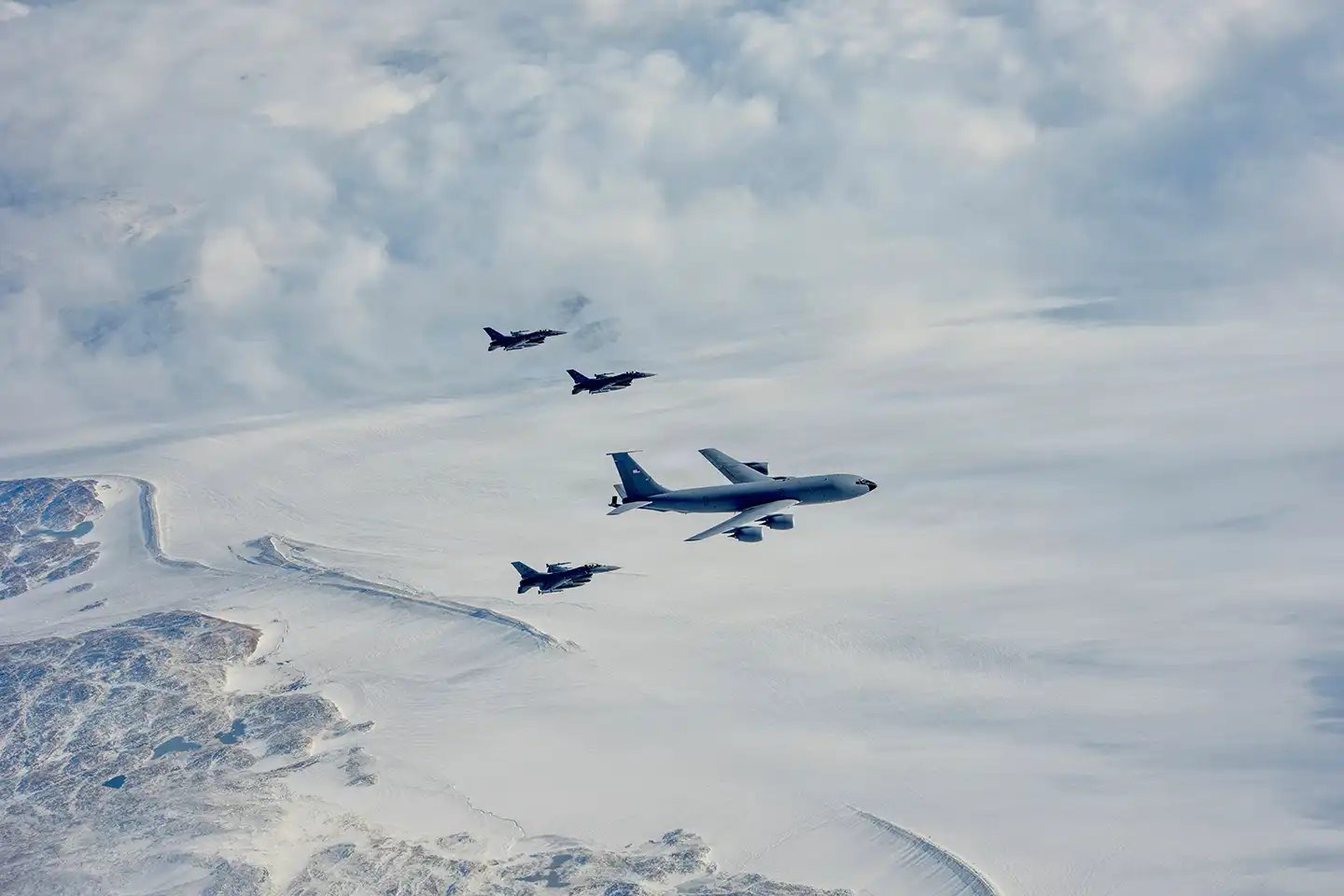
“We welcome NORAD forces to the region and value the experience and capabilities they bring to our combined operations,” said Maj. Gen. Jan Dam, chief of the Royal Danish Air Force, according to an Alaskan NORAD Region release. “Operating together in the air and on the ground builds the trust and coordination we need to strengthen our shared security in the Arctic.”
While Operation Arctic Vanguard 26-4.2 was underway, U.S. President Donald Trump signed an agreement with Denmark and Greenland to establish an enhanced U.S. military presence in Greenland with exclusive permanent basing rights. The accord keeps Greenland under Danish control but still would apply if Greenland ever chooses independence.
Operation Arctic Vanguard 26-4.2 is a planned NORAD operation and part of a recurring series of Arctic exercises to bolster forward presence and defend North America’s northern approaches. Each NORAD region conducts its own iteration of Operation Arctic Vanguard supported by both NORAD and USNORTHCOM in alignment with the commands’ Nordic Bridge concept. Under Nordic Bridge, the commands are shifting away from isolated Arctic endeavors. Instead, they are fully integrating and aligning all regional operations, exercises, and training with those of NATO, individual nations, and regional partners.
“Operation Arctic Vanguard demonstrated the capability to generate an integrated multinational force in the Arctic,” Moar said. “NORAD’s partnerships with the Kingdom of Denmark and NATO to include continued development of the Nordic Bridge are essential to the defense of North America.”
Operations like this develop and refine the resilience, skills and training needed to deploy and sustain essential capabilities in the High North, ensuring NORAD is prepared to detect, deter and defeat threats to North America. “Operation Arctic Vanguard demonstrates that austere conditions and vast distances present no barrier to NORAD’s collective defense,” said Davis, the Alaskan NORAD Region commander. “Deploying combat airpower from Alaska across Canada and forward into Greenland validates our agile combat capabilities.”
In testimony before the U.S. Senate Armed Services Committee in March, Gen. Gregory M. Guillot, commander of USNORTHCOM and NORAD, discussed NORAD’s critical importance to North American defense. “NORAD has stood as the world’s only binational command for more than 68 years as American and Canadian personnel serve side by side in the defense of North America. Tasked with aerospace warning, aerospace control and maritime warning — as well as providing integrated tactical warning and attack assessment to the governments of the U.S. and Canada — NORAD remains essential to continental defense and represents a unique and highly effective defense collaboration that is constantly evolving to stay ahead of new and emerging threats.”
In Tampa, Florida, in May, Guillot spoke at SOF Week, the premier annual convention and trade expo for the Special Operations Forces community, about his plan for the Nordic Bridge, saying, “The goal is always to defend as far away from the homeland as we can,” the Breaking Defense news website reported. Guillot said the Nordic Bridge will “tie together” USNORTHCOM, NORAD, the U.S. European Command (USEUCOM) and Supreme Allied Commander Europe. In strategic roundtables with USEUCOM in October, the concept was framed as a coherent, Arctic-wide construct intended to deter adversary malign activity and secure territory stretching from the Bering Strait to the Barents Sea.