

The Arctic fox has survived for thousands of years by mastering a simple but effective form of camouflage. Its fur turns white in winter, blending into snow-covered landscapes, then changes to brown as the snow melts and the tundra returns to its summer colors.
Now, U.S. Army researchers are looking to borrow that evolutionary advantage, developing adaptive camouflage that could allow military vehicles, equipment and potentially Soldiers to change their appearance to match different environments and evade increasingly sophisticated surveillance.
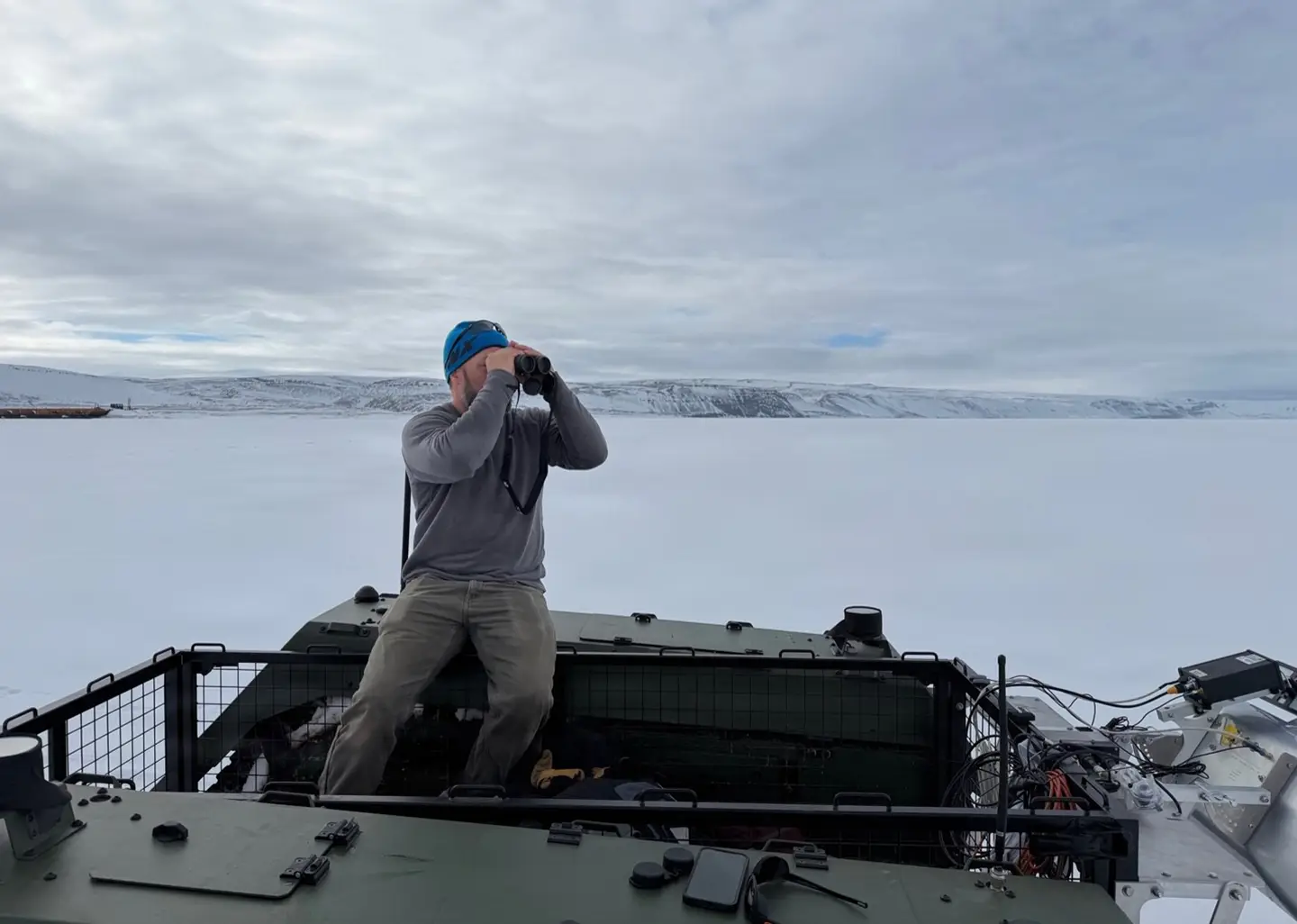
The research was tested this year in Pituffik, Greenland, where the Army Corps of Engineers’ Cold Regions Research and Engineering Laboratory (CRREL) worked with the Army Research Laboratory to evaluate experimental coatings during ship-to-shore operations. The effort was part of a broader multinational research initiative organized through the International Cooperative Engagement Program for Polar Research and the Office of Naval Research, reflecting the growing importance of the Arctic as a military operating environment, the Military Times reported on October 29.
Unlike traditional camouflage, which relies on fixed patterns and colors, adaptive systems could use coatings or specialized fabrics that can be changed to accommodate different terrain, lighting conditions and seasons. The Arctic presents particularly difficult challenges for military concealment. Periods of prolonged darkness alternate with nearly continuous daylight, while low-angle sunlight can make the landscape appear yellow or orange. Sea ice can look gray, and military equipment painted white can stand out against an otherwise snow-covered landscape.
“It’s dark for some periods; it’s light for other periods,” Dr. Tom Douglas, a research chemist and senior scientific technical manager at CRREL’s Alaska Research Office, told the Military Times.
“Everything can look kind of yellow or orange when the sun’s setting,” he said. “You’ve got sea ice, which can look kind of gray. … You can stand out pretty blatantly in a vast open white field where there’s no vegetation, right? So, there’s that, and then thinking about coatings or snow covering things, and maybe making it worse now that your camo doesn’t work.”
Researchers also must account for surveillance technologies that can detect objects beyond the visible spectrum. Anthony Fragoso, CRREL’s cold regions artificial intelligence lead, told the Military Times that researchers used sensors to evaluate several experimental coatings and determine how effectively they concealed their targets.
The Arctic foxes in Greenland provided an important source of inspiration. Their ability to change fur color with the seasons illustrates the kind of reversible, adaptable concealment the Army hopes to develop. “Things that are reversible, flexible is kind of what we’re after,” Fragoso told the Military Times.
That flexibility could be valuable for units that must operate across dramatically different environments. The Alaska-based 11th Airborne Division, known as the Arctic Angels, trains for operations in the far north but also prepares for deployments to the Pacific, including environments with dense tropical vegetation.
“They’re the Arctic Angels, but they are also worried about fighting in the jungle,” Fragoso told the Military Times. “So, they don’t want to paint stuff white, and then it has to go to Taiwan.”
The Army’s camouflage research is unfolding alongside another technological contest: developing artificial intelligence that can identify concealed enemy forces. The Army is developing AI software that can analyze large collections of images, learn to recognize military vehicles and equipment, and identify potential targets in live drone footage, Stars and Stripes wrote in an October 29 article.
At the same time, the Army’s fiscal 2027 research budget outlines efforts to use AI and experimental materials to develop camouflage patterns specifically designed to confuse automated target-recognition systems.
An experiment involving Carnegie Mellon University, Florida State University and the Army Research Laboratory demonstrated the potential. Researchers found that AI-generated camouflage reduced a computer’s ability to detect vehicles in digitally altered images from 99.5% to 38.2%, according to research published in March, Stars and Stripes said.
For the Army, the challenge is increasingly about concealing equipment not only from human observers but also from drones and automated sensors. The adaptive camouflage project is still in the research and development stage, but scientists are preparing to move toward practical testing. The next phase is expected to involve applying a rapidly deployable coating system to the Army’s cold weather all-terrain vehicles in Alaska. The Alaska National Guard plans to use helicopters equipped with thermal imaging cameras to evaluate whether the vehicles can be detected from above.
“The Alaska National Guard is going to fly over it with helicopters, film it with thermal, all that stuff,” Fragoso told the Military Times. “Everything now is counter-[unmanned aerial systems], so it’s making sure stuff isn’t being spotted from above by a $1,000 drone.”
Researchers have not settled on a final design. The technology could involve removable coatings, specialized fabrics or other materials that provide concealment across multiple environments.
Mike Parker, CRREL’s cold regions mobility lead, said the research is not limited to Arctic operations. The objective is to develop adaptable concealment that can give military forces an advantage wherever they operate.
“It has to remain flexible, and all aspects of it are on the table,” Parker told the Military Times. “It doesn’t have to be just a coating; it could be a fabric … anything that can give us the tactical advantage is being evaluated.”