

REUTERS
The United States and Mexico in October 2021 discussed a new joint security plan to fight drug cartels as U.S. Secretary of State Antony Blinken met with Mexico’s president during a visit to strengthen ties between the countries.
The Biden administration is increasingly reliant on its southern neighbor to stem the flow of Latin American migrants heading to the United States.
Overhauling an earlier security plan, known as the Merida Initiative, is expected to take months as the two sides work out how best to work together. The United States has channeled about U.S. $3.3 billion since 2007 to help Mexico fight crime under the previous accord.
Blinken’s visit was part of the Biden administration’s first U.S.-Mexico High-Level Security Dialogue, where the delegations sought to sketch out how to tackle everything from drug flows to the United States to the smuggling of U.S.-made guns into Mexico.
In a joint statement about the new accord, dubbed the Bicentennial Framework, the nations pledged to work on the causes of violence and drug addiction, as well as monitor port smuggling of precursor chemicals for fentanyl and other drugs fueling a record number of overdose deaths in the U.S.
“After 13 years of the Merida Initiative, it’s time for a comprehensive new approach to our security cooperation, one that will see us as equal partners in defining our shared priorities,” Blinken said.
Earlier, Lopez Obrador took Blinken on a tour of the murals at the National Palace before a working breakfast.
The Mexican leader said in a tweet afterward that there were “excellent conditions to inaugurate a new stage of the bilateral relationship.” He also invited U.S. President Joe Biden to visit.
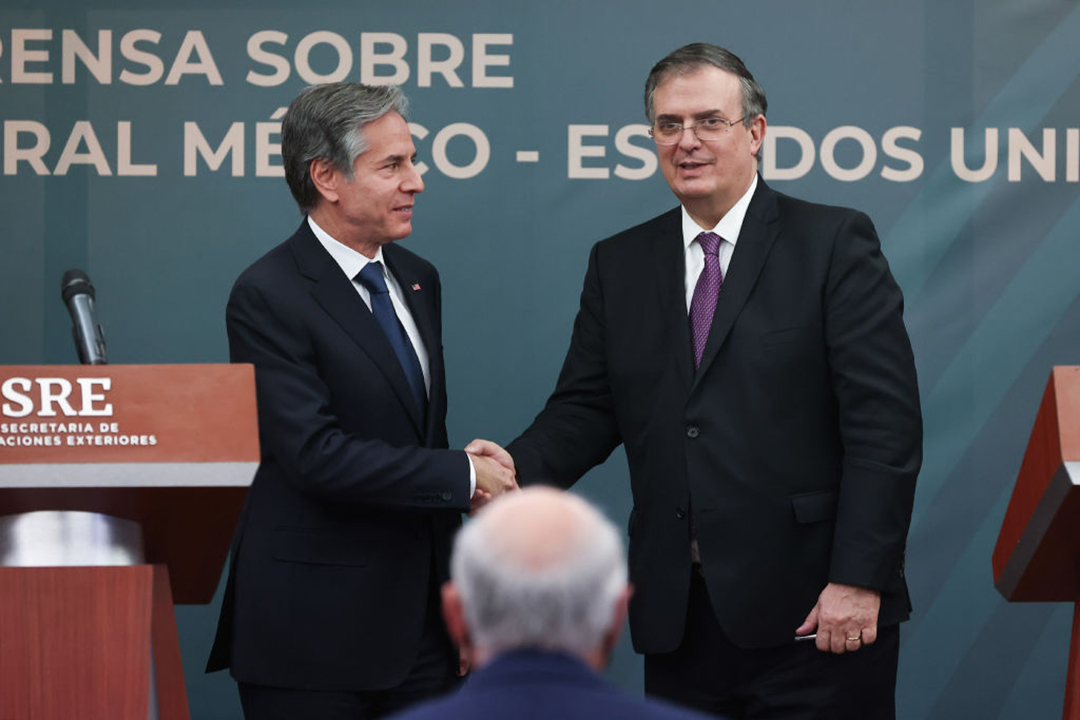
U.S. Secretary of Homeland Security Alejandro Mayorkas and U.S. Attorney General Merrick Garland accompanied Blinken, who also met with Foreign Minister Marcelo Ebrard. (Pictured: U.S. Secretary of State Antony Blinken and Mexican Foreign Minister Marcelo Ebrard shake hands during a high-level security dialogue in Mexico City, Mexico.)
U.S. officials are touting the new security accord as broader than the Merida Initiative, which initially provided military equipment for Mexico and later helped train Mexico’s security forces, police and the judiciary.
Lopez Obrador has been a vocal critic of the program, saying it was tainted by its association with previous governments and its failure to prevent bloodshed and escalating violence in the so-called war on drugs.
But negotiating a new agreement will be challenging. Washington espouses a more muscular approach to battling drug gangs inside Mexico while Lopez Obrador prefers softer and less confrontational methods to fighting gangs, according to analysts.
“There is a complete clash of paradigms,” said Falko Ernst, a Mexico-based senior analyst at the Crisis Group. “But they are stuck on the same carriage on a very long and winding road.”
The positive is that both sides are talking and eager to pragmatically reset the relationship, Ernst added.
Blinken said the United States wants the bilateral relationship to be about more than security and border issues, though migration remains a key element in the balance of ties.
A surge in the number of Haitian and other Latin American migrants arriving at the U.S.-Mexico border plunged the Biden administration into another crisis in September 2021 and underlined Washington’s reliance on Mexico to help stem the flow.
Blinken said the United States was in daily contact with Mexican officials over U.S.-bound Haitian migrants.
IMAGE CREDIT: AFP/GETTY IMAGES