

THE WATCH STAFF
SpaceX has been awarded a contract by the Air Force Research Laboratory (AFRL) to help explore the viability of transporting cargo around the world by heavy rocket.
The contract awarded January 14 is worth more than U.S. $102 million and falls under the AFRL’s rocket cargo program. The news was first reported by Aviation Week and the contract listed on the SAM.gov website.
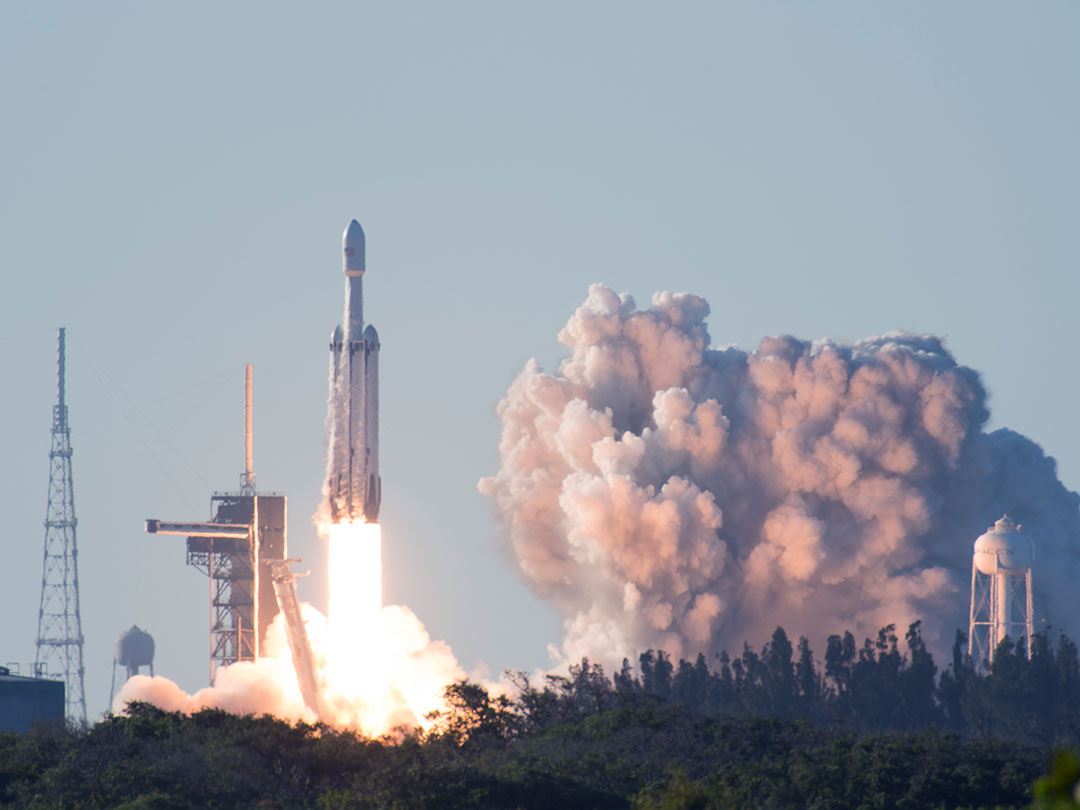
The program seeks to take advantage of heavy launch capabilities that SpaceX and other companies have brought to the commercial market, according to a January 20 story by the CNET website. (Pictured: A SpaceX Falcon Heavy rocket lifts off at Florida’s Kennedy Space Center in 2019.)
Dr. Greg Spanjers, the program’s manager, told SpaceNews in a statement January 19 that the military is “very interested in the ability to deliver the cargo anywhere on Earth to support humanitarian aid and disaster relief.”
The contract doesn’t specify which SpaceX rocket will be used, according to CNET. SpaceX has used its Falcon 9 and Falcon Heavy, which is made up of three Falcon 9 boosters, for past military missions.
Spanjers, in his statement to SpaceNews, said the contract represents a partnership between the military and commercial sector to “determine exactly what a rocket can achieve when used for cargo transport, what is the true capacity, speed and cost of the integrated system.”
The contract is the largest awarded to date for rocket cargo, according to SpaceNews. U.S. Transportation Command (USTRANSCOM) signed cooperative agreements in 2020 with SpaceX and Exploration Architecture Corp. to study rapid transportation through space. The command also signed an agreement with Blue Origin in December 2021, SpaceNews reported.
“Think about moving 80 short tons, the equivalent of a C-17 payload, anywhere on the globe in less than an hour,” U.S. Army Gen. Stephen R. Lyons, then commander of USTRANSCOM, said at the Airlift/Tanker Association Conference in 2020. “We should challenge ourselves to think differently about how we will project the force in the future, and how rocket cargo could be part of that.”
AFRL will have access to SpaceX’s commercial launches and booster landings to collect data. SpaceX also will provide cargo-bay designs compatible with USTRANSCOM containers, according to SpaceNews.
“Commercial vendors envision fixed point-to-point transport to established sites, a commercial service that we are certainly interested in procuring once available,” Spanjers said.
For humanitarian relief however, disasters often take place far from commercial spaceports.
“We are therefore exploring a wider range of novel trajectories to mitigate overflight issues, exploring a broad range of landing options for austere sites, researching human factors when landing near populations and integrating a broader range of cargo including medical supplies,” Spanjers told SpaceNews.
There is no timeline for a rocket-cargo demonstration.
“AFRL will be leveraging several commercial demonstration launches over the next few years to collect the data,” Spanjers said. The Air Force “does not drive this schedule but rather will collect data whenever SpaceX flies relevant missions.”
IMAGE CREDIT: 2ND LT. ALEX PREISSER/U.S. AIR FORCE