

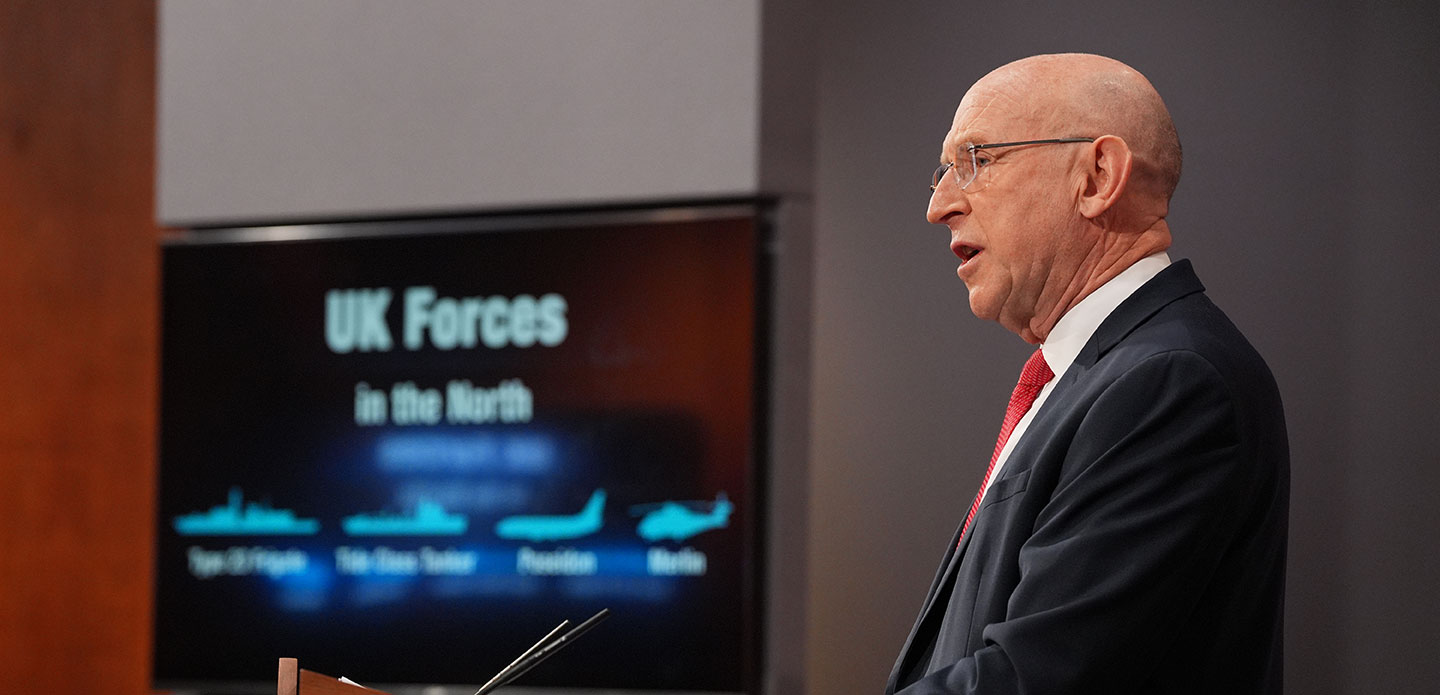
The United Kingdom and Norway led a weekslong military operation to foil a Russian plot to survey undersea cables in the North Atlantic, U.K. Defence Secretary John Healey said on April 9, 2026, accusing Russian President Vladimir Putin of using the distraction of Middle East conflict to escalate its malign activity against Europe. “To President Putin, I say, we see you. We see your activity over our cables and our pipelines, and you should know that any attempt to damage them will not be tolerated and will have serious consequences,” Healey said.
The defense secretary said a Royal Navy frigate, aircraft and hundreds of personnel tracked a Russian attack submarine and two spy subs lurking north of the U.K., and prevented the spy vessels from carrying out “nefarious” operations against underwater infrastructure. Healey said the Russian subs left the area after U.K. and Norwegian forces had been there for more than a month. There is no indication that the Russians damaged any cables or pipes, he said. The Russian embassy in London denied the claims, saying, “it is impossible to either believe or verify this statement.”
The U.K. said other allies were involved in the operation but didn’t identify them. NATO countries have alleged Russia could use its fleet of spy ships to destroy underwater cables that carry global communications. Russia has denied the allegations, but repeatedly, starting in 2023, undersea cables and pipelines were cut in the Baltic Sea. Russia also was blamed for those incidents.
At a news conference in London, Healey said, “Putin would want us to be distracted by the Middle East,” but Russia is the main threat to the U.K. and its allies. “We will not take our eyes off Putin.”
In November 2025, after the Russian spy ship Yantar was detected near U.K. waters north of Scotland, the U.K. told Russia it was ready to confront any incursion into its territory. The next month, Norway and the U.K. announced they would coordinate joint naval patrols to protect undersea cables from Russia, after Prime Minister Keir Starmer and his Norwegian counterpart, Jonas Gahr Støre, held defense talks.
The U.K. said then that a combined fleet of at least 13 warships would “hunt Russian submarines and protect critical infrastructure in the North Atlantic.” The partnership came nearly a year after NATO announced a multidomain mission to deter sabotage in the Baltic Sea.
In March of this year, the U.K. also said its military was ready to seize ships suspected of being part of Russia’s shadow fleet of vessels shipping oil in violation of international sanctions tied to Moscow’s war on Ukraine. The fleet is made up of old oil tankers of opaque ownership intended to circumvent the sanctions.
Norwegian Defence Minister Tore O. Sandvik said Russia’s most recent operation was in and near Norwegian and British maritime areas. Norway and the U.K. said the submarine activity was coordinated by Russia’s Main Directorate of Deep Sea Research, known as GUGI, which is part of Russia’s armed forces. Norway’s Defense Ministry said the Russian operation is a reminder that Russia continues to build on its abilities to map and sabotage the West’s critical underwater infrastructure.
Healey said the Russian subs are “designed to survey underwater infrastructure during peacetime and sabotage it in conflict.” He said the recent submarine activity occurred in the U.K.’s exclusive economic zone, within 200 nautical miles of shore, but not in its narrower territorial waters, a zone of 12 nautical miles.