
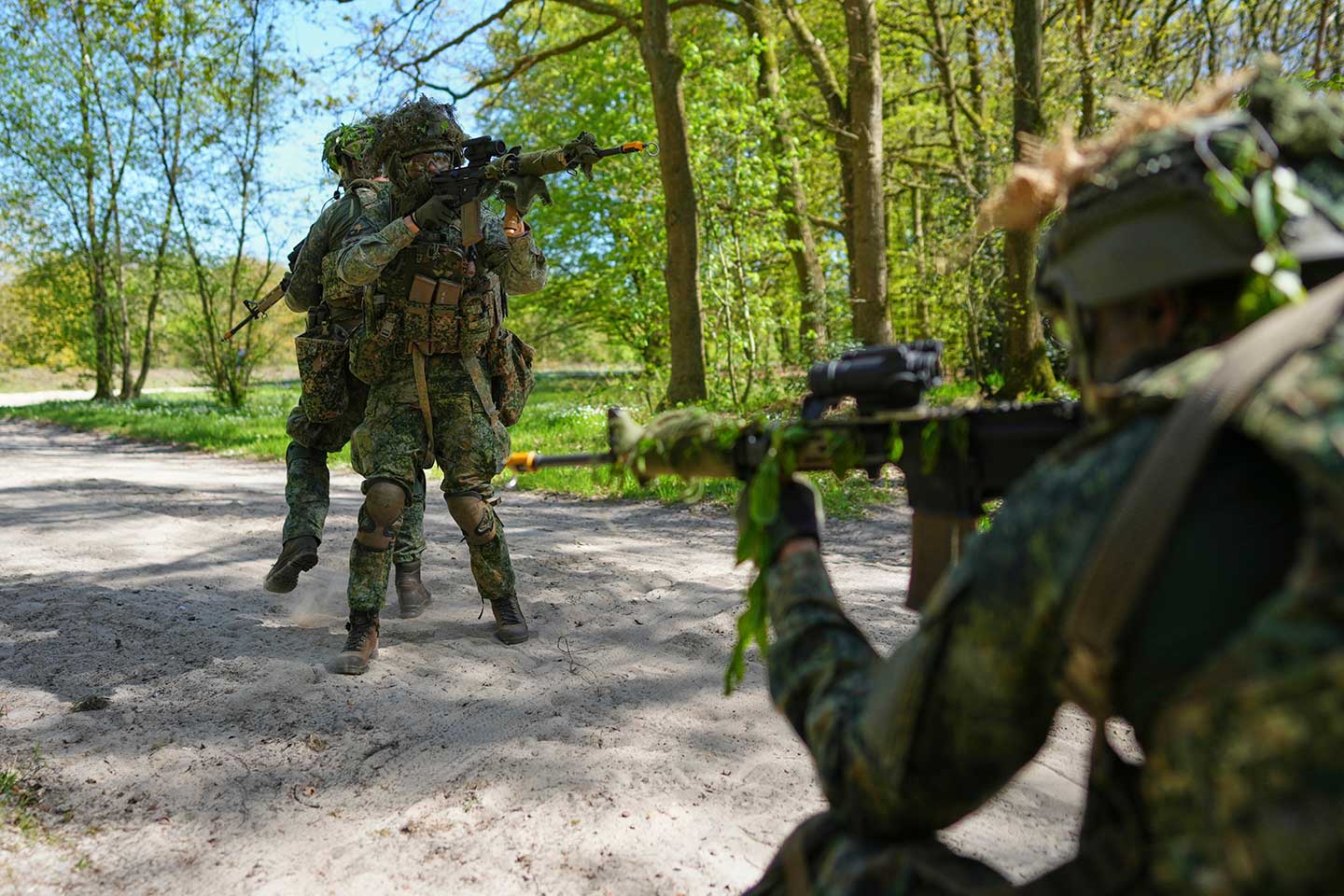
Their faces daubed with camouflage, the troops emerge almost silently from a forest with Colt C7 rifles slung across their chests. They scan their surroundings for potential threats.
The Soldiers are members of the 10th Infantry Battalion Guard Security Corps National Reserve on a weekend exercise to hone their skills as the Netherlands bolsters its military with new recruits and volunteers. The Dutch government and top brass have committed to raising military personnel from 80,000 to 120,000 by 2035 — plans that have broad political support.
The recent enlistment by the country’s queen and her eldest daughter as reservists appears to be helping as authorities scramble to arm and train new recruits. The recruitment drive in the Netherlands reflects moves across Europe to expand and modernize militaries as leaders warily eye the grinding war launched by Russia against Ukraine.
A corporal in the Dutch reserve battalion, who spoke on condition of anonymity, said she’s seen priorities shift as the global security outlook has become more volatile and less predictable.
“When I first joined, there was almost no risk or almost no threat … and now it’s changing so we are more aware of it,” she said. That has meant a mindset shift toward “more what we call ‘green things,’ infantry things.”
She added: “We are here to defend our country and to make sure to keep the threat down.”
The threat is very real, according to European Union and NATO officials, who believe Russian President Vladimir Putin could be ready to launch an attack elsewhere in Europe in three to five years, especially if he wins the war in Ukraine.
New NATO plans aimed at countering that threat require allies to prepare their armies for big battles, focused on more mobile forces that can be quickly deployed.
House of Orange in military green
Dutch recruitment got a significant boost when Queen Maxima and her eldest daughter and heir to the throne Amalia, Princess of Orange, enlisted as volunteer reservists. Photos of Maxima in training and aiming a pistol on a shooting range were published around the world.
That royal seal of approval, together with recruiting campaigns running everywhere from newspapers and billboards to social media, has proved so successful that the military is now working overtime to arm, train and accommodate all the newcomers.
At the Defense Ministry, it’s known as “the Amalia effect.”
“It’s really a thing, yes,” State Secretary for Defense Derk Boswijk told The Associated Press. “It’s very inspiring to see how members of our royal family inspired people to join our armed forces.”
Boswijk said that there are about 9,000 reservists in the Netherlands, and recruiters aim to have at least 20,000 in 2030.
“We have more applications than we can handle,” Boswijk said. Now the military must battle “a lack of training capacity, a lack of housing. You have to give them all uniforms, you have to give them weapons.”
But, he said: “It’s a luxury problem.”
Other nations boost recruitment
German lawmakers are considering a government plan to offer better pay and conditions for people who join up on a short-term basis, along with better training and more flexibility on how long recruits must serve.
The aim is to draw sufficient recruits without reviving conscription, which was suspended for men in 2011. The plan leaves the door open for limited compulsory recruitment, if not enough people volunteer.
Like the Netherlands, France is leaning into voluntary service to boost the military. A program starting in September seeks to recruit 3,000 volunteers from ages 18-25. They will serve in uniform for 10 months in France’s mainland and overseas territories only. The plan seeks to attract up to 50,000 volunteers per year by 2035.
In northern and eastern Europe, where the threat from Russia is felt most keenly, some nations still have some conscription.
Finland has a draft for all males and a voluntary system for women. Sweden reinstated a gender-neutral partial military service in 2017. If not enough people volunteer, a lottery is held to select people for the remaining slots. Neighboring Denmark has a similar system, as does Latvia since it revived its draft in 2023 in response to Russia’s full-scale invasion of Ukraine.
The Netherlands never fully abolished its draft, but call-ups have been suspended since 1997 and there are no immediate plans to reintroduce them. Instead, the Defense Ministry is seeking to make the military more attractive to a broad cross section of society.
Threats have expanded from traditional battlefields into cyberspace and the digital world, he said, “so we need all kind of skills, to keep our society, our country, our allies safe. So, yes, we need also people wearing hoodies, having blue hair, who can game perfectly.”