

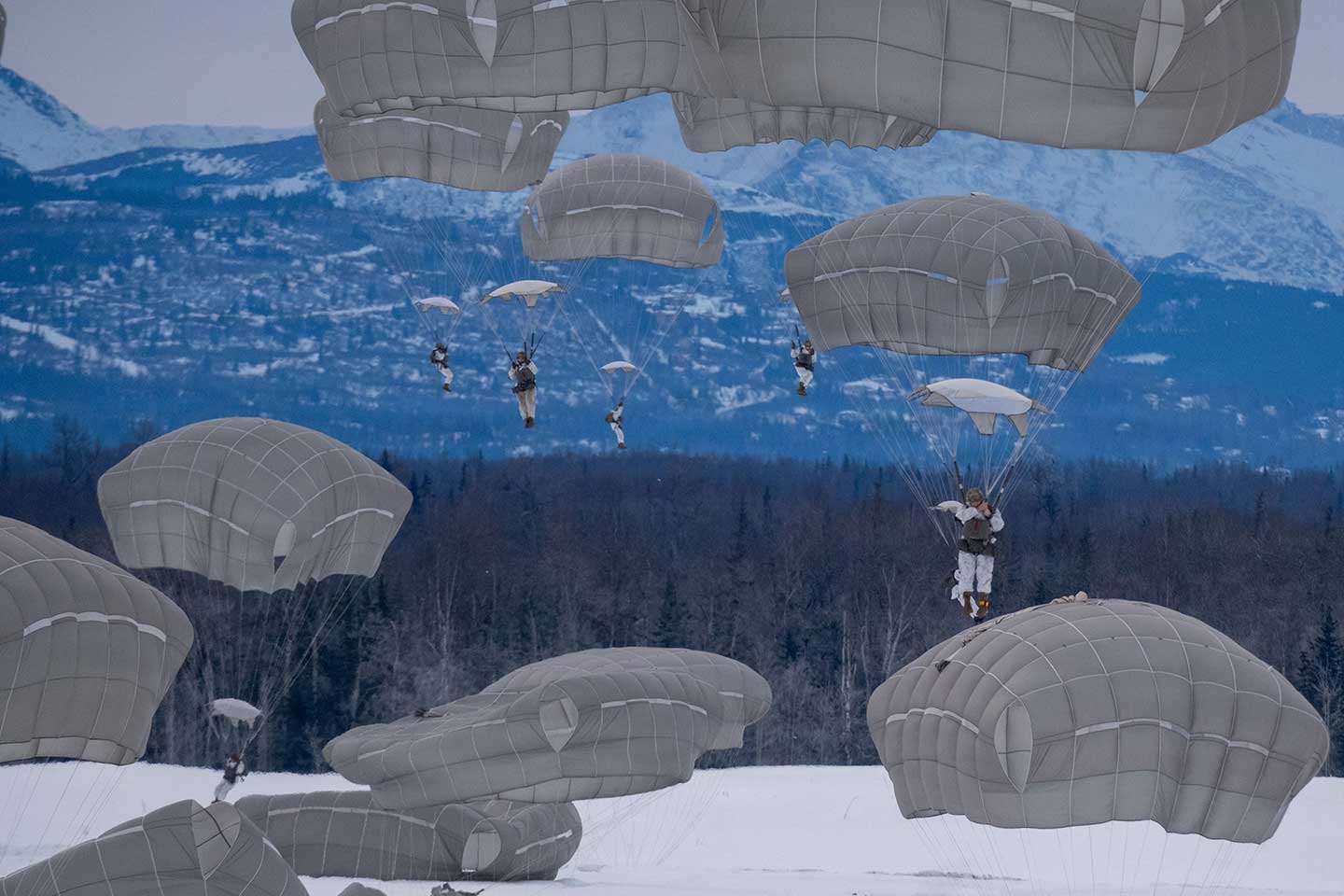
Each day was an exercise in survival at Joint Pacific Multinational Readiness Center (JPMRC) 26-02 in Alaska, as United States and Canadian Soldiers trained in Arctic warfighting on an unforgiving battlefield while reinforcing their focus on lethality, readiness and operational capabilities. Getting through each day and night was the first order of business.
The air reached as low as minus 40 degrees Celsius. At that temperature, exposed skin can freeze in less than 10 minutes — even faster if wind chill makes it feel colder.
“Everything’s harder in the Arctic,” Maj. Gen. John Cogbill, commanding general of the 11th Airborne Division, told NBC News. “Just surviving up here is a challenge in and of itself.”
Leading up to February’s exercise, U.S. Army medical personnel assigned to 2nd Infantry Brigade Combat Team (Airborne), 11th Airborne Division, conducted a medical evacuation rehearsal at one of the JPMRC exercise sites in Alaska. Arctic conditions add layers of complexity to trauma care, and medics must aggressively manage hypothermia, balancing speed, precision and supply limitations.
“In the Arctic operational domain, hypothermia has to be addressed immediately,” Capt. Blake Arnold, commander of the Brigade Support Medical Company, said in an Army news release. “That means getting patients into warming shelters as fast as possible, minimizing heat loss during treatment, and ensuring all temperature-sensitive medical supplies are ready to go.”
To support those needs, medical teams used Arctic-specific tents, warming systems and cold-weather medical equipment. They relied on HemaCool storage systems — rugged, portable battery-powered refrigerator/freezer units — and tested freeze-dried plasma to keep blood products viable in subzero conditions.
During the rehearsal, Soldiers treated two simulated casualties replicating injuries associated with Arctic conditions. Medical teams conducted triage, treatment and assessment before coordinating an aerial evacuation with Charlie Company Dustoff, 1-52 General Support Aviation Battalion, Arctic Aviation Command. The simulation ended with an evacuation to Bassett Army Community Hospital at Fort Wainwright in Fairbanks.
“The Arctic is unforgiving, and we don’t have time for error,” Arnold said, emphasizing the importance of rehearsal and repetition to achieve the best possible care outcomes.
Kicking off JPMRC 26-02, Soldiers assigned to 2nd Infantry Brigade Combat Team (Airborne), 11th Airborne Division, and Canadian 3rd Battalion, The Royal Canadian Regiment, conducted a joint airborne operation near Joint Base Elmendorf-Richardson, Alaska, on February 7. Jumpmasters from both militaries provided expertise and maintained safe conditions during the operation.
The jump “created trust and enhanced interoperability related to tactics, techniques, and procedures between Airborne organizations,” Canadian Army Brig. Gen. Robert McBride, deputy commanding general of operations for the 11th Airborne Division, said in an Army release. McBride is part of a long-standing program of officer exchanges between Canadian, U.S. and other NATO countries’ armed forces.
“As the importance of the Arctic grows, the 11th Airborne Division will continue to execute bilateral airborne operations with our Arctic partners, to include Canada,” McBride said. “The bond between the 11th Airborne Division and the 3rd Battalion, The Royal Canadian Regiment was apparent on the drop zone during the foreign wing exchange. I anticipate this relationship will continue to grow and lead to a long-lasting partnership.”
A few days after that operation, the same units — under a night sky lit by the aurora borealis — jumped together as the opposing force (OPFOR), simulating a lethal enemy for 1st Brigade Combat Team (Arctic), 11th Airborne Division, at the Yukon Training Area, adjacent to Eielson Air Force Base, near North Pole, Alaska. As the OPFOR, the 2nd Infantry Brigade Combat Team replicated a capable adversary focused on speed, mobility and disciplined execution. About 4,000 Soldiers from the 11th Airborne Division took part in the training battle, which pitted two similarly sized forces against each other.
Green Berets and support personnel assigned to 3rd Battalion, 10th Special Forces Group (Airborne), also took part, pushing themselves to the limit and using their unique skills in the simulated large-scale combat operation. Several small teams of operators leveraged reconnaissance and disruption of adversary technology to provide a decisive advantage in fires and maneuvering across the battlespace.
Before entering the JPMRC training area, Green Beret teams conducted 14 days of focused cold-weather training in Alaska to refine their Arctic survival skills. The teams rehearsed small-unit movement over snow-covered and difficult terrain, cold-weather sustainment that included meal preparation, communications in extreme temperatures, and long-duration dismounted operations. The training reinforced the discipline needed to maintain combat power when weapons freeze, batteries die, fuel turns into a viscous jelly and even basic tasks can become a struggle.
“Having two weeks of solid cold-weather training prior to going into the box helped us and other teams really prepare for the subfreezing temperatures that we were going to face,” said a Special Forces Team sergeant, the senior noncommissioned officer on one team. “When guys are exposed to this environment [like Alaska], they stop doing the simple things — changing socks, drinking water, and eating. These mistakes can begin to snowball if not taken seriously.”
Gen. Gregory M. Guillot, commander of U.S. Northern Command (USNORTHCOM ) and the North American Aerospace Defense Command (NORAD), spoke about the importance of Arctic security during testimony before the Senate Armed Services Committee on March 19, saying, “The ability of the Joint Force to conduct all-domain operations in the Arctic approaches to North America remains a strategic necessity as military and economic competition in the region steadily expands.”