

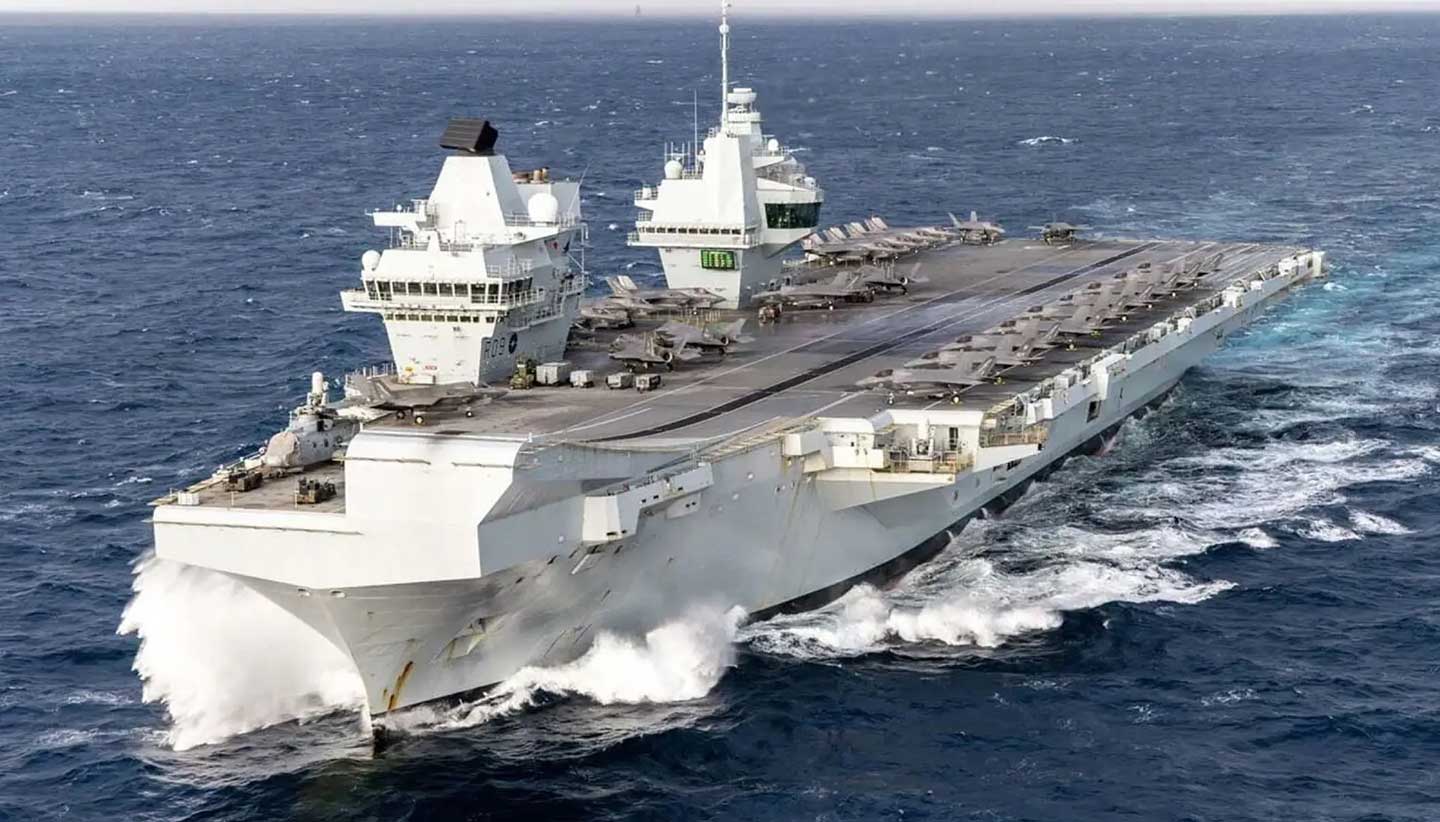
A British aircraft carrier led a NATO anti-submarine exercise in the Norwegian Sea in May 2026 at a time of heightened activity in the region by Russian military forces. HMS Prince of Wales took part in the alliance’s Dynamic Mongoose exercise between May 18 and 29. The High North anti-submarine warfare exercise trains NATO forces to detect and counter enemy submarines through multithreat scenarios for submarines, surface ships and aircraft. The United Kingdom has made the defense of NATO’s northern flank a central pillar of its defense strategy. “This 2026 deployment delivers a clear signal of the U.K.’s steadfast commitment to working with regional partners and securing Europe’s northern flank,” said Cmdr. James Mitchell aboard the destroyer HMS Duncan, which is sailing alongside HMS Prince of Wales,according to the Barents Observer, a Norwegian newspaper.
The exercise comes amid increasing Russian military activity in the Arctic, especially in the icy waters between northern Norway and the Svalbard archipelago. “We have seen increasing Russian activity in the north. Our fighter aircraft on NATO standby have been identifying Russian surveillance planes heading out into the Norwegian Sea on a daily basis. It is happening more frequently than usual,” Vice Adm. Rune Andersen, head of the Norwegian Joint Headquarters (NJHQ), told VG, a Norwegian newspaper.
In the first five months of 2026, Norwegian F-35s have scrambled about 39 times from Evenes Air Station in northern Norway and identified 51 Russian warplanes operating outside Norway’s airspace — the same total as in all of 2025. The Russian planes are based in the nearby Kola Peninsula and regularly engage in cat-and-mouse sorties with British, Norwegian and United States warplanes. NATO regularly patrols the Norwegian and Barents seas with P-8 Poseidon submarine-hunting aircraft, the Barents Observer reported.
Royal Navy Cmdr. Maryla Ingham recently assumed command of NATO’s Maritime Standing Group 1, which has, for the first time, participated in the alliance’s ongoing Arctic Sentry operation. For Dynamic Mongoose, the naval squadron will gain valuable experience in the High North, she said. “We are bringing together an array of NATO capabilities with a particular focus on underwater in the Arctic and High North. By integrating live surface, subsurface and air assets we can provide a realistic exercise scenario which tests the ships taking part in order to ensure they are ready to face potential threats in the future,” Ingham said, according to the Portsmouth News, a U.K. newspaper.
Dynamic Mongoose, hosted by Norway, involved submarines from Germany, the Netherlands and Portugal. Throughout the training, the submarines alternated between hunting other submarines and evading detection, a NATO news release stated. Maritime Patrol Aircraft from Canada, France, Germany, Portugal, the United Kingdom and the United States contributed to the exercise, supported by surface vessels from Denmark, France, Germany, the Netherlands, Norway and Portugal, according to NATO.