

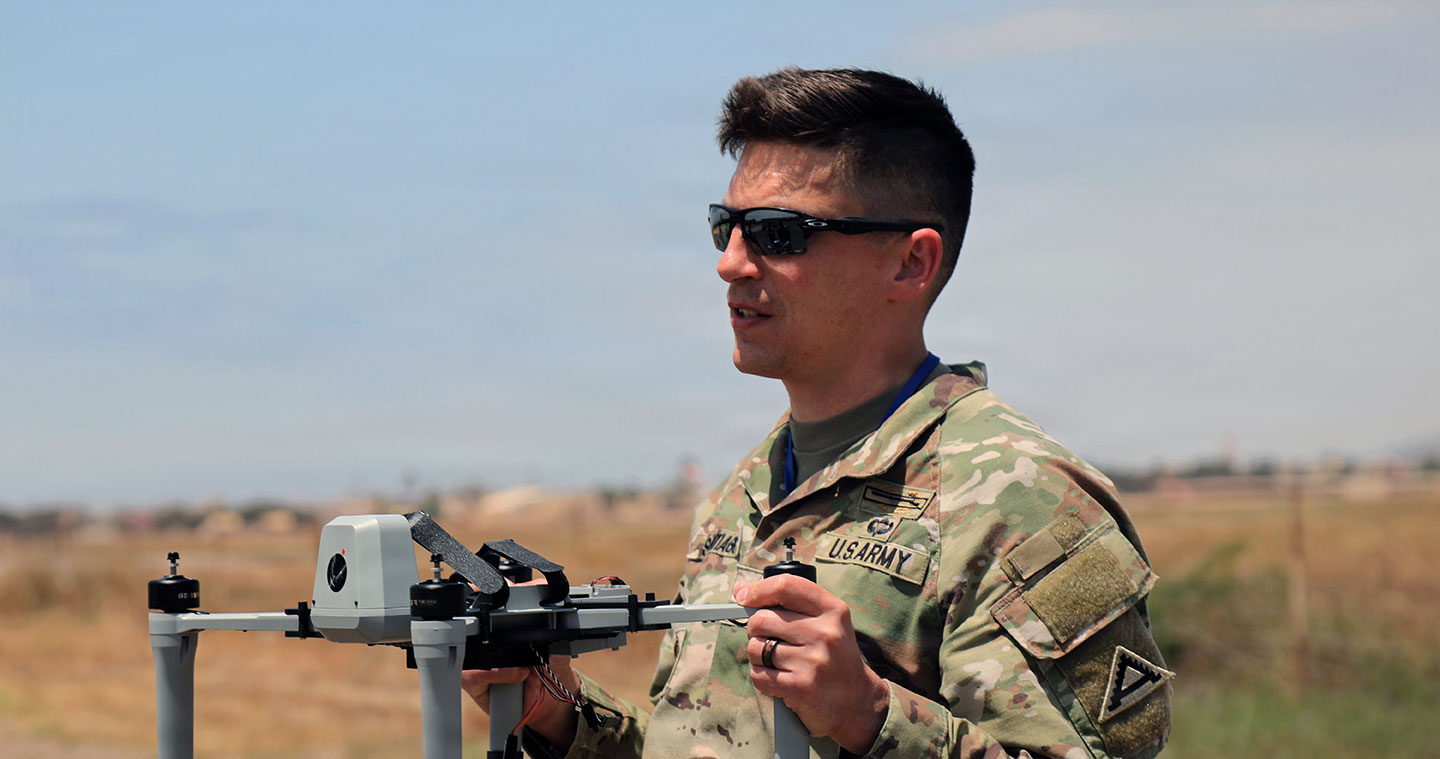
Joint Interagency Task Force (JIATF) 401, the organization tasked with researching, testing and buying emerging counterdrone technologies for the United States Department of War (DOW), has awarded a $500 million contract to a California startup whose products have earned praise for downing thousands of Russian attack drones over the past two years in Ukraine. The three-year agreement with Perennial Autonomy will accelerate the DOW’s capacity to deploy low-cost air-to-air drone interceptors to counter uncrewed aerial systems (UAS) and protect warfighters at home and abroad.
Under the deal announced May 18, 2026, Perennial will provide a range of artificial intelligence-enabled, attritable counter-UAS, including Merops interceptors, Bumblebee quadcopters and Hornet midrange strike drones. Attritable means the drones must be inexpensive and rugged enough that they can be placed at high risk or even lost in action without busting the budget. The contract does not set a specific end date or production target.
All three systems already are being used by forces operating in U.S. Central Command. Merops interceptors have blocked or destroyed more than 4,000 Russian drones in Ukraine since mid-2024, the company says.
The Perennial systems integrate detection, tracking and engagement capabilities using computer vision, radio frequency sensing, jam-resistant communications and autonomous targeting, a DOW news release said. Soldiers retain decision-making authority over the use of lethal force.
“Drones are the defining threat of our time,” U.S. Army Brig. Gen. Matt Ross, director of JIATF 401, said in a Perennial news release. “The proliferation of inexpensive unmanned aerial systems allows nonstate actors and individuals to access intelligence, surveillance, reconnaissance and precision strike tools in ways that were previously only available to state actors.”
Low-cost Shahed drones built by both Iran and Russia have played a significant role in Russia-Ukraine and Middle East fighting. As a result, demand has soared for Perennial’s counter-UAS systems. During budget hearings in April, Army Secretary Daniel Driscoll told lawmakers that the U.S. military had bought 13,000 Merops interceptors in the early days of the Iran war at about $15,000 per unit, whereas each Shahed costs $30,000 to $50,000.
JIATF 401 announced a $5.2 million deal with Perennial in late January to buy the Bumblebee V2 counterdrone system. Manufacturing and deliveries began soon after that, and JIATF 401 began testing initial prototypes of the Bumblebee V2 at Fort Bragg, North Carolina, on April 23. The defense intelligence company Janes reported in April that tens of thousands of Bumblebee V1 quadcopters had been sent to Ukraine’s Unmanned Systems Forces over an undisclosed period.
DOW announced the Drone Dominance initiative in December 2025. Under the plan, $1 billion will be invested over the next two years to buy small, lethal drones. The funding also will accelerate growth of the nation’s UAS industrial base and rapidly arm combat units with low-cost drones.
In a video posted to the social platform X announcing the program on December 2, War Secretary Pete Hegseth said: “Drone Dominance will do two things: drive costs down and capabilities up. We will deliver tens of thousands of small drones to our force in 2026 and hundreds of thousands of them by 2027. … At the Department of War, we’re adopting new technologies with a ‘fight tonight’ philosophy, so that our warfighters have the cutting-edge tools they need to prevail.”