
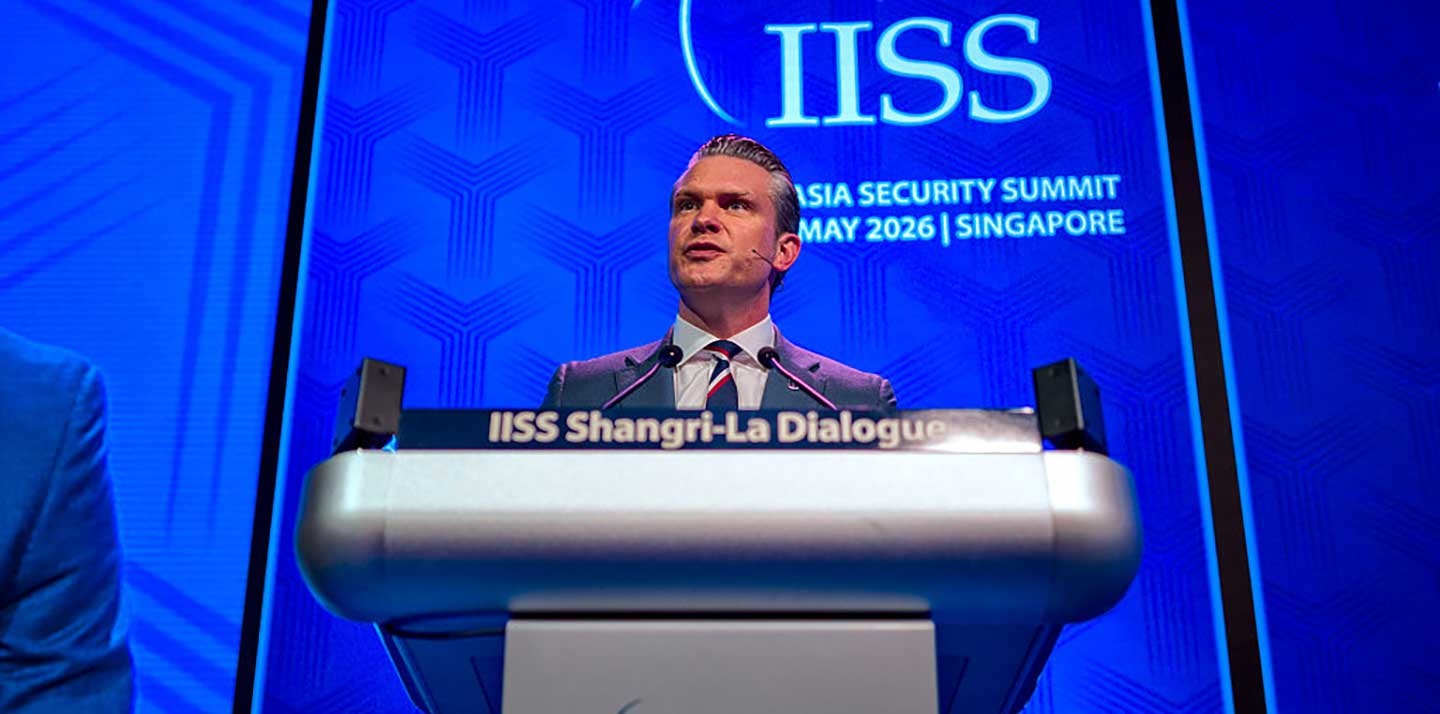
United States Secretary of War Pete Hegseth urged Asian allies on May 30, 2026, to ramp up military spending to counter the Chinese Communist Party’s (CCP) growing influence and prevent its dominance in the region, warning of “rightful alarm” over its rapid military buildup.
Hegseth, speaking at the Shangri-La Dialogue in Singapore, the Indo-Pacific’s premier forum for defense leaders, military officials and diplomats, said a stronger, more self-reliant network of allies is essential to deter aggression and preserve the balance of power. “There is rightful alarm regarding (the CCP)’s historic military buildup and the expansion of its military activities in the region and beyond,” he said.
“A Pacific dominated by any hegemon would unravel the regional balance of power,” Hegseth said. “No state, including China, can impose its hegemony and hold the security or prosperity of our nation and our allies in question.”
The U.S. expects its Indo-Pacific allies and partners to increase defense spending to 3.5% of GDP as it pledged a $1.5 trillion investment in its military, the Department of War chief said. “Less Shangri-La, more ships, more subs,” Hegseth said, stressing that the region needed greater defense capability than conferences. Allies want stability, not escalation, he said.
“What they want, and what the United States delivers, is strength that is disciplined, resolve that is steady, and leadership that is confident enough to speak and walk softly while carrying a big stick.”
Hegseth also struck a measured tone on U.S.-CCP ties, saying relations are “better than they have been in many years,” with more frequent military-to-military engagement helping to manage tensions. “We are meeting more frequently with our Chinese counterparts by maintaining open lines of military-to-military communication.”
Zhou Bo, a senior fellow at Tsinghua University and retired People’s Liberation Army senior colonel who was part of the CCP delegation, described U.S.-CCP relations as “complicated.”
“Both sides have open channels of communication. The situation is not as exaggerated as the outside world makes it out to be,” Zhou said.