

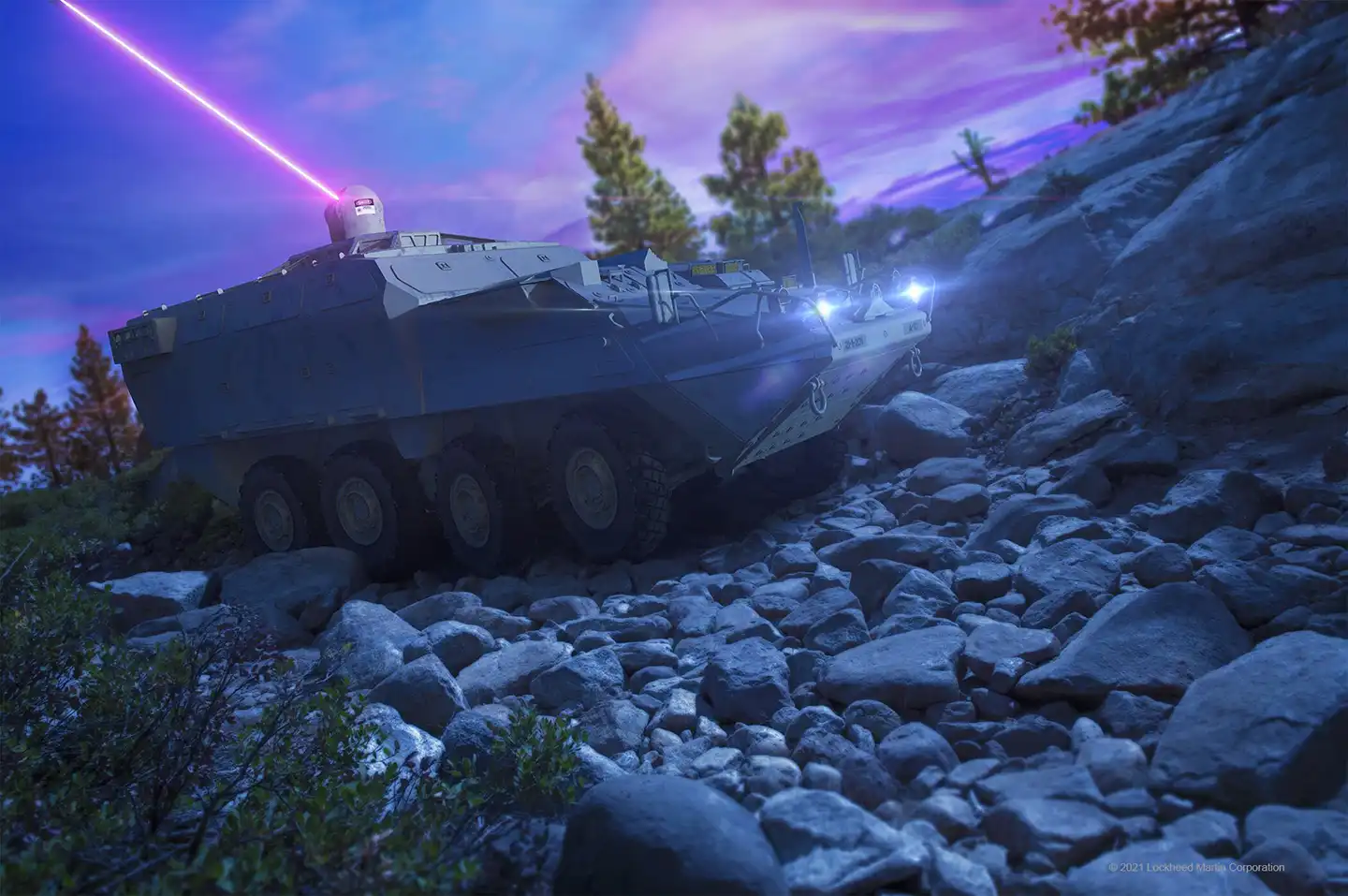
The United States Department of War should possess high-energy lasers that can melt active aerial threats by 2030, a top Lockheed Martin official told the Breaking Defense website in July. “They’re here, they’re effective, and they are working,” Stephanie Hill, president of Lockheed’s rotary and mission systems division, said at the Farnborough Airshow in England.
Lockheed has effectively executed “a number” of laser intercepts, she noted. Those directed-energy weapons will be ready to be deployed “before the end of the decade,” Hill predicted.
Laser systems often are seen as surefire air defense solutions that are always just out of reach. “The air defense community has pursued this chimera for decades,” retired Adm. James Stavridis said in a 2025 Bloomberg Opinion article about President Donald Trump’s Golden Dome missile defense shield. “Lasers feel like they are the air defense weapon of the future … forever.”
But the commitment of time and money is worth it, the former Supreme Allied Commander of NATO said. “The promise of lasers is simple: High-powered beams of light are the means of destroying the enemy’s systems. You never run out of missiles and your system moves at the speed of light, far faster than a conventional defensive missile.”
Hill concurred. “If you have power … you have basically an infinite magazine,” she told Breaking Defense. “So highly effective, highly cost-effective as well.”
Hill’s prediction of battlefield lasers by 2030 came just two weeks after Lockheed and a Colorado company won two major War Department contracts to get laser systems into the hands of Soldiers. The Joint Laser Weapon System (JLWS) agreements with Lockheed Martin’s Aculight business unit and nLIGHT Defense — which focuses on transforming laser technology into ruggedized, combat-ready defense platforms — will start at $86 million but could be increased to as much as $847 million.
The JLWS contracts will “transition directed energy capabilities from demonstration prototypes into field-ready, production-oriented platforms,” a War Department news release said. “By developing containerized high-energy laser weapons, the Department aims to provide combatant commanders with scalable, cost-effective intercept solutions for asymmetric and high-tier adversary threats.
“These prototype systems offer critical operational advantages over traditional kinetic systems, including speed-of-light engagement, exceptionally deep magazines and significantly lower cost-per-intercept, attributes essential for countering high-volume UAS [unmanned aerial system] swarms and advanced cruise missile threats.”
The companies will develop a prototype system that harnesses 150 kilowatts (kW) of power for “urgent operational demands,” the news release said. Later, that will be scaled up to 500 kW “for robust cruise missile defense.” The contract did not specify a timeline.
Paul Lemmo, vice president and general manager of Lockheed’s sensors, effectors and mission systems unit, said in a company news release announcing the 500 kW system award: “We are honored to field this operational‑tactical prototype — the highest‑power laser ever packaged in a transportable container. By applying our expertise in lowering size, weight, and power along with rugged‑system design, we can rapidly build containerized laser weapons in the near term.”
Lockheed’s lasers use spectral beam combining technology, merging multiple laser beams at different wavelengths into a single, high-intensity beam. Paired with advanced adaptive optics to cut through atmospheric distortion, these systems can precisely disable drones, small boats, rockets and cruise missiles.
In testimony before the United States Senate Armed Services Committee in March, Gen. Gregory M. Guillot, commander of the U.S. Northern Command (USNORTHCOM) and the North American Aerospace Defense Command (NORAD), spoke about the Golden Dome and USNORTHCOM’s mission to protect U.S. borders. “As the supported combatant command for Golden Dome for America (GDA), USNORTHCOM drives the development of operational requirements for the layered system of systems that is integrating land-, space-, and sea-based sensors and interceptors to counter ballistic missiles, hypersonic weapons, aircraft, UAS, and advanced cruise missiles,” he said. “NORAD has stood as the world’s only bi-national command for more than 68 years as American and Canadian personnel serve side by side in the defense of North America.”