

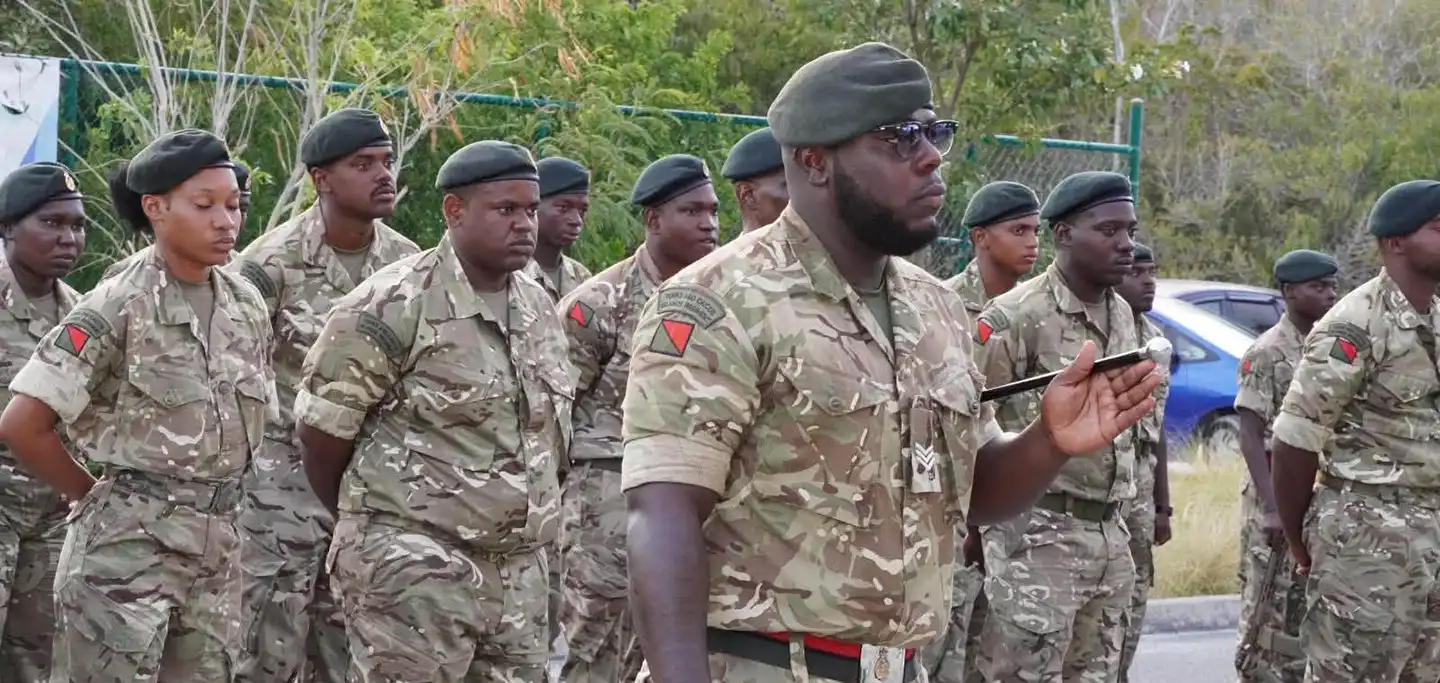
The leaders of the Turks and Caicos Islands (TCI) welcomed 16 Marine recruits into the British Overseas Territory’s (BOT) military force in August 2026 after a two-week intensive training course. Gov. Dileeni Daniel-Selvaratnam and Premier Charles Washington Misick attended the Fourth Passing Out Parade of the TCI Regiment, which was founded as a territorial defense, humanitarian assistance and disaster relief force in 2020.
Daniel-Selvaratnam and Washington Misick praised the recruits for their commitment and willingness to serve. The leaders also thanked the military leaders and members for their support as the TCI Regiment expands its capability and capacity, according to Magnetic Media, a Caribbean news site.
“Whether responding to disasters, providing humanitarian support, safeguarding our borders, conducting maritime operations or supporting law enforcement, the TCI Regiment plays a vital and growing role in strengthening the resilience and security of these Islands,” Daniel-Selvaratnam said, reported The Sun, a TCI newspaper.
The August 3 ceremony honored the achievements of recruits, which included training in humanitarian and disaster relief support skills, battlefield casualty drills, security and basic policing skills. They will join a regiment that has expanded its force projection in recent months. After Hurricane Melissa, a Category 5 storm in October 2025 that was the strongest ever to hit the island, the TCI Regiment, along with other BOT militaries, responded by sending troops to help rebuild devastated communities. This effort was the first time the regiment had deployed outside of TCI.
In six years, the regiment has grown from its original authorization of 46. In 2023, Lt. Col. Ennis Grant, the regiment’s commanding officer, said the 69 active troops at the time were slated to be expanded to 150 by 2028, according to the website NewslineTCI. Most of the troops are reservists.
The TCI government announced in March 2026 plans to expand the regiment, citing increasing illegal migration and narcotics smuggling as challenges to the territory’s security. Misick said at the time that an increase in tourism, population growth and regional challenges required a greater investment in marine surveillance, intelligence gathering and border security. Misick also pledged deeper cooperation with regional and international partners.
The United Kingdom spent about $9.9 million in 2025 and 2026 on military upgrades, including border security, maritime security and coastal sensors, according to Global Military, an online military affairs news site.
Daniel-Selvaratnam said those investments are paying off. “For a nation of islands, this responsibility carries particular weight. Our waters are not just geographic boundaries, they are central to our identity, our livelihoods, our economy and our security. Protecting them requires vigilance, skill and resolve. The continued development of maritime capability and the investment in the people who deliver it, reflects a serious and necessary commitment to safeguard our borders, to protect our communities and to respond with clarity and strength to threats that are increasingly regional in nature,” she said, according to The Sun.