

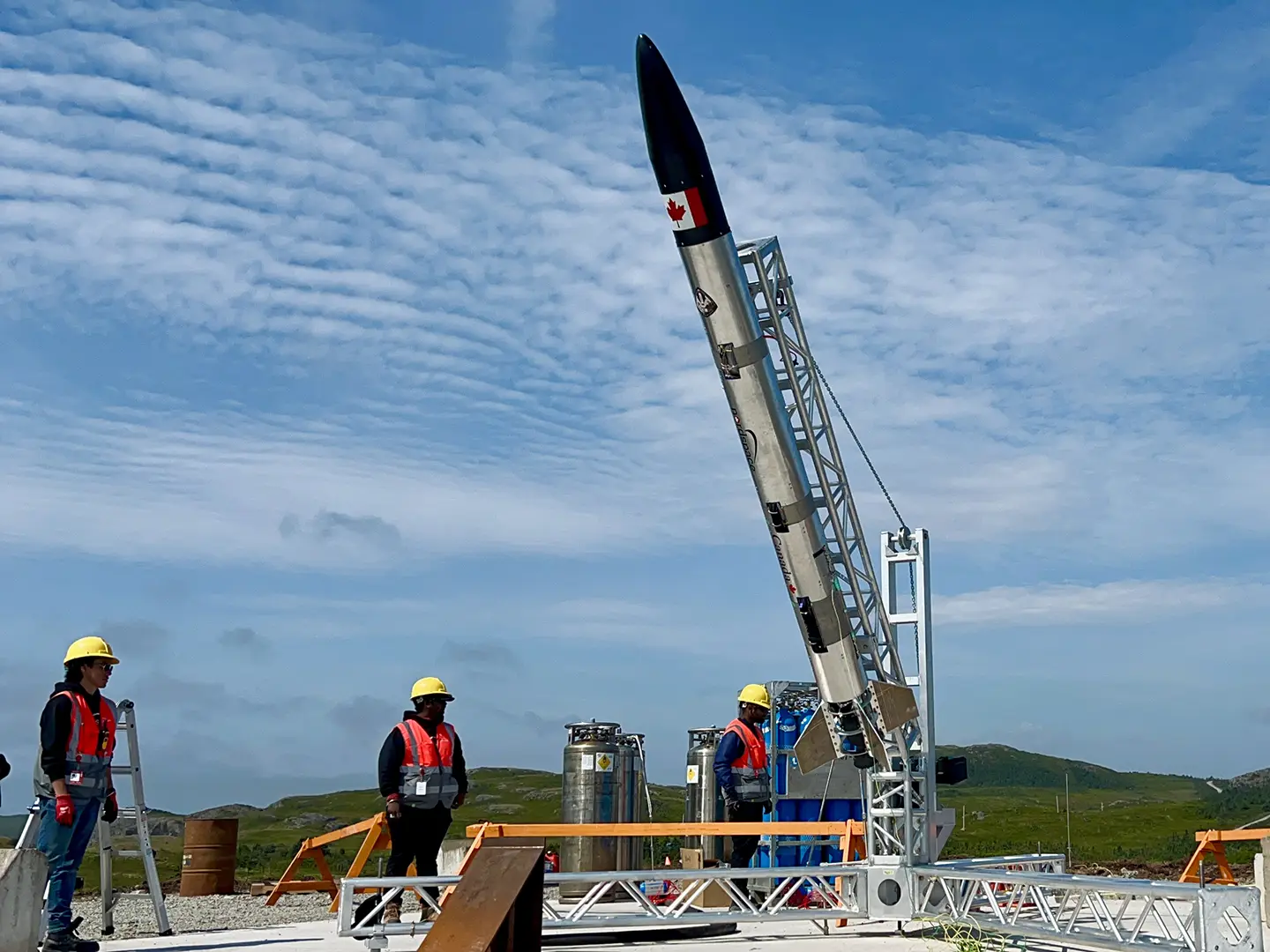
Canadian Defence Minister David McGuinty announced a range of initiatives in October to build out the nation’s space launch program, including a 10-year, $14.3 million deal to secure access at a NordSpace complex in Newfoundland and Labrador; a $12.8 million investment to improve satellite connectivity in the Arctic and other remote regions; and full membership in the NATO STARLIFT space launch capabilities project. The commitments bring the total value of Canada’s space-related contracts, grants and contributions announced this year to more than $2.1 billion.
Access to space is increasingly viewed as a critical capability for national defense and economic opportunity. “A sovereign spacefaring Canada needs the ability to launch a payload into orbit on its own schedule, from its own soil, on its own rocket when national security demands it,” NordSpace CEO and founder Rahul Goel said in a company news release. “That capability is only possible if a Canadian company owns the full stack from launch vehicle to launch pad, and that vertical integration is exactly what we are building at NordSpace.”
The agreement with NordSpace will provide the Canadian Armed Forces (CAF) and its partners access to launch rockets at the company’s Atlantic Spaceport Complex, which is being built on the Burin Peninsula in Newfoundland and Labrador, and to conduct research and development there. The deal provides launch capacity in addition to what was secured in Nova Scotia in a 10-year, $143 million lease agreement with Maritime Launch Services announced in March.
The CAF’s Innovation for Defence Excellence and Security program, meanwhile, is investing $12.8 million in projects to improve satellite connectivity through its Gateway to the Stars challenge. As part of Gateway to the Stars and in support of future CAF operations, McGuinty said, Canada is awarding a $3.4 million contract to Kepler Communications to develop optical intersatellite communication networks to enhance the speed and dependability of space-based communications, especially in Canada’s Arctic and other remote regions. The two-year contract aims to develop and test laser-based links that allow satellites to exchange data directly.
The investment also will support objectives under the Northern Wide-Area Tracking and Continuous Horizon (NORTHWATCH) program by strengthening Canada’s surveillance and threat detection capabilities in the Arctic. NORTHWATCH, which replaced the older Polar Over-the-Horizon Radar program, uses a hybrid network of ground- and space-based sensors to monitor Canada’s Arctic and polar regions. The system works with the CAF’s Arctic Over-the-Horizon Radar program, which focuses on the northern and eastern approaches to the continent.
“By investing in Canadian innovation, strengthening our sovereign access to space, and advancing communications capabilities in the Arctic, we are building the expertise and capacity Canada needs to compete and lead in the global space economy,” Minister of Industry Mélanie Joly said in a CAF news release. “These investments will create good jobs, grow Canadian businesses, and build a stronger, more secure Canada.”
McGuinty also announced that Canada has become a full member of the NATO STARLIFT initiative, which aims to develop a more resilient, responsive and cost-effective network of space launch capabilities. STARLIFT helps NATO allies launch space assets, payloads and replacement satellites quickly from spaceports across the alliance.
To meet the growing needs of Canadian space operations, the CAF is establishing a dedicated space mission operator role that will allow the Royal Canadian Air Force to attract, train and retain highly skilled personnel. The Department of National Defence announced in August that it is investing more than $850,000 over two years to attract the next generation of Canadian space professionals, including engineers, scientists, technicians, software developers and advanced manufacturing specialists.
“Behind many of Canada’s achievements in space are the companies, researchers and innovators driving our space sector forward,” McGuinty said in the CAF release. “Canada has the talent, technology and ambition to remain a leader in space. As we strengthen our defence capabilities, we’ll create new opportunities for Canadian industry and help shape the future of Canada’s space sector.”