

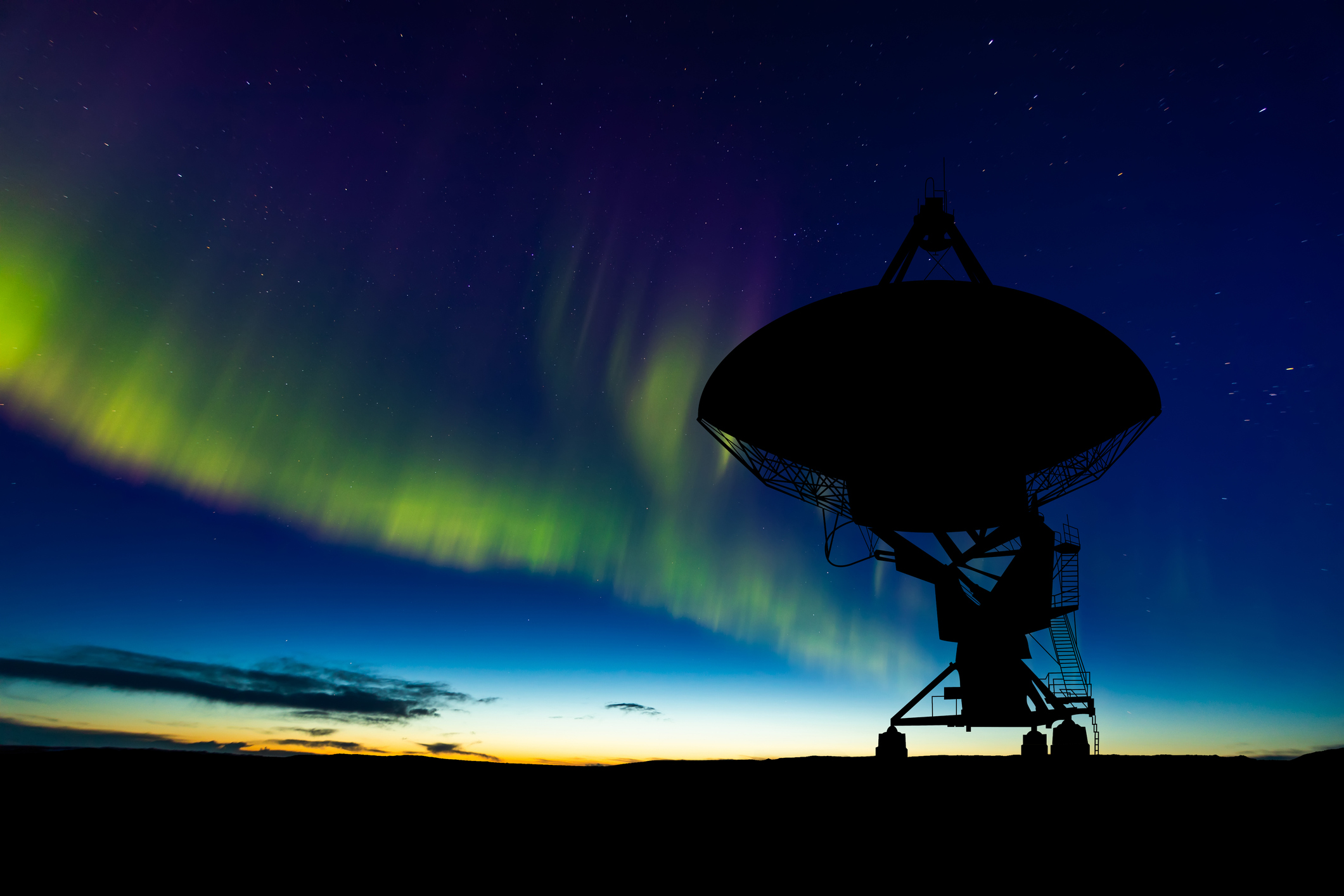
USNORTHCOM and NORAD Commander Gregory Guillot cautioned against the sale of the “Goldilocks” portion of the electromagnetic spectrum, saying it could imperil North American missile defense. AFP/GETTY IMAGES
THE WATCH STAFF
The commander of the United States Northern Command (USNORTHCOM) and the North American Aerospace Defense Command (NORAD) urged federal lawmakers in April 2025 to resist pressure to auction off a crucial segment of the electromagnetic spectrum. Gen. Gregory Guillot told the House Armed Services Committee that opening the sweet spot of radio frequencies known as the “Goldilocks” part of the spectrum to commercial users would endanger North American missile defense, especially the space-based Golden Dome for America project.
Guillot told committee members that he has “a strong concern” about auctioning the 3.1-3.45 GHz band that is part of the Goldilocks spectrum. “Almost all the systems that we use for homeland defense rely on that part of the spectrum that’s being considered to be either sold or shared,” Guillot said at the April 1 hearing, according to Breaking Defense, a military affairs news site.
The Federal Communications Commission (FCC), one of the institutions responsible for auctioning the spectrum, hasn’t set a date for the sale. The military says sharing the Goldilocks frequencies could harm sensitive communications, especially early warning and other aspects of missile defense. Commercial users say the frequencies can support dual uses and have lobbied for the auction.
House Armed Services Committee Chairman Mike Rogers of Alabama asked Guillot about the spectrum auction in the hearing. “There is an effort afoot to auction off parts of the spectrum of DOD, and DOD needs to track incoming missiles. This spectrum supports most of our military radar systems, including our early warning and homeland missile defense. Losing it would put President Trump’s Golden Dome initiative at serious risk and undermine our security,” Rogers said at the hearing.
Spectrum space cannot be used by two parties at the same time, and crowding reduces the spectrum’s effectiveness. “It is a zero sum game. There is finite spectrum, and the physics of the spectrum, about the desirability of the lower [3 GHz band] both for our target acquisition radars and for 5G, this makes it very difficult,” John Sherman, former DOD chief information officer and now dean of the Bush School of Government and Public Service at Texas A&M University, told Breaking Defense in January 2025.
A 2024 Defense Department report concluded that sharing the Goldilocks portion of the spectrum is problematic from a logistical standpoint. In that report, according to Breaking Defense, the Pentagon said the Army and Marine Corps used the spectrum for land-based radars to detect threats fired at Soldiers on the move, the Air Force relied on it for air traffic control following hurricane devastation, and it noted the Navy counts on maritime radars for time-critical strike coordination. “Spectrum sharing in the band is not feasible” unless certain conditions were met and the department followed rigorous testing with the Joint Force, the report stated. “DOD is concerned about the high possibility that non-Federal users will not adhere to established coordination conditions at all times.”