

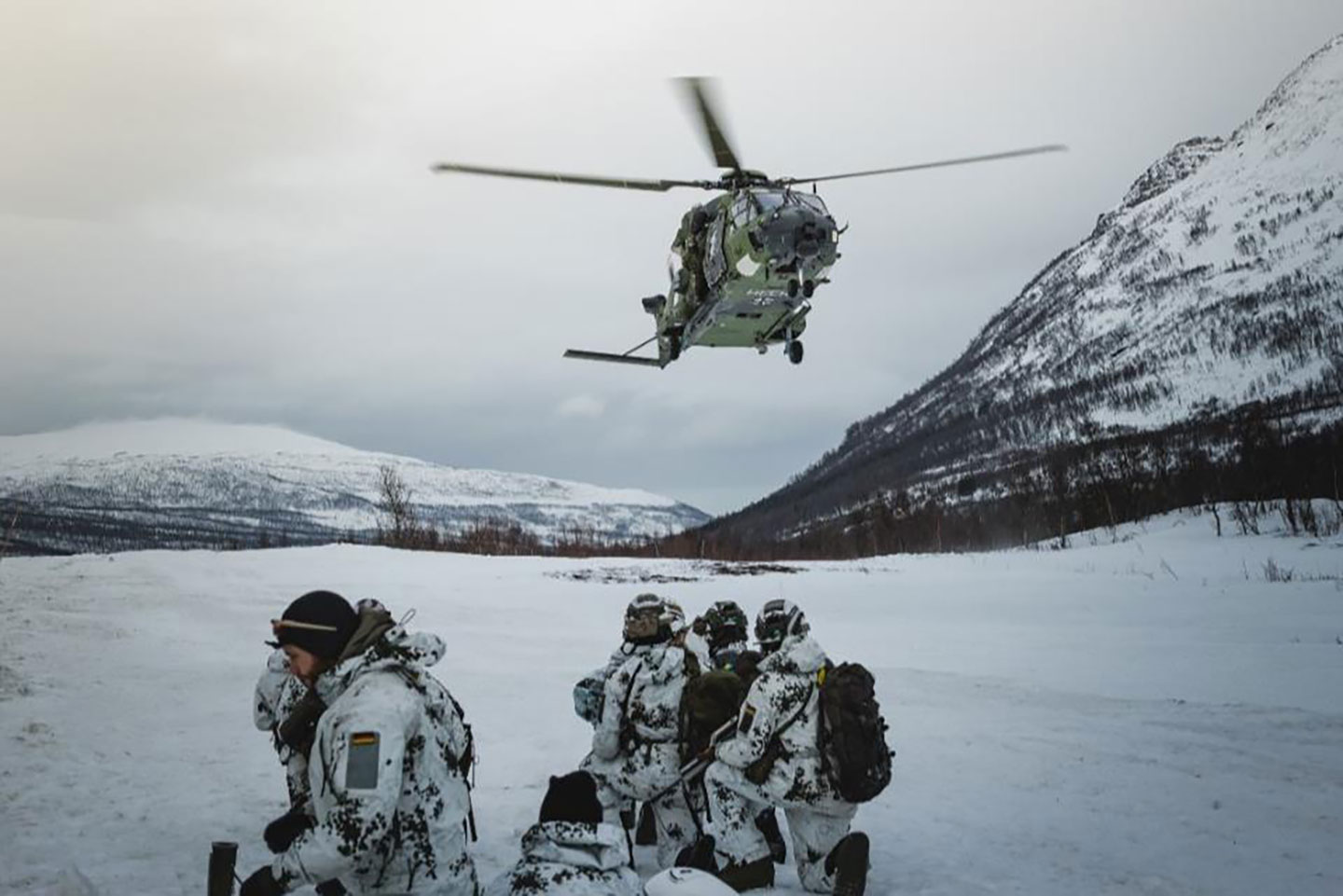
Cold Response, a Norwegian-led NATO military exercise, took place in Norway and Finland in March 2026, bringing together 25,000 troops from more than a dozen nations. The cold-weather exercise gave participating forces the opportunity to operate in challenging conditions and demonstrate interoperability, logistical readiness and rapid deployment in the face of threats to NATO’s northern flank.
For the first time, NATO’s Joint Force Command-Norfolk in Virginia commanded the exercise in which NATO allies collaborated on joint flight operations, mass casualty drills, live-fire events, situational lanes, multilateral land training and amphibious missions. Cold Response, which occurred between March 9 and March 21, is part of the framework of Arctic Sentry — NATO’s recently announced multidomain military activity.
About 7,500 troops operated in Finland primarily transporting equipment and personnel between the cities of Rovaniemi and Sodankylä as well as between Kajaani and Sodankylä, according to Yle, Finland’s national broadcasting service. In other actions, commandos from the British Royal Marines executed reconnaissance and strike-support mission in a Norwegian fjord after disembarking in inflatable raiding craft from a German U-35 attack submarine roughly 322 kilometers inside the Arctic Circle, reported Defence Industry Europe, a Polish defense industry publication. Norwegian F-35A warplanes conducted quick-response flights to monitor Russian surveillance aircraft, coordinating with naval forces in the Norwegian Sea. Other participating nations included Canada, Denmark, France, Italy, Netherlands, Spain and Sweden.
United States Marines from the II Marine Expeditionary Force based in Camp Lejeune in North Carolina deployed to test rapid response reinforcements. The Marines combat power was tested along with the logistical challenges of moving personnel and equipment through the Arctic with the help of Norwegian forces.
In preparation for the exercise, the Marine Corps’ 2nd Marine Logistics Group and the Norwegian Joint Logistics Support Group (JLSG) established the Combined Joint Logistics Support Group (CJLSG) in January, the first fully integrated joint logistics headquarters between the nations. Once the exercise began, the CJLSG conducted complex logistical maneuvers, bolstering power projection for the multinational force, according to a Marine Corps news release. “This ability to rapidly project combat power and prepare the Arctic theater for follow-on forces is a fundamental prerequisite for conducting a training evolution of this scale in an austere environment and sends a clear message of shared resolve and readiness,” the release stated.
Russia announced live-fire missile testing in early March in the Barents Sea, which straddles its border with Norway. The operations underscored the potential threats faced by NATO in the region, reported The Barents Observer, a Norwegian newspaper. The Russian missile tests reinforced the reason for deploying thousands of troops from Norway into Sweden and Finland. “Exercises like Cold Response 26 are crucial for ensuring Norway’s readiness and resilience, as well as demonstrating burden sharing across the Alliance. This exercise isn’t just about preparing for today’s threats; it’s about building the capabilities and strengthening the capacity necessary to deter future aggression and safeguard our shared interests,” said Maj. Gen. Daniel L. Shipley, commander, U.S. Marine Corps Forces Europe and Africa, in a Marine Corps news release.