

Norway has unveiled a plan to spend an additional $11.8 billion on its military over the next decade “to ensure the effective development of our defense capabilities in these more dangerous times,” Prime Minister Jonas Gahr Støre said on March 27, 2026. The increase puts the country on track to meet NATO’s military spending target of 3.5% of gross domestic product by 2035.
Just two years after the Norwegian Parliament approved a record defense plan of about $170.5 billion over the next 12 years, an updated and expanded version has now been presented, totaling $182.3 billion. “Since we first presented the plan in 2024, the world has become more unpredictable, and the security situation has grown more serious,” Støre said.
Defense Minister Tore O. Sandvik said the extra money will “build up important capacities faster” as Norway arms itself “to deter, to be prepared and to avoid war.” He said the Navy would receive the largest share of the investment. “We are strengthening Norway’s defense capabilities, accelerating the largest investments in submarines and frigates, and speeding up the establishment of the Finnmark Brigade,” he said.
The new plan fast-tracks delivery of new submarines and the purchase of frigates. Norway has committed to buying six submarines from Germany’s ThyssenKrupp Marine Systems, at least five frigates from Britain’s BAE Systems, and long-range rockets and artillery systems from South Korea’s Hanwha Aerospace. The first submarine is scheduled for delivery in 2029, and the first two frigates are expected in 2030 and 2032, Støre said.
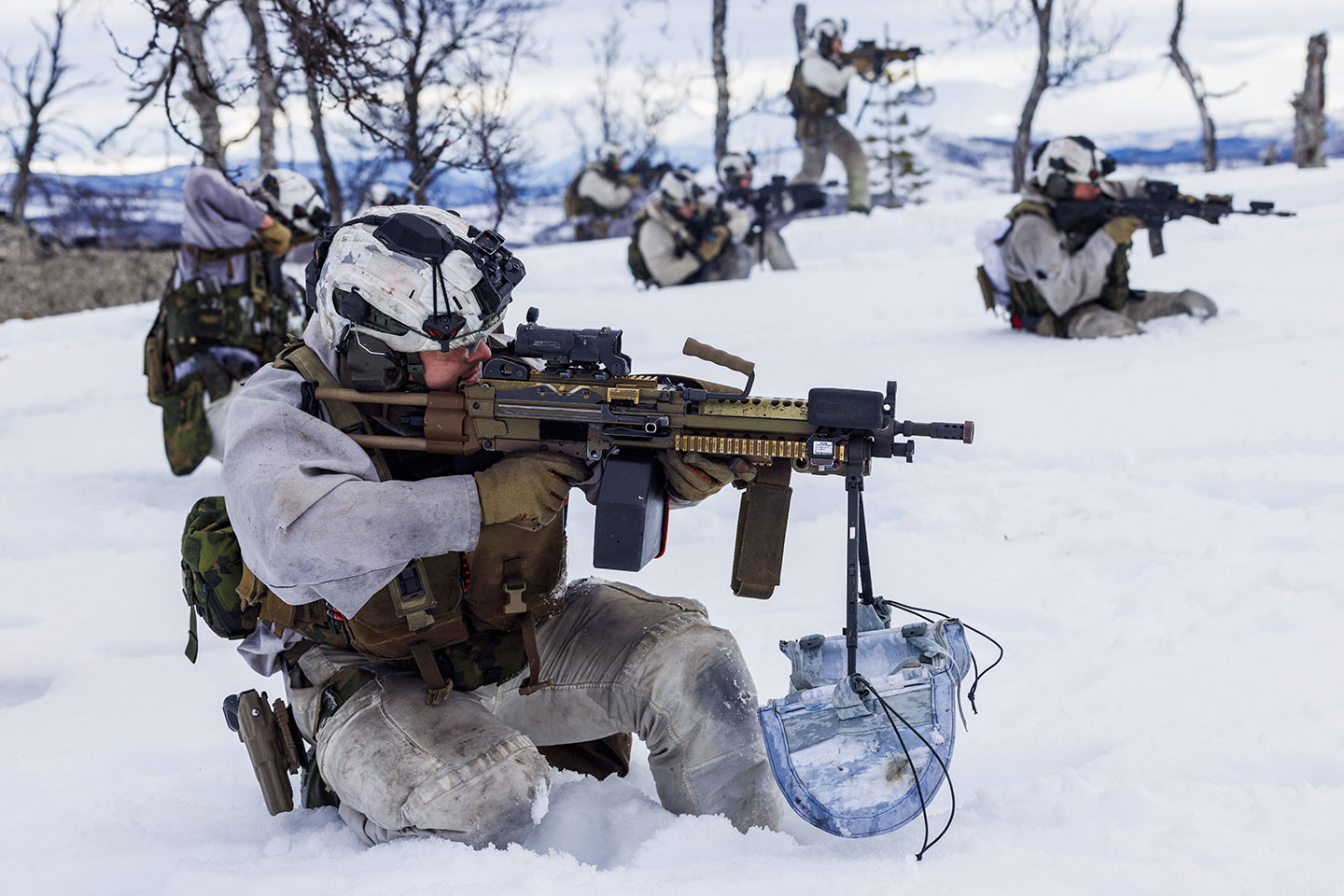
Norway is increasingly concerned about Arctic security and its border areas with Russia. The government is speeding up introduction of the Finnmark Brigade, which will be fully operational by 2033, two years earlier than initially planned. The brigade is primarily intended to boost NATO’s presence in the Arctic and will be based on the border with Russia’s heavily militarized Kola Peninsula.
The existing Finnmark Land Defense will be strengthened with anti-aircraft weapons, an artillery battalion, a light infantry battalion, an engineer company, an intelligence company and stronger command structures, The Barents Observer online newspaper reported. The brigade will add a rapid reaction force that can be combat ready on short notice. The aim is to inflict the greatest losses to Russian invaders as quickly as possible if they cross the border into Norway.
Norway’s Defence Ministry is warning that the security situation in the region will continue to deteriorate. “While the war in Ukraine remains the immediate focus, Russia is preparing for a potential future conflict with NATO,” the updated defense plan says. “This includes a major military buildup along the entire NATO border, including a doubling of ground forces in the northwest.”
Other top priorities under the updated plan are electronic warfare, anti-drone defenses, short-range air defense and space-based communications, The Barents Observer reported. The plan outlines a layered air defense system with anti-drone and short-range air defense capabilities. Among systems that are being delayed under the new plan are long-range maritime surveillance drones and long-range antiballistic air defenses, the Reuters news service reported.
“We are prioritizing readiness and endurance in the Armed Forces by replenishing stocks while Russia remains at war in Ukraine,” Sandvik said. “At the same time, we are maintaining high operational activity and ensuring control in Norway’s border areas.”
The Arctic is an increasingly contested region as melting sea ice unlocks new, faster shipping routes, critical minerals and other natural resources. In testimony before the U.S. Senate Armed Services Committee on March 19, 2026, Gen. Gregory M. Guillot, commander of U.S. Northern Command and the North American Aerospace Defense Command, said: “The ability of the Joint Force to conduct all-domain operations in the Arctic approaches to North America remains a strategic necessity as military and economic competition in the region steadily expands.”