

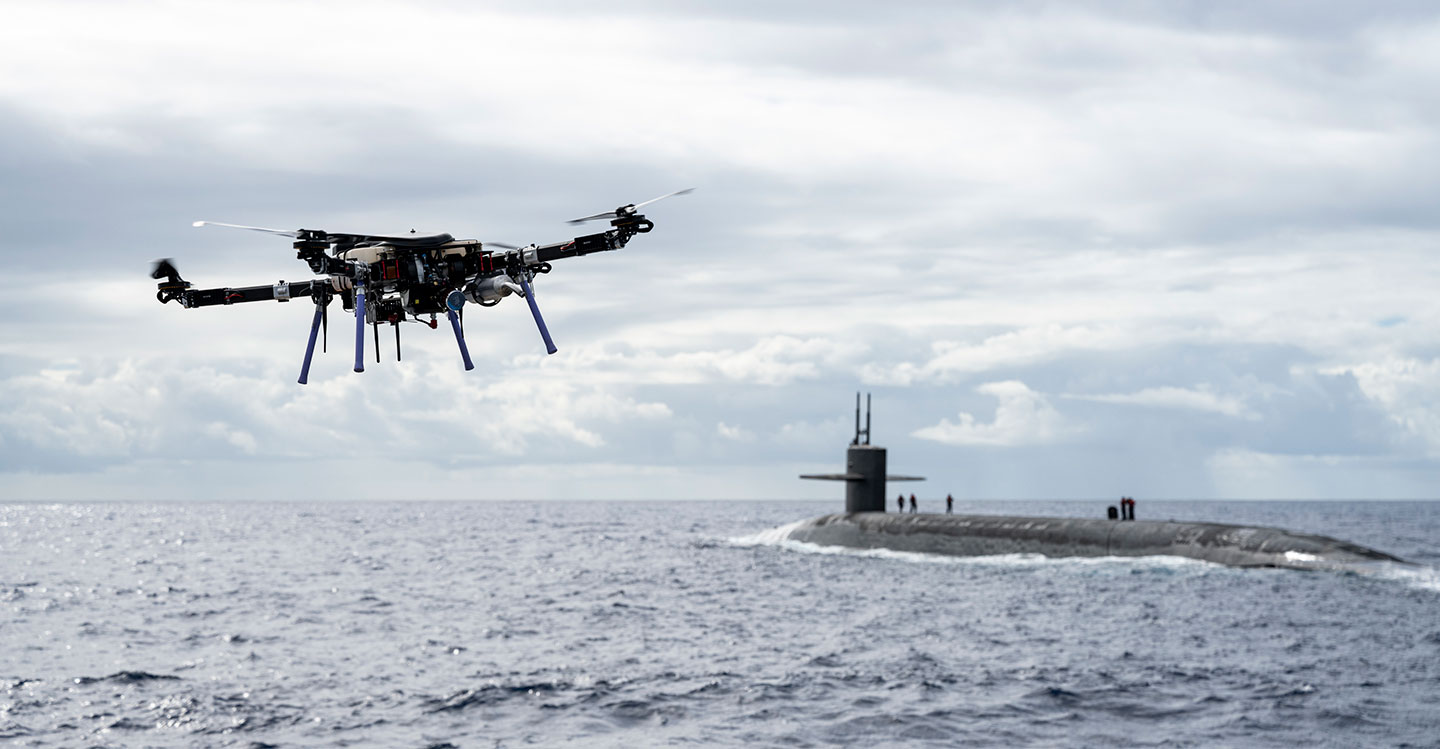
Polar-hardened drones that can operate in all domains are indispensable for NATO’s future Arctic deterrence, according to a report from the Center for European Policy Analysis (CEPA).
A fleet of airborne and maritime uncrewed autonomous systems (UAS) designed to operate in the region’s extreme environment would allow the alliance to more closely watch Russian military operations in the region, the report said. In addition to small drones, uncrewed aircraft such as the United States Air Force’s remotely piloted MQ-9 Reaper, which has proven itself in an intelligence-collection role, could be adapted to fill any surveillance gaps over the vast Arctic, according to the CEPA report. The U.S. Air Force also is developing AI-enabled uncrewed aircraft — sometimes called loyal wingman drones — that it envisions performing missions alongside, and under the command of, pilots flying U.S. warplanes that someday could include early warning surveillance aircraft. Adapting these future drones for Arctic operations is worthy of study, the CEPA report said.
In the Arctic, melting sea ice is allowing access to new shipping routes and natural resources, which is escalating commercial and military activity. Russia and the Chinese Communist Party (CCP) are investing in their uncrewed capabilities as they boost their presence in the High North.
“In short, the Arctic and Northern Europe, by extension, has become a front line for strategic competition,” United States Air Force Gen. Alexus Grynkewich, who serves as NATO’s Supreme Allied Commander Europe, told a Swedish national security conference in January 2026, according to Defense News.
NATO is facing increasing threats that include hybrid warfare, airspace violations, satellite interference and risks to underwater infrastructure, said Gen. Grynkewich, who also leads U.S. European Command.
The North American Aerospace Defense Command (NORAD) has seen a change in the Arctic activity of Russia and, to a lesser extent, the CCP, in the past year, according to Gen. Gregory M. Guillot, who heads U.S. Northern Command (USNORTHCOM) and NORAD.
The air and sea incursions into zones just outside North America have become more frequent and more coordinated, Gen. Guillot told the CBC in January 2026. “I’d say the most consequential difference in 2025 has been the volume, the simultaneous volume [of incursions],” Gen. Guillot said.
As those incursions mount, NATO must develop UAS designed specifically to operate in the Arctic’s extreme conditions, which the CEPA report said would allow the alliance to pursue a “deterrence by detection” strategy.
“This means being able to track Russian submarine patrols leaving the Kola Peninsula, monitor aircraft flights across the Barents and Bering Seas, identify changes in Russia’s Arctic force posture and infrastructure, and detect potential surface and subsurface threats to critical infrastructure,” the report said.
A Reuters survey of 14 companies and six defense ministries and armed forces in Northern Europe and the U.S. showed the industry working rapidly to buy or develop drones that can endure icy conditions, and a priority among NATO states to acquire them.
The U.S. Army conducted a large-scale UAS and counter-UAS experiment in Alaska with manufacturers in November 2025 to measure how the systems function in extreme cold.
“On the defensive side, I’ve been very pleased with the performance of the systems that we’ve brought up there from a counter-UAS perspective. I’ve been very pleased with how they operate up in the harsh conditions,” Guillot said.
While the CEPA report notes that drones are not a full-fledged replacement for traditional capabilities, it says they are indispensable as force multipliers in the High North. The report’s advice to NATO, according to the CBC and the Stars and Stripes newspaper, includes:
- Alliance nations should accelerate their acquisition of uncrewed systems designed to meet the demands of Arctic operations with components such as improved
cold-rated batteries and thermal-management systems. - The pre-positioning at bases throughout the High North of spare parts that are essential to sustain the high sortie rates of UAS in extreme weather.
- Consider the establishment of new drone units with specialized training that could free up manned aircraft and ships for other duties.
“The next decade is a decisive window of [Arctic] opportunity,” the CEPA report said, emphasizing that those nations fastest to adapt to the High North’s challenges will develop a “security architecture capable of deterring and defeating emerging threats.”
Sentry is a publication of the U.S. Strategic Command