

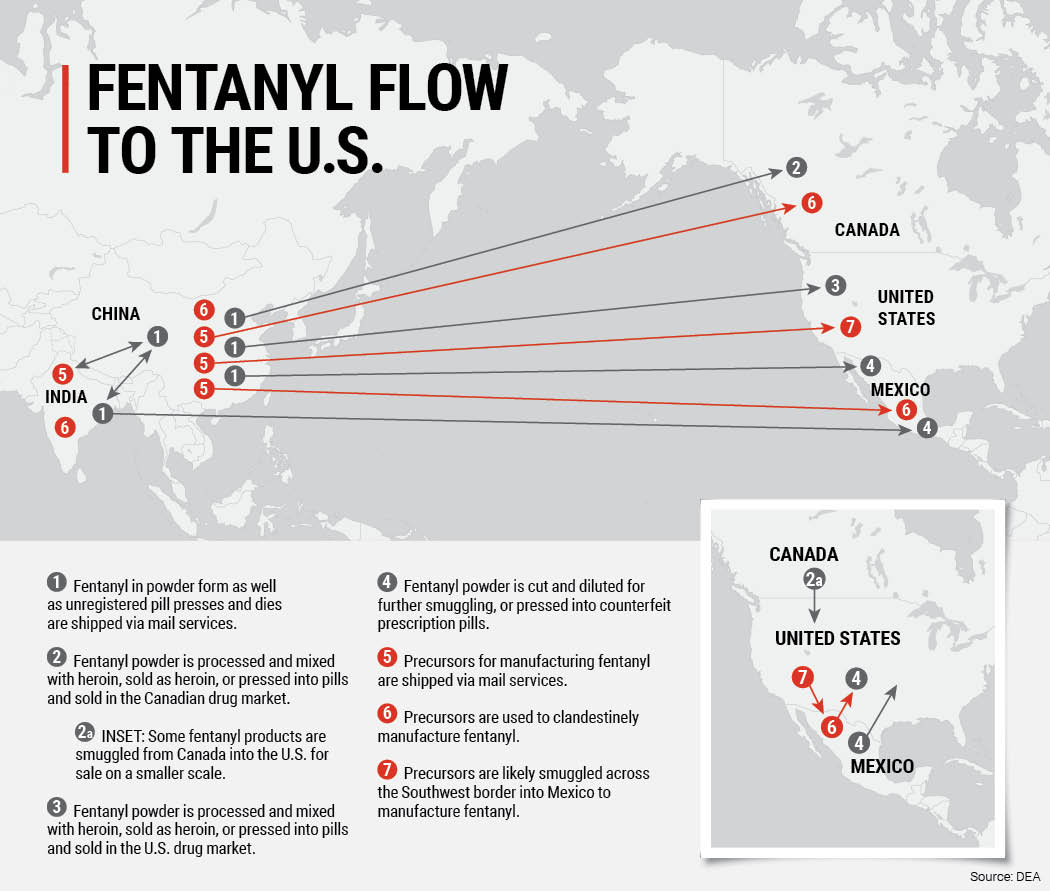
Chemical manufacturers in China continue to fuel clandestine labs by churning out fentanyl precursors and contributing to a crisis that kills thousands in the United States every year. In many cases, according to the U.S. Drug Enforcement Administration’s (DEA) 2025 National Drug Threat Assessment, they are delivering precursor chemicals to transnational criminal organizations, or TCOs, which convert them into the addictive and deadly opioid.
Although the Chinese Communist Party (CCP) has scheduled fentanyl and many precursors on its controlled substances list, the chemicals used to make the drug continue to flow from China to Mexico because the synthetic opioid is much easier and cheaper to produce than plant-based drugs. “China scheduled fentanyl and fentanyl analogs, and we realized somewhat of a reduction of direct shipments of fentanyl and fentanyl analogs directly from China to the United States,” David Luckey, senior international and defense researcher for the nonprofit think tank Rand Corp., told The Watch. “But the shipment of fentanyl or precursor chemicals continued and perhaps increased from China to Mexico, and Mexican production of illegal fentanyl and fentanyl analogs increased,” he added.
The U.S. in September 2025 sanctioned the Chinese chemical company Guangzhou Tengyue Chemical Co. Ltd. and two of the company’s representatives for manufacturing and coordinating shipments of illicit opioids and chemical agents to the U.S. “Overdoses from synthetic opioids like fentanyl is the leading killer of young Americans from 18-45,” the U.S. State Department said in a news release. “China plays a central role in this crisis, not merely by failing to stem the ultimate source of many illicit drugs distributed in the United States, but by actively sustaining and expanding the business of poisoning our citizens.”
Dr. Vanda Felbab-Brown of the Brookings Institution, a nonprofit organization in Washington, D.C., told the U.S. Senate Committee on Foreign Relations in July 2025 that countering the smuggling of precursors is an important but complex law enforcement and regulatory effort. Although signs of CCP cooperation with the U.S. are emerging, Felbab-Brown said the CCP could do much more to help.
“After years of no cooperation between China and the United States, the two countries built up multifaceted anti-fentanyl cooperation in 2024,” she testified. The CCP has scheduled dozens of precursors and other drugs, cooperated with the U.S. on anti-money laundering efforts, and acted on U.S. intelligence to stem the flows. Felbab-Brown, a senior fellow at Brookings, directs the Initiative on Nonstate Armed Actors and the Brookings series The Fentanyl Epidemic in North America and the Global Reach of Synthetic Opioids.
While the U.S. has welcomed the CCP’s newfound cooperation, the assistance isn’t as full-throated as it could be. “The cooperation was far from perfect and featured significant gaps and limitations, such as the lack of law enforcement actions by China against Chinese smuggling networks knowingly selling nonscheduled chemicals to Mexican criminal groups with the clear knowledge they would use the precursors for illegal purposes,” Felbab-Brown testified. “China has demurred on such cooperation with the explanation that its legal framework lacks material support and racketeering laws or that the Chinese sellers didn’t know — despite evidence to the contrary — that they were selling to criminal networks abroad for the production of illicit drugs.”
Ray of hope
The CCP’s attempts at regulation, coupled with U.S. pressure on China and TCOs, have had some positive results. Although nearly 87,000 U.S. residents died from drug overdoses in the 12 months ending in September 2024, that’s a 24% decline from the previous year, when the death toll was 114,000, according to the Centers for Disease Control and Prevention.
In China’s latest enforcement effort, the CCP strengthened controls on two chemicals used to make fentanyl. It recently added 4-piperidone and 1-Boc-4-piperidone to a list of precursors to be more strictly controlled, according to a June 2025 report by The New York Times newspaper. The move “demonstrates China’s sincerity in wanting to work with the United States on this issue,” said Yun Sun, director of the China program at the Stimson Center, a Washington, D.C., research institute, the Times reported.
The new restrictions were announced shortly after Wang Xiaohong, the CCP’s minister of public security, met with David Perdue, the U.S. ambassador to China, in Beijing. The CCP also agreed to address the fentanyl supply chain in an agreement reached with the U.S. in late 2025. The CCP said it would stop the shipment of certain designated chemicals to North America and strictly control exports of certain other chemicals to all destinations in the world.
Punishing the producers
The U.S. also is ramping up enforcement on TCOs. The U.S. State Department in February 2025 implemented an executive order designating eight TCOs as foreign terrorist organizations, or FTOs, expanding the government’s authority to stem the illicit activities of the cartels. In September and November, the State Department added four more organizations to the FTO list.
And, according to the DEA threat assessment, the cartels are a huge part of the problem. “Transnational criminal organizations (TCOs) — including international drug cartels and other violent criminal groups — threaten the safety of the American people, the national security of the United States, and the safety and stability of the Western Hemisphere,” the DEA stated. “These organizations produce and traffic multi-ton quantities of illicit drugs, routinely engage in acts of violence and extortion, and orchestrate the flow of contraband and people through territories along the U.S.-Mexico border.”
Mexican TCOs are among the world’s leading producers of illicit drugs, such as fentanyl, heroin and methamphetamine, the DEA threat assessment states. The TCOs also control the wholesale trafficking of these drugs and others into the U.S. These organizations form business ties with U.S. drug trafficking operations to distribute and sell drugs.
The foreign terrorist designation now applies to six Mexican cartels and six violent international gangs. Those designated were Barrio 18, Cartel de los Soles, Gulf Cartel, Jalisco New Generation Cartel, Los Choneros, Los Lobos, Mara Salvatrucha (MS-13), New Michoacan Family, Northeast Cartel, Sinaloa Cartel, Tren de Aragua and United Cartels.
Military operations also could be part of the recipe for stemming cartel crime. The U.S. government acknowledged in August 2025 that it was deploying three Aegis guided-missile destroyers to the waters off Venezuela to combat threats from Latin American drug cartels, Reuters and The Associated Press reported. The USS Gravely, the USS Jason Dunham and the USS Sampson all traveled to the region. A U.S. War Department official also confirmed for the AP that military assets had been assigned to the region in support of counternarcotics efforts.
Cooperation between Mexico and the U.S. to fight the cartels has been increasing. In August 2025, Mexico sent 26 cartel figures to face justice in the U.S. after the U.S. government requested them, AP reported.
 India’s emerging role
The fight against illicit fentanyl now includes a new player. The U.S. is enlisting the help of India to reduce the supply of precursors making their way into the U.S. In an August 2025 appearance on “The Joe Rogan Experience” podcast, FBI Director Kash Patel revealed that the U.S. is collaborating with Indian law enforcement to dismantle the trafficking of precursors.
Known as the “pharmacy of the world” for its role in supplying affordable medicines, vaccines and generic drugs globally, India has become a key transit point for Chinese chemical manufacturers sending precursors to Mexican cartels, Patel said.
Patel accused Chinese suppliers of routing precursors through India to evade enforcement in a deliberate campaign by the CCP to target the U.S. population. “You don’t hear fentanyl deaths in India,” he said. “You don’t really hear fentanyl deaths in England, Australia, New Zealand or Five Eyes partners in Canada,” he added.
The FBI has established direct contact with Indian authorities to tackle the issue. “We’re going to find these companies that buy it and we’re going to shut them down,” Patel said. Those efforts build upon a framework of cooperation established by the formation of the U.S.-India Counter Narcotics Working Group, which held its sixth annual meeting in 2025.
The working group’s framework has three pillars:
(1) countering illicit production and trafficking of drugs, as well as their precursor chemicals; (2) advancing a sustainable and holistic public health partnership; and
(3) advancing a secure and growing pharmaceutical supply chain. Both countries also have joined a global effort to stem the scourge of synthetic drugs by joining the Global Coalition to Address Synthetic Drug Threats, which was launched in 2023.
Such cooperation has led to criminal indictments. Indian chemical manufacturers already have been named in U.S. indictments, including Vasudha Pharma Chem Ltd., which has been charged with conspiring to send fentanyl precursors to Mexico and the U.S. The U.S. Justice Department announced in March 2025 that Vasudha and three employees were charged. They were Vasudha’s chief global business officer, Tanweer Ahmed Mohamed Hussain Parkar, 63; marketing director Venkata Naga Madhusudhan Raju Manthena, 48; and marketing representative Krishna Vericharla, 40. Each was charged with multiple counts of manufacturing and distributing a List 1 fentanyl precursor chemical for unlawful importation into the United States. Two other companies, Raxuter Chemicals and Athos Chemicals Private Ltd., face similar charges.
 The other side of the fentanyl challenge
Rand Corp.’s Luckey played a key role in an expansive opioid study by helping lead his organization’s research for the Commission on Combating Synthetic Opioid Trafficking. The 2022 report called for a whole-of-nation approach to shutting off the flow of illicit opioids, expanding access to treatment and reducing fatalities by spreading the use of overdose-reversing drugs such as naloxone. The commission included four members of Congress, officials from seven executive branch departments, four nongovernmental experts and more than 60 Rand researchers and analysts.
While much of the report keys on stemming the supply, it places a large emphasis on reducing the harm of the often-deadly drug through better public health approaches. “Better access to and continued scientific understanding of treatments for OUD [opioid use disorder], including through medication, are primary needs. Innovative prevention messaging must inform entire communities — including those with OUD, those who casually use drugs, and the public at large — of the pervasiveness of synthetic opioids used as a lacing agent and resources available to those struggling with addiction.”
Education about the deceptive marketing tactics used by the cartels is paramount, the commission’s report said. “Global drug traffickers continue to evolve to meet consumer preferences — the advent of synthetic opioids in pill form leverages Americans’ familiarity with taking pills and does away with the social stigma of injection, snorting, and smoking. Of deepest concern is that most consumers are not — at least initially — seeking fentanyl specifically,” the report said. “Rather, it is being laced into heroin or manufactured as counterfeit tablets, including such brand names as OxyContin, Percocet, Vicodin, Adderall, and Xanax, driving overdose deaths.”