

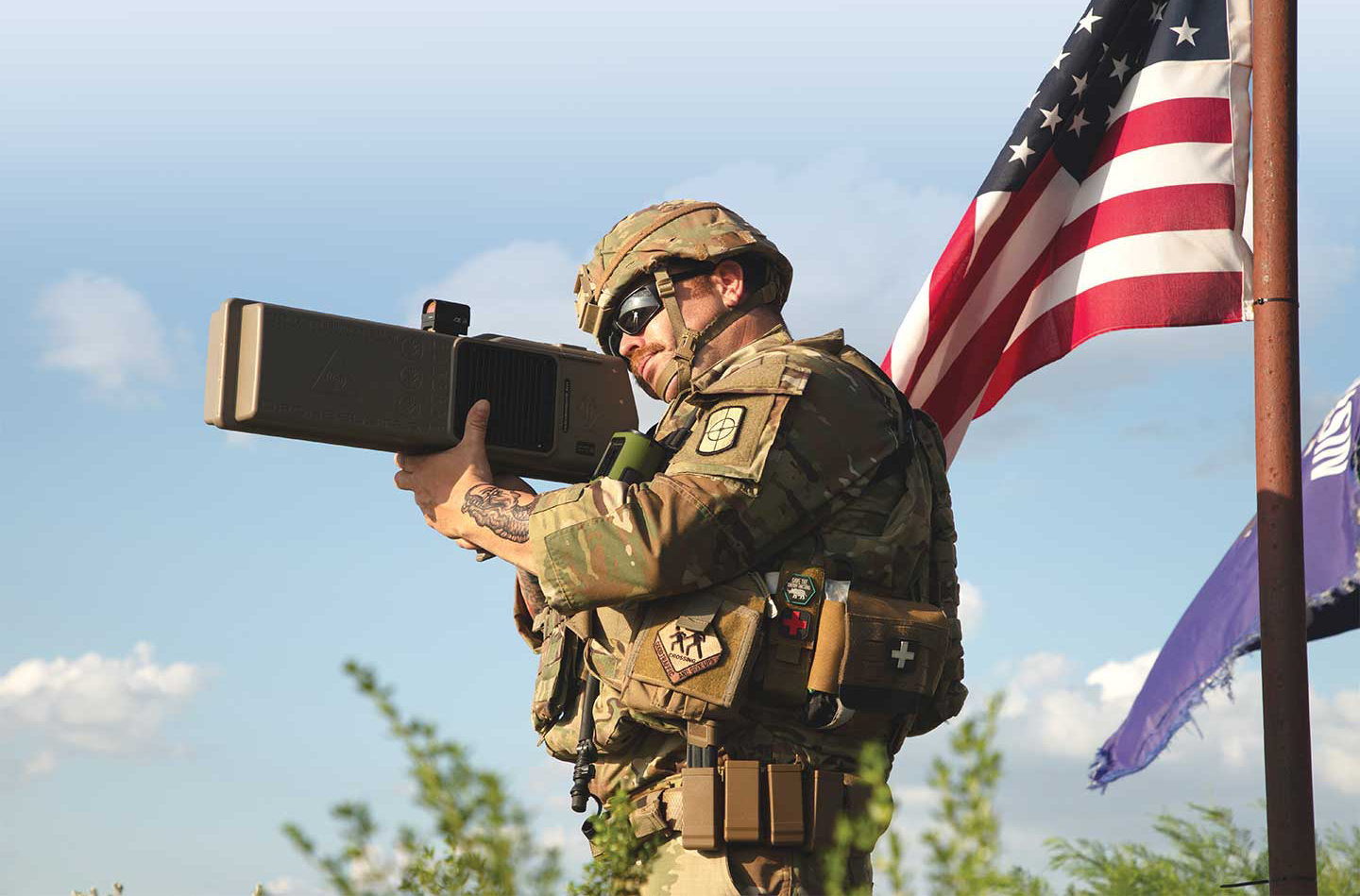
As technology for unmanned aerial systems (UAS), or drones, evolves rapidly, U.S. companies remain at the forefront in countering them. In April 2025, DZYNE Technologies of Irvine, California, unveiled its latest counter-UAS (c-UAS) system for European allies: the Dronebuster 4-EU.
The Dronebuster is a hand-held, nonkinetic device that sends electromagnetic signals to disrupt or disable UAS navigation and control. It also can spoof or simulate global navigation satellite signals, potentially ordering the drone to return to its starting point or shift direction. Weighing 2.25 kilograms, it has an effective range of 1 kilometer. DZYNE’s detect, track, identify, mitigate kit upgrades the Dronebuster unit by adding a wearable detection and identification capability while retaining its portability.
Other portable C-UAS systems:
DedroneDefender: Another rifle-shaped c-UAS weapon made by a U.S. company, Dedrone Holdings, which was bought by Axon in October 2024. The DedroneDefender is billed as a “smart jammer” powered by artificial intelligence.
FIM-92 Stinger: An infrared homing surface-to-air missile made by U.S. defense contractor Raytheon. The Stinger can be shoulder-fired or mounted and has a range of up to about 4.57 kilometers. The missile is 1.5 meters long, 7.1 centimeters in diameter and weighs 10 kilograms.
DroneGun: A compact, lightweight and durable gun made by Australian company DroneShield. The DroneGun Mk4 can disrupt control, video and navigation signals across multiple frequency bands. It weighs 3.2 kilograms, and the startup time is less than 3 seconds.
EDM4S SkyWiper: A portable electronic warfare device developed by the Lithuanian company NT Service. It has been used widely by the Ukrainian Armed Forces against Russian drones.
SMASH 2000L: An advanced smart scope made by the Israeli company SmartShooter. The scope is mounted on an M4A1 rifle and can automatically target and disrupt drones. Marine and Army units have placed orders for the SMASH 2000L scopes, which already have been deployed in the field by NATO allies and U.S. Special Forces. Marine units will start getting them in fiscal year 2026.