

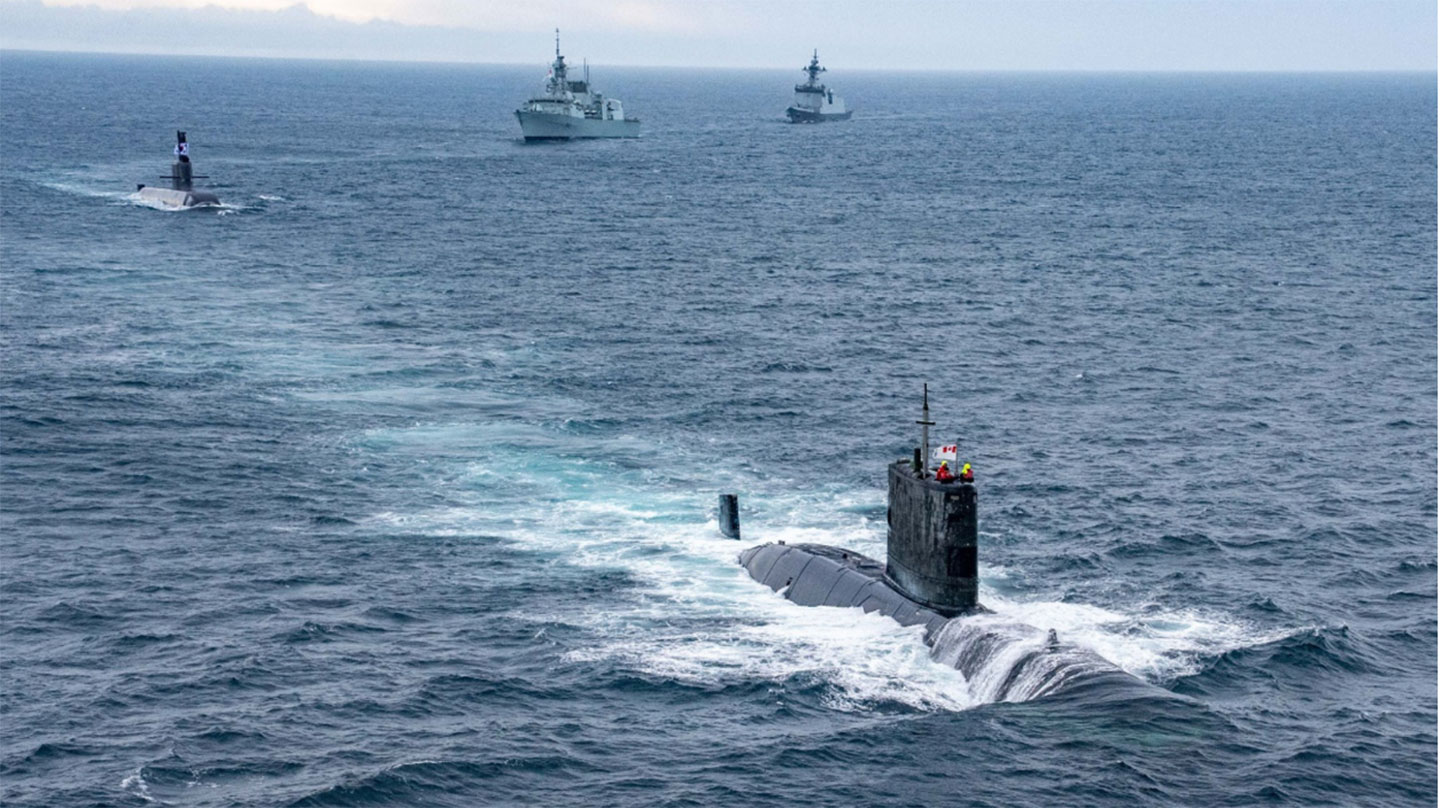
Forces from the Royal Canadian Navy (RCN) and the Republic of Korea (ROK) Navy conducted a joint maritime exercise off Canada’s Pacific coast June 3-4, 2026, marshaling warships, submarines, helicopters and maritime patrol aircraft in a display of the deepening defense partnership between the nations. “By training and operating together, we strengthen interoperability, deepen mutual understanding, and reinforce our shared commitment to security and stability in the Indo-Pacific,” said Rear Adm. David Patchell, commander of RCN Maritime Forces Pacific and Joint Task Force Pacific.
Held in waters off British Columbia, the exercise saw one of the ROK Navy’s most advanced submarines operate alongside RCN and Royal Canadian Air Force (RCAF) vessels and aircraft. ROK Navy forces included the Dosan Ahn Chang-ho, lead vessel of the KSS-III submarine class; the Daegu-class frigate Daejeon; and an AW-159 Wildcat maritime helicopter embarked on the Daejeon. RCN and RCAF assets included the Halifax-class frigate Ottawa, the Victoria-class submarine Corner Brook, CH-148 Cyclone helicopters and a CP-140 Aurora long-range patrol aircraft.
The joint forces executed communications, coordination and tactical training activities, including anti-submarine warfare, anti-surface warfare and maritime surveillance. The exercise merged surface combatants, submarines, shipborne helicopters and long-range patrol aircraft into a single training environment. The ROK Navy said the drills would enhance interoperability and improve readiness for future multinational missions.
“We welcome opportunities to host like-minded allies and partners and value continued engagement and cooperation,” Patchell said, as reported by the CHEK News website. He said it was inspiring “watching sailors working side by side, building trust and friendships at sea, and it is a great honour to host the Republic of Korea Navy here at Maritime Forces Pacific.”
Adm. Kim Kyung-ryul, ROK Navy chief of naval operations, said the training represents a historical partnership between the two nations, CHEK News reported. “I hope this training serves as an important opportunity to further advance both our navies and maximize the momentum of our bilateral exchange and cooperation,” he said.
The deployment began even before ROK Navy ships reached Canadian waters. After leaving South Korea, the Dosan Ahn Chang-ho and Daejeon traveled about 14,000 kilometers across the Pacific Ocean via Guam and Hawaii before docking at Canadian Forces Base Esquimalt on May 23. It was the first trans-Pacific voyage by a South Korean-built submarine and validated the endurance and operational reach of the KSS-III class.
In Hawaii, two RCN submariners boarded the Dosan Ahn Chang-ho and helped integrate communications and command and control with Canadian systems. That provided an early assessment of interoperability between the navies.
A South Korean company is one of the last two contenders for Canada’s submarine replacement program. The Canadian Patrol Submarine Project is expected to replace the RCN’s aging Victoria-class submarines with a new generation of conventionally powered vessels that can operate in the Atlantic, Pacific and Arctic oceans. South Korea’s Hanwha Ocean is offering a variant of the KSS-III. The other company vying for the submarine contract is Germany’s ThyssenKrupp Marine Systems.