

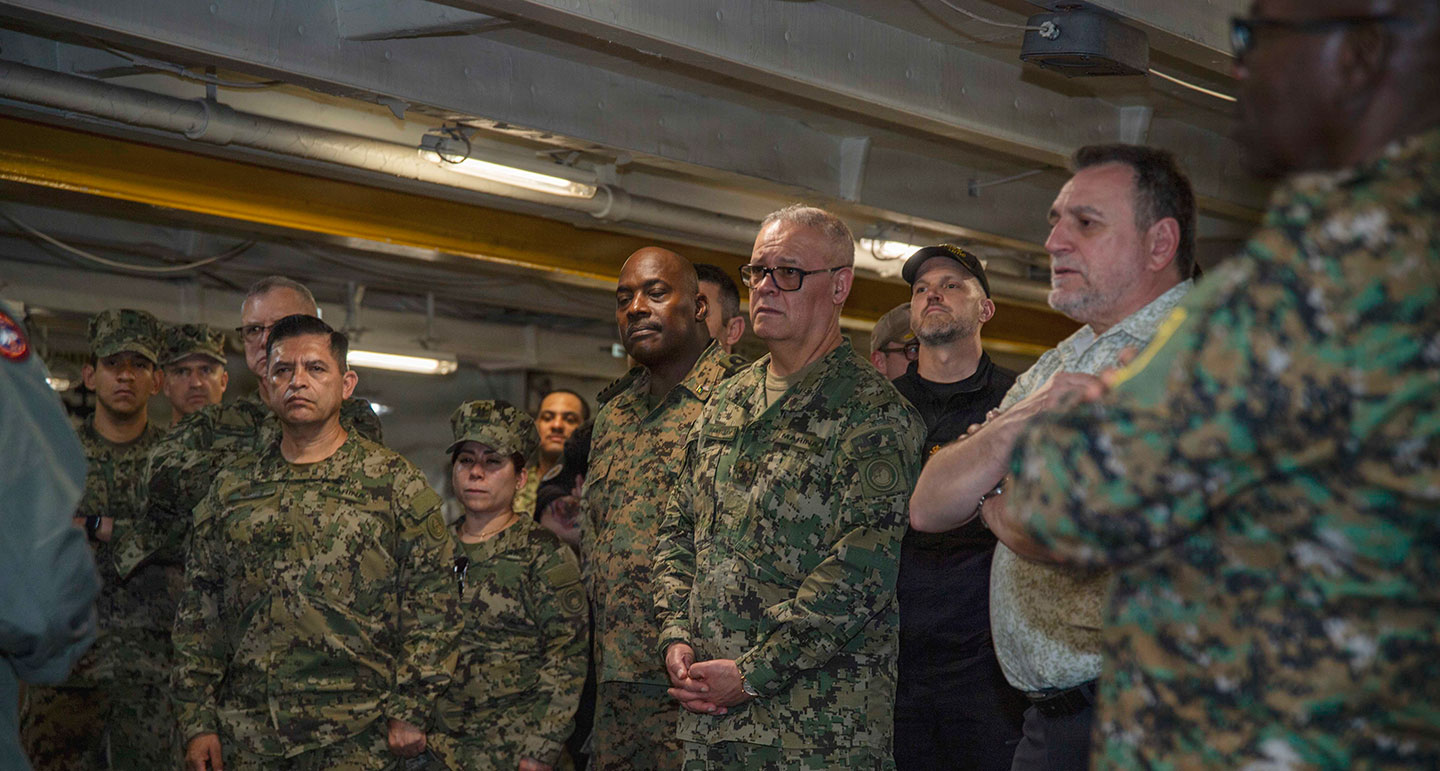
Top Navy and Coast Guard officers from Canada, Mexico and the United States met in May 2026 to sign off on a new security protocol and discussed turning the 18-year-old North American Maritime Security Initiative (NAMSI) into an even more effective tool against transnational criminal organizations (TCOs). Executive teams from U.S. Naval Forces Northern Command (NAVNORTH), U.S. Coast Guard Atlantic Area, the Royal Canadian Navy Maritime Component Commander and the Mexican Secretariat of the Navy talked about how to move NAMSI forward to confront current threats. The executive meeting “brought together key maritime forces to enhance collaboration and strengthen operational effectiveness between the three partner nations,” according to news release from the United States Northern Command (USNORTHCOM).
NAMSI was established in 2008 to strengthen interoperability among the three partners nations and increase the security and maritime protection of North America. The Norfolk, Virigina, gathering “centered on operationalizing the initiative, expanding joint training opportunities, and revising the security and defense strategy to combat transnational criminal organizations,” a U.S. Navy news release stated.
The delegations approved the NAMSI Handbook, which updates standard operating procedures to effectively enforce international maritime law, improve communication to thwart “illicit acts” against safe maritime navigation and the defense of incidents or other actions that threaten maritime security.
“The complex security challenges in the North American maritime domain require a unified, highly coordinated response,” said Rear Adm. Martin Muckian, director of maritime operations for NAVNORTH and executive agent of USNORTHCOM for NAMSI. “Marking almost two decades of the North American Maritime Security Initiative, the signing of this revised handbook represents our continued dedication to adapting our tactics and strengthening our bonds. Today’s discussions ensure that U.S., Canadian, and Mexican maritime forces remain fully synchronized in our efforts to deter threats and maintain regional stability.”
The Coast Guard is a vital part of this effort as the maritime force merges defense and law enforcement capabilities. “The Coast Guard operates at the critical intersection of national defense and law enforcement, bringing unique statutory authorities to this critical trilateral partnership,” said Rear Adm. Jay Vann, deputy commander of U.S. Coast Guard Atlantic Area. “By integrating our maritime governance capabilities with the defense posture of the U.S. Navy and our Canadian and Mexican partners, we create a seamless maritime shield.”
Canadian maritime leadership highlighted how combined exercises and shared expertise translate directly to operational success across North America’s coasts. “Interoperability with our partners of the United States Navy and Mexican naval forces is essential to safeguarding the continental waters surrounding our respective countries,” said Rear Adm. Josée Kurtz, commander, Maritime Forces Atlantic and Joint Task Force Atlantic, Royal Canadian Navy. “Through NAMSI, the Royal Canadian Navy contributes to strengthening collective readiness and ensuring that our expertise delivers tangible results in operations and exercises at sea.”
NAVNORTH is the maritime component of USNORTHCOM and executes maritime homeland defense and security operations in North America.