

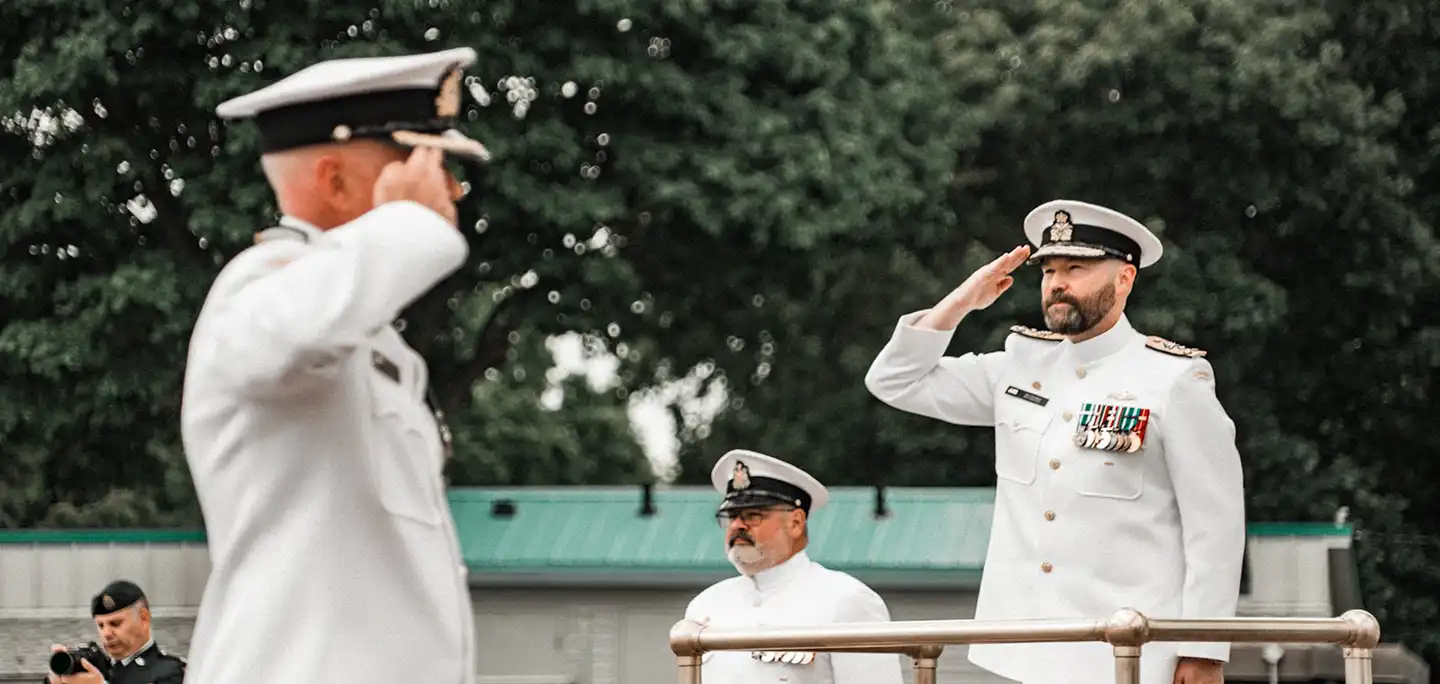
Vice Adm. Dan Charlebois assumed command of the Royal Canadian Navy (RCN) from Vice Adm. Angus Topshee on June 16, 2026, at a change-of-command ceremony presided over by Gen. Jennie Carignan, chief of defence staff, at the HMCS Star in Hamilton, Ontario. “I am humbled and honoured to assume the watch as Commander of the Royal Canadian Navy,” Charlebois said, according to an RCN news release. “Our sailors, together with our civilians and the families who support them, are the foundation of everything we do.”
Charlebois is the 39th commander of the RCN. He has served in command and staff roles, most recently as the RCN’s deputy commander. “I’m grateful for Vice-Admiral Topshee’s leadership and for the momentum built on his watch, and I look forward to working with the One Navy Team to strengthen our culture, support our people, sustain readiness today, and continue delivering the Navy Canada needs,” Charlebois said.
After four years as RCN commander, Topshee, who has been in the Navy 36 years, will assume the role of vice chief of the defence staff in a ceremony later this summer. “I have been inspired daily by the skill, grit, and ingenuity of our regular and reserve sailors and the wider Navy team whether in uniform or out, who deliver results for Canadians at home and abroad,” Topshee said in the RCN release. “While we have made a lot of progress, there is still a lot of difficult work to be done, and I can’t imagine anyone better to lead those efforts than Vice-Admiral Dan Charlebois.”
About 13,000 full- and part-time military members and about 3,700 civilians are in the RCN, the news release said. Charlebois said those numbers must increase.
“We need to grow that significantly, and that’s just what we need to crew our future fleet with a bit of resilience and robustness,” Charlebois said after the ceremony, according to CBC News. He said he hopes to meet that goal by emphasizing naval reserve divisions (NRD) and depots across the country.
With the Navy based on both coasts, it’s difficult for Canadians to keep his branch top of mind, he said. “A lot of Canadians don’t see much of our navy because our navy exists largely in Halifax and in Esquimalt in British Columbia, but we do have our naval reserve divisions and key city centres,” Charlebois said, according to CBC News. “So, we are attracting and recruiting directly at our NRDs across our country.”
Charlebois was raised in Kingston, Ontario. He began his career in the Canadian Armed Forces (CAF) in 1992 as a Naval Reservist and transferred to the Regular Force in 1994, a government biography said. He graduated from Wilfrid Laurier University in 1997 and completed Naval Warfare Officer training at the Naval Officer Training Centre Venture, the primary training ground for junior naval officers in the RCN.
Charlebois served aboard the frigates Charlottetown and Halifax, deploying to the Persian Gulf, Arabian Sea and Mediterranean Sea in support of United Nations sanctions and counterterrorism missions. He attended the Naval War College in Newport, Rhode Island, and earned a Master of Science in Management from Salve Regina University. He then was appointed executive officer of the frigate Fredericton and later served on the Naval Staff in Ottawa in Force Development.
In May 2013, he assumed command of the frigate Regina, deploying to the Arabian Sea, Horn of Africa and the Mediterranean. Promoted to commodore in 2020, he commanded Combined Task Force 150 from Bahrain, leading coalition counterterrorism operations in the region. In July 2021, he was appointed director general readiness at Canadian Joint Operations Command. He was appointed deputy commander in summer 2025.
The RCN is Canada’s fighting force at sea. It protects Canadians and Canada’s sovereignty and makes essential contributions to operations with allies and trusted international partners.
In testimony before the U.S. Senate Armed Services Committee on March 19, Gen. Gregory M. Guillot, commander of United States Northern Command (USNORTHCOM) and the North American Aerospace Defense Command (NORAD), praised the Canadian Armed Forces and highlighted their essential role in the defense of North America. “NORAD has stood as the world’s only bi-national command for more than 68 years as American and Canadian personnel serve side by side in the defense of North America. … Defense cooperation between USNORTHCOM and the Canadian Armed Forces remains a cornerstone of continental defense.”