

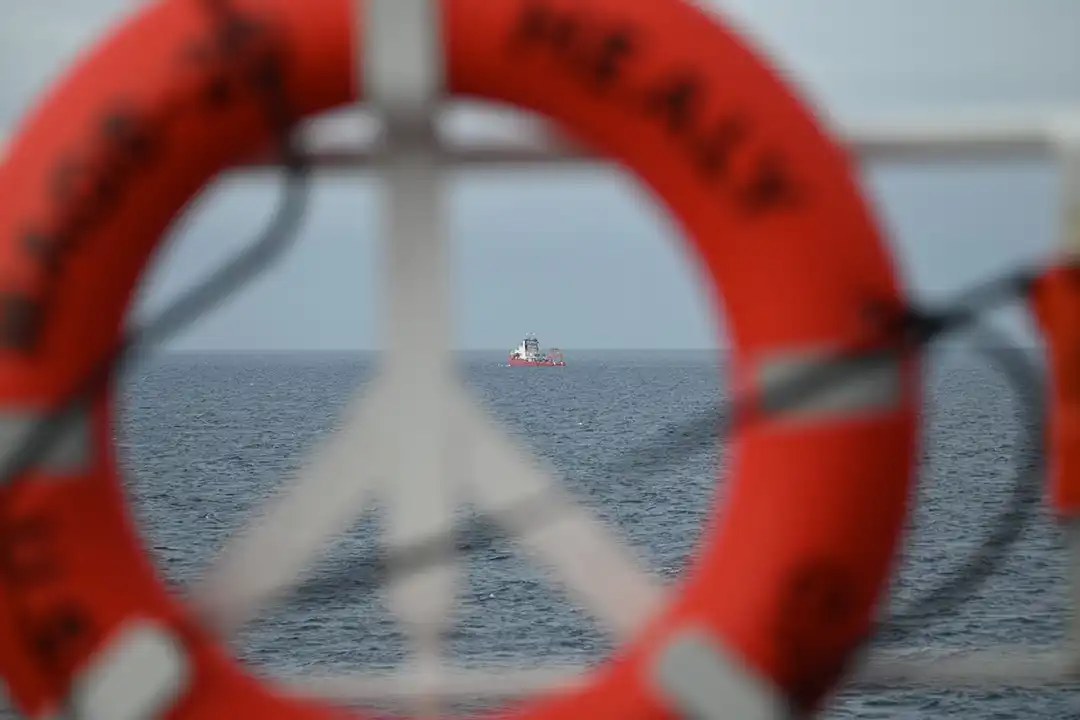
The United States Coast Guard deployed a cutter in July 2026 to monitor two Chinese Communist Party (CCP) icebreakers as they traveled through the U.S. exclusive economic zone and the nation’s extended continental shelf in the Bering Sea. The cutter Munro was dispatched to surveil the polar research ships — the first such incursion by the CCP in the region this year. “Alongside the Department of War, the Department of State, and our international partners, we are actively responding to competitor activities across an increasingly contested Arctic,” Rear Adm. Bob Little, U.S. Coast Guard Arctic District commander, said in a Department of War news release.
The Xue Long and Xue Long 2 traveled northbound through the Bering Sea in mid-July on their way to the Arctic Ocean. CCP ships made similar voyages in 2025. The CCP vessels have the legal right under international maritime law to transit the area, but any maritime research requires prior approval of the U.S. The Munro’s observation of the ships “was designed to protect American sovereign rights, ensure consistency with international law and position the Coast Guard to rapidly respond to any detected malign activity,” the July 20 release stated.
In recent years, the presence of CCP and Russian naval and aerial assets, often conducted in joint patrols, repeatedly have probed the Alaskan Arctic. The Bering Sea, especially the Bering Strait, is a crucial choke point for maritime activity, and melting sea ice has made it more accessible. Undersea cables and energy pipelines as well as potential mineral and energy deposits increase its strategic importance. In 2024, the War Department warned that Russia and the CCP were collaborating in the Arctic, prompting a new focus on the region’s defense.
The U.S. government, following an October 2025 executive order, has stepped up its production of a new class of icebreakers for the Coast Guard. Six polar security cutters will be delivered by 2031, with the first arriving in 2028. Four will be built in the U.S. with an additional two icebreakers constructed in Finland at a cost of $3.3 billion. The new icebreakers will protect shipping lanes, defend Alaskan territory and safeguard energy and mineral resources. The ships also will bolster maritime commerce and provide a quick response to regional crises, according to Military.com.. “America’s future in the Arctic demands strength, capability and resolve,” Department of Homeland Security Secretary Markwayne Mullin said in July.
In 2025, DHS described the CCP’s Arctic activity as “unprecedented,” pointing to a record number of CCP research and dual-use vessels operating in or near U.S. Arctic waters. The ships spent extended periods over the U.S. extended continental shelf and launched dozens of manned submersible dives in the Arctic Ocean, reported gCaptain, a maritime news site. The Coast Guard responded by simultaneously deploying two icebreakers to monitor at least five CCP ships in the region last year, including the Xue Long 2, the website reported. The dual deployment was the first in decades.
To effectively counter this threat, the Coast Guard announced in April that three of the polar security cutters will be homeported in Alaska — two in Kodiak and one in Seward. “Homeporting Arctic Security Cutters in Kodiak and Seward will strategically position these state-of-the-art icebreakers to reinforce America’s maritime dominance in the Arctic,” Adm. Kevin E. Lunday, commandant of the Coast Guard, said in a June news release. “This positioning is critical to national security, enabling the Coast Guard to defend our northern border and meet evolving threats with speed and strength.”