

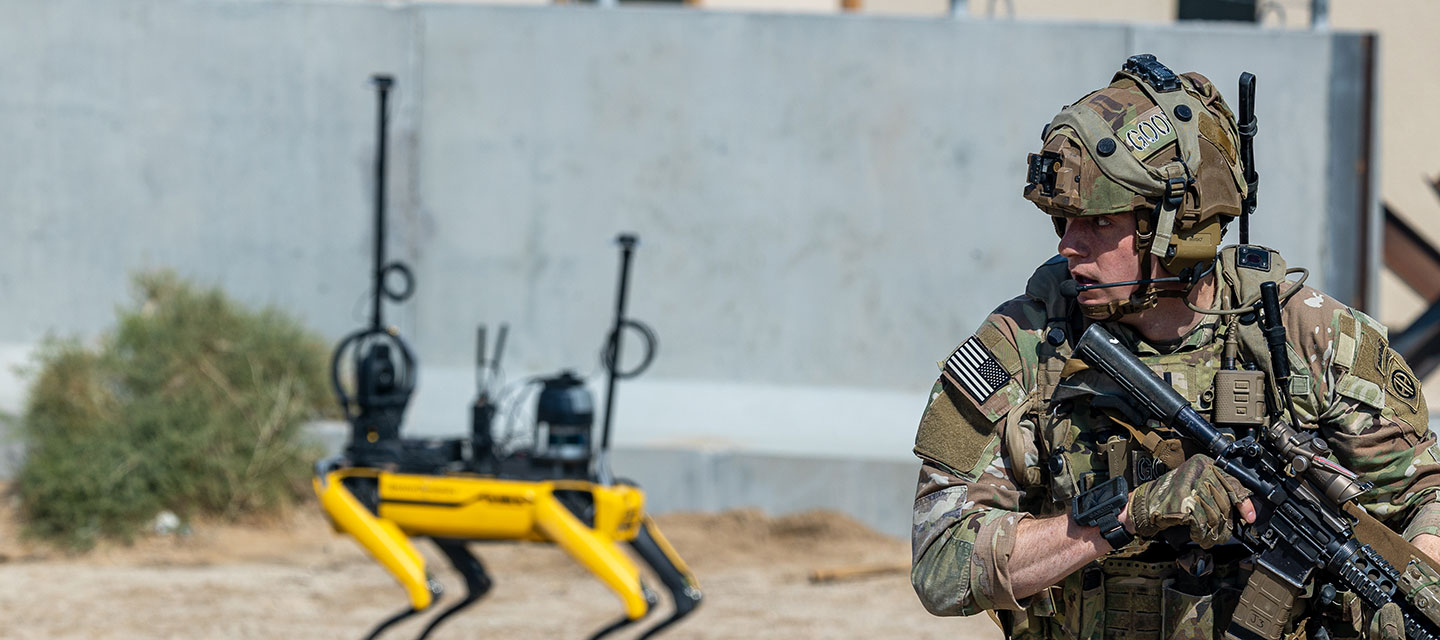
For the United States and its allies, interoperability is crucial to maintaining a strong security posture. The United States’ Combined Joint All-Domain Command and Control (CJADC2) initiative represents a cornerstone of this vision, driving efforts to integrate sensors, systems and decision-making tools across domains and borders. At its heart, CJADC2 is about interoperability that goes beyond military exercises: Allies operate in a unified, connected network that enables swift, accurate decision-making.
Defense leaders call this the new overmatch — addressing the demand for speed, precision and resilience for decision advantage. These capabilities rely on the real-time data sharing and synchronized operations that CJADC2 will enable, leveraging an Internet of Military Things: a secure, integrated network that connects sensors, platforms and decision tools across land, air, sea, space and cyber domains.
In 2025, CJADC2 evolved from the experimentation stage to operational capability development, with major milestones achieved across technology, governance and international collaboration. In November, the Shadow Operations Center-Nellis (ShOC-N) at Nellis Air Force Base, Nevada, hosted Capstone 2025, the final event in a series of rigorous experiments conducted at ShOC-N designed to enhance joint and coalition interoperability and accelerate progress in C2 modernization, according to a U.S. Air Force news release. Capstone 2025 focused on AI-enabled human-machine teaming, kill-chain automation and multidomain operations. Participants joining the U.S. Air Force included the U.S. Army Pacific, U.S. Navy, U.S. Marine Corps, and allies Canada and the United Kingdom.
“Capstone 2025 demonstrated the vital role of AI/ML [machine learning] in modernizing our approach to battle management,” said U.S. Air Force Lt. Col. Wesley Schultz, ShOC-N director of operations. “By applying real-world rigor and focusing on the warfighter’s needs, we can refine and integrate solutions that make a tangible impact on operational readiness.”
Another exercise, Project Convergence Capstone 5 (PC-C5), took place in March and April 2025 at the U.S. Army’s National Training Center at Fort Irwin, California, and other locations within the U.S. Indo-Pacific Command’s area of responsibility. PC-C5 included more than 6,000 personnel from Australia, Canada, France, New Zealand, the U.K. and the U.S. The exercise trained forces to fully integrate the future capabilities of joint and multinational allies and partners while assessing advanced warfighting concepts across all domains: land, air, sea, space and cyber.
“What Project Convergence does is bring every single war-fighting system we have together in one place,” U.S. Army Brig. Gen. Zachary Miller, commander of the Joint Modernization Command, said in a U.S. Army news release. “We’re layering new technology, new capabilities, with a new way to organize and seeing if that helps us achieve the warfighting aims.”
In addition to joint and combined exercises, 2025 brought technological breakthroughs for CJADC2 development. In July, U.S. defense contractor Ultra I&C announced its release of the first cloud-enabled C2 gateway authorized by the military to update itself. This continuous authority to operate results in shorter development cycles and reduced costs while resolving interoperability challenges among a large volume of datalinks, including those of allies, according to a company news release. Lockheed Martin announced it is ready to deploy an open-architecture software stack designed to connect the machine languages of existing weapons systems, facilitating greater connectivity and interoperability. The platform was developed at the company’s Interoperability Factory, according to a news release.
“The challenge is to deter aggression, we need to maintain overmatch now and many of our nation’s existing advanced weapon systems were not originally designed to connect and ‘talk’ with each other this way,” said Ron Fehlen, Lockheed Martin’s vice president, mission architecture, national security space. “Most of our defense systems communicate using about a dozen different software languages. This is where the CJADC2 Interoperability Factory comes in.”
Sentry is a publication of U.S. Strategic Command.