

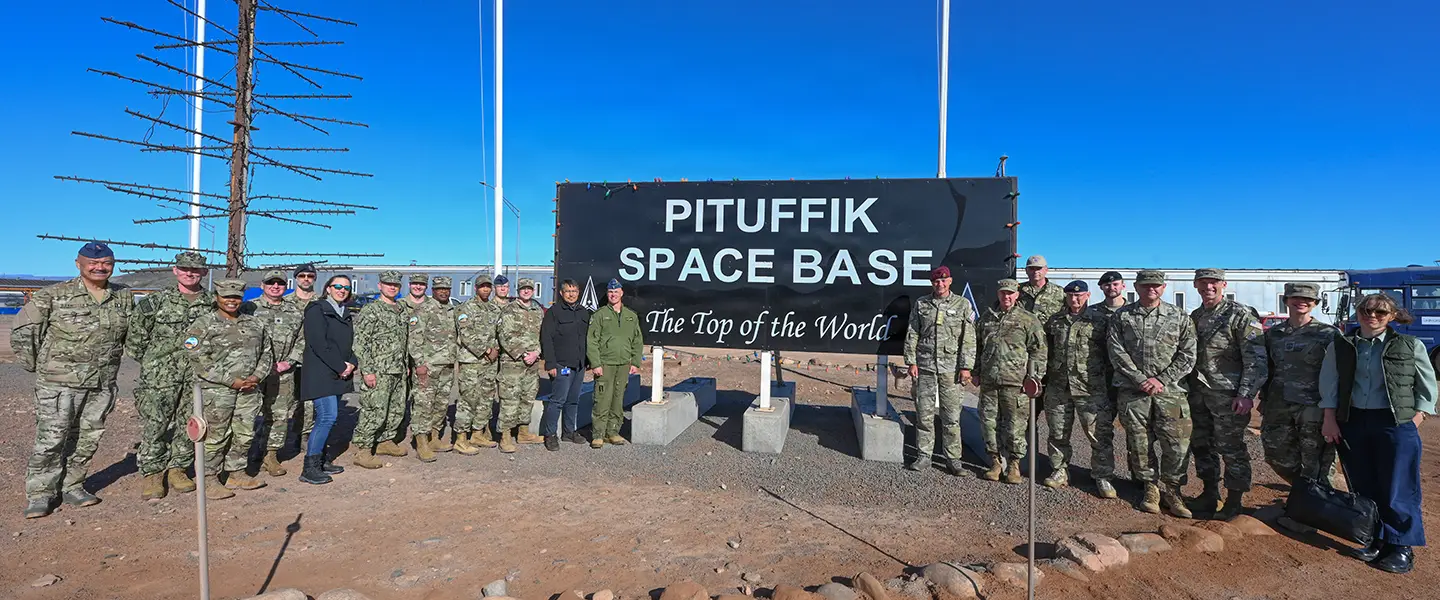
Defense and diplomatic leaders from Denmark, its autonomous territory of Greenland, and the United States gathered at Pituffik Space Base in August 2026 to commemorate the base’s 75th anniversary. The ceremony honored the vital post in Greenland that protects NATO’s northern flank, advances scientific research and ensures U.S. and allied space superiority. Gen. Gregory M. Guillot, commander of U.S. Northern Command (USNORTHCOM) and the North American Aerospace Defense Command (NORAD), Gen. Michael Hyldgaard, chief of defense for the Danish military, Mininnguaq Kleist, Greenland’s permanent secretary of foreign affairs, and Maj. Gen. Soren Anderson, commander of Denmark’s Joint Arctic Command, headlined the event to mark the perseverance and adaptability that has characterized the military presence in a harsh Arctic climate for the better part of a century.
“Pituffik Space Base is a cornerstone of our layered defense and is absolutely vital to our mission to deter, detect, and defeat threats to North America,” Guillot said in a USNORTHCOM news release. “For 75 years, this remote polar outpost has stood as a powerful testament to strength and resilience. Maintaining a secure, stable and vigilant Arctic region is more critical than ever. The outstanding multinational team of Guardians, Airmen and allied partners operating here at the ‘top of the world’ represents the very best of our collective defense and joint interoperability.”
Created in 1951 after a cooperative defense agreement between Denmark and the U.S., the base was built through the work of an ambitious military engineering effort that was the largest Navy amphibious operation since the Normandy landing in World War II, the release stated.
Originally Thule Air Force Base, the base was renamed Pituffik (pronounced bee-doo-FEEK) in April 2023 to reflect the surrounding area, which is known by the same name in Greenland. The name change occurred shortly after the 2019 transition of the base from the Air Force to the U.S. Space Command. Situated 1,110 kilometers north of the Arctic Circle, Pituffik lies in a broad valley surrounded by glaciers. Facing North Star Bay and close to the landmark 220-meter Mount Dundas in northwest Greenland, Pituffik is known for months of total darkness, subzero temperatures and high winds. But its strategic importance provides “an irreplaceable geostrategic advantage,” the release stated. Close to the Greenland-Iceland-United Kingdom Gap, the 821st Space Base Group, the unit assigned to the base, provides crucial intelligence to the U.S. and its allies.
“Operating at the ‘top of the world’ requires a special kind of dedication,” said Col. Shawn Lee, the base’s outgoing commander. “The strategic advantage Pituffik provides to our shared defense is undeniable, but it is the unwavering resilience of our Guardians, Airmen, and our indispensable Danish, Greenlandic and Canadian partners that truly secures our northern flank. We rely on each other to thrive in this austere environment, and that shared commitment is what makes our allied defense unbreakable.”
The 821st provides base services to support other units operating at the base, including the 12th Space Warning Squadron, which operates early warning radar to provide ballistic missile warning, missile defense and space domain awareness. Pituffik also serves as host of key exercises like Operation Noble Defender, which tests NORAD’s capabilities of aerospace warning and control to defend North America.
Pituffik also houses Detachment 7 of the 22nd Space Operations Squadron, which manages the northernmost remote tracking station in the Satellite Control Network. The detachment conducts critical telemetry, tracking and command of operations for hundreds of government and military satellites.
The U.S. presence is bolstered by a significant Danish military footprint. The Danish Joint Defense Command, the Joint Arctic Command, a Danish liaison officer, and a Danish police inspector all are located on the base.
“We have an amazing close-knit multinational team that includes Space Force, Air Force, Canadian military, Danish military, and our dedicated American, Greenlandic, and Danish contractors,” Lee said. “There is a profound sense of community that comes from a small team living and working together in such a remote location. That shared bond is imperative for our mission success and survival in the Arctic; it’s what keeps us ready every single day.”