

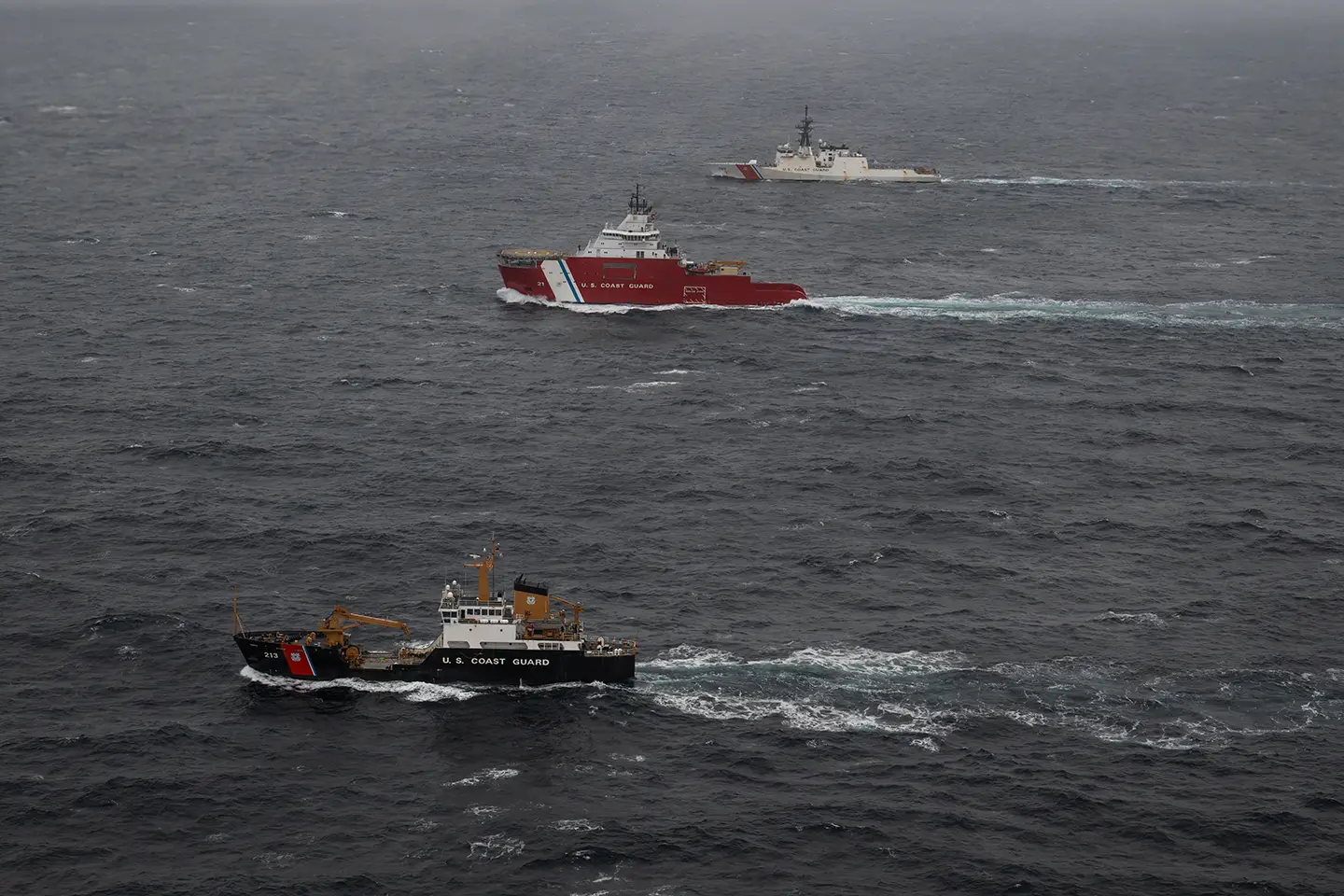
Two United States Coast Guard (USCG) cutters returned to their home ports in October 2026 after prolonged patrols in the Arctic, demonstrating a resolve to assert sovereignty and deter adversarial threats in the increasingly contested region. The cutters Munro and Stratton deployed to the High North to execute a range of duties, including protecting fisheries, training with allies and partners, and defending U.S. territorial waters from naval forays by the Chinese Communist Party (CCP).
The Munro spent 112 days at sea, covering 23,000 nautical miles across the Arctic and Bering seas, the Coast Guard said in a news release, before returning to its home port in Alameda, California, on October 9. During its deployment, the Munro monitored three CCP-flagged research vessels, which often are used for military intelligence and mapping purposes. The Munro, as part of Operation Frontier Sentinel, ensured that the vessels complied with international maritime law while demonstrating U.S. sovereignty. The Munro also participated in combined exercises with the Royal Canadian Navy (RCN) to enhance bilateral law enforcement capabilities. The maritime forces increased their domain awareness of the remote, often inhospitable region. Their joint work tested multidomain homeland defenses and command andcontrol networks, the release stated.
Embedded law enforcement teams also boarded vessels in the Bering Sea, which is home to a $6 billion fishing and crabbing industry, to check for compliance with federal safety regulations and laws related to preserving vital fish stocks.
“The Arctic is a demanding maritime environment that can test any crew and vessel,” said Capt. Adam J. Disque, the Munro’s commanding officer. “We were proud to sustain U.S. presence in the region to safeguard our Arctic coastline and reinforce a rules-based order in the High North. We also strengthened our enduring partnership with Canadian counterparts, advancing shared domain awareness and coordination across the remote region. I am exceptionally proud of everything this crew accomplished in one of the world’s most challenging maritime environments.”
The Stratton spent 103 days in the Arctic and Bering seas, executing similar duties during operations Frontier Sentinel and Tundra Merlin before returning to Alameda in late October. The cutter also performed joint exercises with the RCN offshore patrol vessel Max Bernay in the Bering Sea and conducted flight operations with a USCG MH-60T Jayhawk helicopter off Kotzebue, Alaska, in August, augmenting efficiency between cutter and aviation crews. The Stratton refueled the USCG cutter Storis in Broad Bay, Alaska, expanding logistical military capabilities in the Arctic. The Stratton spent 26 days above the Arctic Circle, protecting U.S. territorial integrity and sovereignty, the release stated.
“I am proud of this crew for the professionalism they showed during a long and demanding patrol in the Arctic and Bering Sea,” said Capt. Matthew Press, the Stratton’s commanding officer. “From search and rescue response and safeguarding U.S. sovereignty to joint operations with our Canadian partners and engagement with Alaskan communities, they delivered presence and readiness where it mattered most.”