

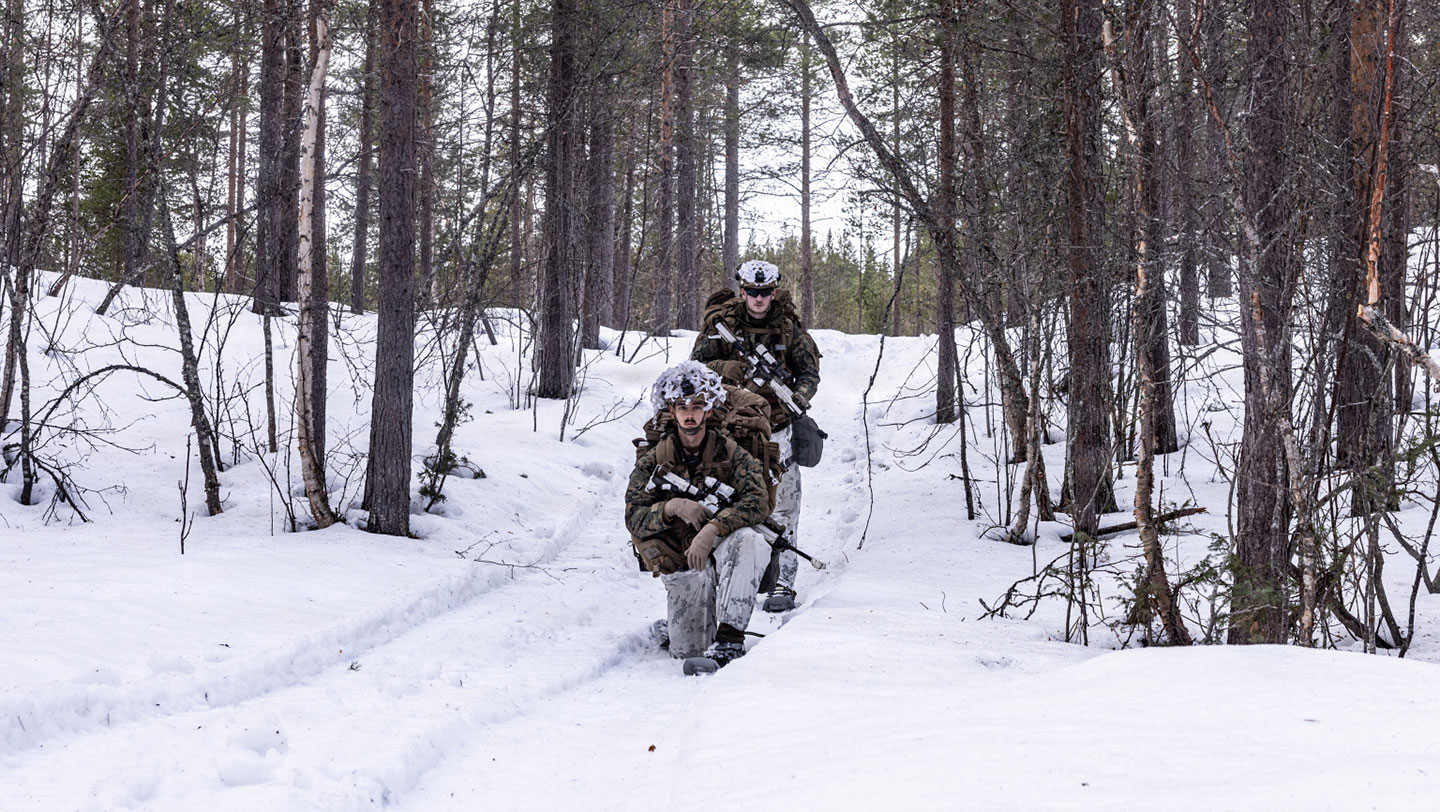
The United States military trained with NATO allies in two Arctic exercises in March 2026, practicing complex troop and equipment maneuvers in frigid conditions to test their capacity to defend the increasingly contested region. NATO’s Cold Response exercise, which took place in Finland, Norway and Sweden, demonstrated the ability of the U.S. Marine Corps and NATO allies to transport previously stored equipment across long distances before meeting a Spanish regiment acting as an enemy force. In Greenland and Alaska, Canadian, Danish and U.S. troops along with federal partners engaged in special forces operations and counter unmanned aerial systems (c-UAS) exercises to show their ability to deploy quickly to act against threats to the western Arctic. “In crisis, we don’t have the luxury of time; we have to be ready,” said Marine Corps Maj. Gen. Farrell Sullivan, commanding general of the 2nd Marine Division, which participated in Cold Response, according to a Department of War news release. “Our ability to globally deploy combat credible forces into the High North in support of NATO underpins our commitment to allies and partners and our national interests.”
Cold Response involved more than 30,000 troops from 14 allied countries. The Marine Corps Combat Logistics Battalion 6 retrieved equipment that had been stored in climate-controlled caves in the Norwegian mountains before helping to move it to the Norwegian port of Narvik. From there, Swedish and Norwegian military police escorted the gear across Sweden to Finland in a long-range convoy over two days. Simultaneously, combined French, German and U.S. Marine air transport squadrons airlifted Echo Company, 2nd Battalion, 6th Marine Regiment, from Norway to Finland on KC-130J Super Hercules aircraft. The company then was placed under tactical control of the Swedish Army’s 4th Mechanized Brigade, fighting as a NATO-fused force for the first time, stated a U.S. Department of War news release.
Meanwhile, other Marine companies from the battalion joined Norwegian combat logistical support troops in a simulated fight against a Spanish Mountain Infantry regiment, which acted as the enemy force. “The purpose of Cold Response is deterrence, and the only way you can deter is if you have a credible threat,” said Marine Corps Lt. Col. Chase Bradford, commanding officer of the 2nd Battalion. “With our Marines training collectively, we know that if we ever have to fight together with our NATO allies, we can immediately come together and win.”
At the other end of the Arctic, the U.S.-led Arctic Edge exercise brought together Danish and U.S. special forces to train in the strategically vital autonomous territory of Greenland. Denmark hosted the U.S. forces to share best practices for operating in the harsh environment, according to CBS News. In Alaska, Soldiers practiced using counter UAS weapons and sensors to detect and disable drones. The counter UAS defenses, which are electronically powered and more resistant to low temperatures than battery-powered systems, performed well, said Air Force Lt. Gen. Robert Davis, head of U.S. Alaska Command, the Alaskan NORAD region, and commander of the 11th Air Force. No drones went undetected, and counter UAS defenses captured one drone with a net, Davis told CBS News.